

Nursing Interview Questions | Best Answers to Get Hired in 2026
Landing a nursing job takes more than clinical knowledge. Today’s healthcare employers want nurses who communicate well, solve problems quickly, stay calm under pressure, and deliver compassionate patient care.
That’s why preparing for nursing interview questions is just as important as earning your nursing degree or certification.
Whether you’re a new graduate, an experienced registered nurse, or transitioning into a new speciality, the right preparation can help you stand out from other candidates.
In this guide, you’ll learn what hiring managers are really looking for, how to prepare effectively, and 30 of the most common nursing interview questions with expert guidance to help you answer confidently.
Why Nursing Interviews Matter More Than Ever
Healthcare hiring has changed significantly over the past several years. Hospitals, clinics, long-term care facilities, and home healthcare agencies face increasing patient demand while also navigating workforce shortages. As a result, employers cannot afford to make hiring mistakes.
Modern nursing interviews are designed to evaluate much more than technical ability.
Hiring managers want confidence that every new nurse will contribute positively to patient outcomes, collaborate with healthcare teams, and adapt to fast-changing clinical environments.
Today’s interview process focuses on how candidates think, communicate, and respond under pressure rather than simply testing textbook knowledge.
What Healthcare Employers Look for Beyond Clinical Skills
Clinical competency is expected. What separates outstanding candidates is how they apply those skills in real-world situations.
Healthcare employers often evaluate:
- Patient-centered communication
- Critical thinking abilities
- Professional judgment
- Emotional intelligence
- Team collaboration
- Adaptability during emergencies
- Ethical decision-making
- Commitment to continuous learning
These qualities directly affect patient safety, team performance, and the overall quality of care.
The Skills That Differentiate Top Nursing Candidates
Communication
Nurses serve as the communication bridge between patients, physicians, families, and interdisciplinary teams. Employers look for candidates who explain medical information clearly, actively listen, and document patient information accurately.
Critical Thinking
Patient conditions can change without warning. Strong nurses assess situations quickly, identify priorities, and make informed clinical decisions based on available evidence.
Teamwork
Healthcare is a team effort. Interviewers want nurses who collaborate respectfully with physicians, therapists, pharmacists, medical assistants, and fellow nurses to achieve the best outcomes.
Compassion
Technical excellence alone isn’t enough. Patients remember how healthcare professionals make them feel. Compassion helps build trust, improve patient satisfaction, and strengthen therapeutic relationships.
Adaptability
Every shift brings unexpected challenges. Successful nurses remain flexible, learn quickly, and adjust to changing priorities while maintaining safe, high-quality patient care.
How Structured Interviews Improve Hiring Decisions
Many healthcare organizations now use structured interviews with behavioural and situational questions because they provide a more consistent way to evaluate candidates.
Instead of asking only about qualifications, interviewers explore how applicants handled real clinical situations in the past. Previous behaviour often predicts future performance more accurately than hypothetical answers.
How to Prepare Before Your Nursing Interview
Preparation builds confidence. Walking into an interview without researching the employer or practising your responses is like beginning a patient assessment without reviewing the patient’s history.
The more prepared you are, the more naturally your answers will flow.
Research the Healthcare Organisation
Learn about the employer before the interview.
Spend time reviewing:
- Their mission and values
- Types of patients they serve
- Specialties offered
- Community involvement
- Recent achievements
- Accreditation status
When you connect your answers to the organization’s values, interviewers recognise genuine interest.
Review the Job Description
Read every requirement carefully.
Identify:
- Required certifications
- Preferred experience
- Technical competencies
- Soft skills
- Scheduling expectations
- Patient populations
Prepare examples that directly demonstrate these qualifications.
Prepare Your Professional Examples
Behavioural interview questions require real experiences.
Think of several examples involving:
- Patient advocacy
- Conflict resolution
- Leadership
- Teamwork
- Clinical decision-making
- Time management
- Patient education
Using authentic stories makes your responses more memorable than generic statements.
Organize Your Certifications and Credentials
Bring multiple copies of your resume and keep important documents organised.
Examples include:
- Nursing license
- BLS certification
- ACLS certification
- PALS certification
- Specialty certifications
- Immunisation records (if requested)
- Professional references
Being organised demonstrates professionalism before the interview even begins.
Dress Professionally and Arrive Prepared
Although you’ll likely wear scrubs on the job, interviews call for professional business attire.
Also, remember to:
- Arrive 10–15 minutes early
- Silence your phone
- Bring a notebook
- Carry a pen
- Maintain positive body language
- Smile naturally
- Offer a confident handshake if appropriate
Small details create strong first impressions.
Learn the STAR Interview Method
Many behavioral nursing interview questions can be answered using the STAR framework.
Situation
Briefly describe the clinical scenario.
Task
Explain your responsibility in that situation.
Action
Describe exactly what you did to address the challenge.
Result
Share the outcome using measurable improvements whenever possible.
For example:
A patient experienced sudden respiratory distress (Situation). I immediately assessed the patient and notified the physician (Task). While preparing emergency equipment, I coordinated with respiratory therapy and monitored vital signs continuously (Action). The patient stabilized quickly, received timely treatment, and recovered without further complications (Result).
The STAR method keeps answers organized, concise, and focused on your contribution.
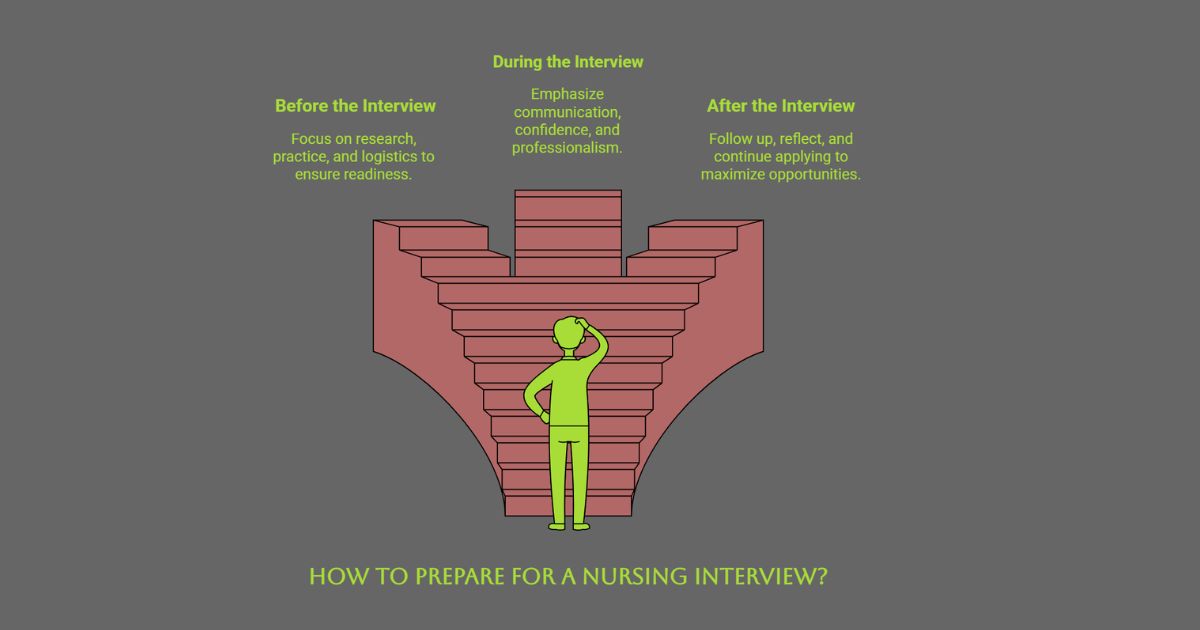
Quick Nursing Interview Preparation Checklist
Preparing for a nursing interview becomes much easier when you follow a structured checklist.
| Before the Interview | During the Interview | After the Interview |
|---|---|---|
| Research the employer | Maintain eye contact | Send a thank-you email within 24 hours |
| Review the job description | Listen carefully before answering | Reflect on your performance |
| Practice STAR examples | Use real clinical examples | Follow up if appropriate |
| Print extra resumes | Ask thoughtful questions | Continue applying if necessary |
| Organize certifications | Demonstrate confidence | Stay positive while waiting |
| Plan your travel route | Highlight teamwork and compassion | Keep improving interview skills |
Think of this checklist as your pre-shift preparation. Just as nurses review patient information before beginning care, preparing before an interview helps you perform with confidence, reduce anxiety, and make a lasting professional impression.
30 Nursing Interview Questions and Sample Answers
General Nursing Interview Questions
1. Tell Me About Yourself
Why do employers ask it
This opening question helps interviewers understand your background, communication style, and how well you summarize your experience.
What interviewers want to hear
They want a concise overview that connects your education, clinical experience, and career goals to the position.
Sample answer
I’m a registered nurse with three years of experience in medical-surgical care. Throughout my career, I’ve developed strong assessment, patient education, and teamwork skills. I enjoy building relationships with patients while collaborating closely with physicians and other healthcare professionals. I’m now looking for an opportunity where I can continue growing professionally while providing high-quality patient care.
Pro Tip
Keep your answer focused on your professional journey rather than your personal life.
Common mistakes to avoid
Avoid repeating your resume word-for-word or sharing unrelated personal details.
2. Why Did You Become a Nurse?
Why do employers ask it
Interviewers want to understand your motivation and commitment to nursing.
What interviewers want to hear
Authentic passion for helping patients combined with realistic expectations about the profession.
Sample answer
I became a nurse because I wanted a career where I could make a meaningful difference in people’s lives every day. During a family member’s hospital stay, I saw how compassionate nurses provided not only medical care but also emotional support. That experience inspired me to pursue nursing and dedicate myself to improving patient outcomes.
Pro Tip
Share a genuine story that reflects your personal motivation.
Common mistakes to avoid
Avoid giving overly generic answers such as, “I just like helping people,” without providing context.
3. Why Do You Want to Work Here?
Why do employers ask it
This question measures how well you’ve researched the organization.
What interviewers want to hear
Evidence that you understand the employer’s mission, culture, and values.
Sample answer
“I’m impressed by your organization’s commitment to patient-centered care and continuous staff development. I’ve also read about your quality improvement initiatives and strong reputation within the community. I believe my collaborative approach and commitment to compassionate care align well with your values.”
Pro Tip
Mention something specific about the organization.
Common mistakes to avoid
Never say you’re applying simply because the hospital is close to home or offers better pay.
4. What Are Your Greatest Strengths?
Why do employers ask it
To identify qualities that will benefit patients and the healthcare team.
What interviewers want to hear
Strengths supported by real examples.
Sample answer
One of my greatest strengths is staying calm under high pressure. During a particularly busy shift, I prioritised patient care effectively, communicated clearly with my team, and ensured every patient received timely attention.
I also enjoy educating patients because it helps improve treatment adherence and overall outcomes.
Pro Tip
Choose strengths relevant to nursing.
Common mistakes to avoid
Don’t list several strengths without explaining how they apply in practice.
5. What Is Your Biggest Weakness?
Why do employers ask it
Interviewers want to evaluate your self-awareness and willingness to improve.
What interviewers want to hear
An honest weakness followed by concrete steps you’ve taken to improve.
Sample answer
Earlier in my career, I sometimes spent too much time perfecting documentation because I wanted everything to be accurate.
I learned to balance thoroughness with efficiency by improving my workflow and using standardised documentation practices. Today, I maintain accuracy while managing my time much more effectively.
Pro Tip
Choose a real but manageable weakness.
Common mistakes to avoid
Avoid saying, I don’t have any weaknesses.
Clinical Knowledge Questions
Clinical questions help employers understand how you apply your nursing knowledge in patient care.
6. How Do You Prioritise Multiple Patients?
Why do employers ask it
Patient prioritisation is one of the most important nursing responsibilities.
What interviewers want to hear
A structured, patient-safety-focused approach.
Sample answer
I prioritize patients based on clinical urgency using assessment findings, vital signs, physician orders, and changes in patient condition.
Life-threatening situations always receive immediate attention. I also communicate with my team to ensure all patients continue receiving safe and timely care.
Pro Tip
Mention assessment frameworks such as ABC (Airway, Breathing, Circulation) if appropriate.
Common mistakes to avoid
Never imply that you prioritize based solely on arrival time.
7. Describe a Patient Safety Situation
What interviewers want to hear
How do you recognise risks and prevent harm?
Sample answer
During medication administration, I noticed a dosage that appeared inconsistent with the patient’s history. Before administering the medication, I reviewed the order and contacted the prescribing physician for clarification. The dosage was corrected before reaching the patient, preventing a potential medication error.
Pro Tip
Show that you follow safety protocols rather than making assumptions.
Common mistakes to avoid
Avoid blaming others when describing the situation.
8. How Do You Handle Medication Errors?
Why do employers ask it
Employers value honesty, accountability, and patient safety.
What interviewers want to hear
Immediate action, transparency, and adherence to organizational policy.
Sample answer
If a medication error occurs, my first priority is the patient’s safety. I assess the patient immediately, notify the physician according to protocol, report the incident honestly, document accurately, and participate in reviewing how the error occurred so similar situations can be prevented in the future.
Pro Tip
Emphasize learning and prevention.
Common mistakes to avoid
Never suggest hiding mistakes.
9. Explain Your Patient Assessment Process
Why do employers ask it
Assessment skills directly affect patient outcomes.
What interviewers want to hear
A systematic approach to evaluating patients.
Sample answer
I begin with a thorough review of the patient’s history and current condition, followed by a head-to-toe assessment. I evaluate vital signs, pain levels, respiratory and cardiovascular status, neurological function, mobility, and any immediate concerns. I then document findings promptly and communicate significant changes to the healthcare team.”
Pro Tip
Highlight both assessment and communication.
Common mistakes to avoid
Avoid giving vague or incomplete answers.
10. Describe a Difficult Clinical Decision
Why do employers ask it
Healthcare often requires quick, evidence-based decision-making.
What interviewers want to hear
Critical thinking, collaboration, and patient advocacy.
Sample answer
After reassessing the patient, I recognised subtle warning signs and immediately notified the physician while initiating appropriate interventions. The patient received timely treatment, and the rapid response helped prevent further complications.
Pro Tip
Choose an example that demonstrates sound clinical judgment without exaggerating your role.
Common mistakes to avoid
Don’t present yourself as acting independently when collaboration is required.
Behavioral Nursing Interview Questions
11. Tell Me About a Difficult Patient You Cared For.
Why do employers ask it
Healthcare professionals frequently work with patients who are anxious, frustrated, or experiencing pain. Interviewers want to know whether you can remain compassionate and professional in challenging situations.
What interviewers want to hear
- Patience
- Empathy
- Active listening
- Professional communication
- Conflict resolution
Sample answer
Instead of becoming defensive, I listened carefully to their concerns, explained the treatment process, and provided regular updates. Once the patient understood what was happening, their anxiety decreased, and our communication improved significantly.”
Pro Tip
Focus on how you solved the situation rather than describing the patient’s difficult behaviour.
Common mistakes to avoid
Never criticise or blame the patient.
12. Describe a Conflict With a Coworker.
Why do employers ask it
Healthcare depends on teamwork. Employers want professionals who resolve disagreements respectfully.
What interviewers want to hear
- Emotional maturity
- Collaboration
- Professional communication
- Problem-solving
Sample answer
A coworker and I had different opinions about assigning responsibilities during a busy shift. We discussed the situation privately, clarified our priorities, and agreed on a plan that ensured patients continued receiving safe care. The experience strengthened our working relationship and improved future communication.
Pro Tip
Show that patient care remained your top priority.
Common mistakes to avoid
Avoid making the other person appear incompetent.
13. Tell Me About a Stressful Shift.
Why do employers ask it
Nursing is naturally demanding. Interviewers want to understand how you perform under pressure.
What interviewers want to hear
- Organization
- Prioritization
- Calm decision-making
- Resilience
Sample answer
During one shift, several patients required urgent attention simultaneously while staffing levels were lower than usual. I prioritized care based on clinical urgency, communicated frequently with my team, delegated appropriate tasks, and ensured every patient received timely treatment. Although the shift was challenging, we maintained safe, high-quality care throughout.
Pro Tip
Highlight your ability to stay calm instead of emphasizing how stressful the situation was.
Common mistakes to avoid
Don’t suggest that stress caused you to lose focus or compromise patient safety.
14. Describe a Time You Made a Mistake.
Why do employers ask it
Everyone makes mistakes. Employers value honesty and accountability more than perfection.
What interviewers want to hear
- Integrity
- Accountability
- Patient safety
- Continuous learning
Sample answer
Early in my career, I overlooked a non-urgent documentation detail. I corrected it immediately after realizing the mistake, informed my supervisor, and reviewed our documentation procedures to prevent it from happening again. Since then, I’ve developed a more systematic documentation routine that has significantly improved my accuracy.
Pro Tip
Choose a genuine mistake that demonstrates growth without raising concerns about patient safety.
Common mistakes to avoid
Never claim you’ve never made a mistake.
15. Tell Me About a Successful Patient Outcome.
Why do employers ask it
This question highlights your clinical contributions and patient-centered mindset.
What interviewers want to hear
- Clinical judgment
- Compassion
- Teamwork
- Positive outcomes
Sample answer
I cared for an elderly patient recovering from surgery who was hesitant to participate in physical therapy. I spent time educating both the patient and family about the benefits of early mobility while encouraging small daily goals. As the patient’s confidence improved, participation increased, resulting in faster recovery and a successful discharge.
Pro Tip
Focus on collaboration rather than taking sole credit.
Common mistakes to avoid
Avoid exaggerating your personal contribution.
Teamwork and Communication Questions
Healthcare organizations know that excellent patient care depends on effective communication across the entire care team.
16. How Do You Communicate With Physicians?
Why do employers ask it
Poor communication can directly affect patient outcomes.
What interviewers want to hear
- Professionalism
- Clarity
- Confidence
- Respect
Sample answer
I communicate clearly, respectfully, and objectively. Before contacting a physician, I gather all relevant assessment findings, vital signs, laboratory results, and patient concerns so I can provide accurate information and receive timely clinical guidance.
Pro Tip
Mention using structured communication tools, such as SBAR (Situation, Background, Assessment, Recommendation), if your workplace does.
Common mistakes to avoid
Avoid suggesting that you hesitate to contact physicians when patient safety requires immediate communication.
17. How Do You Work With Interdisciplinary Teams?
Why do employers ask it
Modern healthcare relies on collaboration among multiple professionals.
What interviewers want to hear
- Respect
- Collaboration
- Shared decision-making
- Patient-centered care
Sample answer
I believe every healthcare professional brings valuable expertise. I actively participate in care planning, communicate patient updates promptly, respect different perspectives, and work collaboratively with physicians, therapists, pharmacists, dietitians, and case managers to achieve the best patient outcomes.
Pro Tip
Demonstrate appreciation for every team member’s role.
Common mistakes to avoid
Don’t imply that nurses work independently from the rest of the healthcare team.
18. How Do You Handle Disagreements at Work?
Why do employers ask it
Conflict is inevitable, but professionalism determines how effectively it’s managed.
What interviewers want to hear
- Respectful communication
- Emotional intelligence
- Problem-solving
- Professional maturity
Sample answer
When disagreements occur, I focus on understanding the other person’s perspective before sharing my own. I prefer discussing issues privately, keeping conversations respectful and centered on what’s best for the patient. If necessary, I involve leadership to ensure a fair resolution.
Pro Tip
Emphasize collaboration rather than winning the argument.
Common mistakes to avoid
Never suggest ignoring workplace conflicts.
19. Describe Excellent Patient Communication.
Why do employers ask it
Patient experience is strongly influenced by communication.
What interviewers want to hear
- Empathy
- Active listening
- Education
- Trust-building
Sample answer
Excellent patient communication means listening carefully, explaining medical information in simple language, checking for understanding, and encouraging questions. I also adjust my communication style based on each patient’s age, culture, emotional state, and health literacy.
Pro Tip
Mention involving family members whenever appropriate.
Common mistakes to avoid
Avoid using technical medical language without explanation.
20. How Do You Educate Patients?
Why do employers ask it
Patient education improves treatment adherence and reduces hospital readmissions.
What interviewers want to hear
- Clear communication
- Individualized education
- Verification of understanding
Sample answer
I begin by assessing what the patient already knows, then explain information using simple, understandable language. I encourage questions throughout the conversation and use the teach-back method to confirm understanding before discharge or completing the education session.
Pro Tip
Explain that education should be personalized for each patient’s needs and learning preferences.
Common mistakes to avoid
Don’t assume every patient understands medical terminology.
Expert Interview Advice
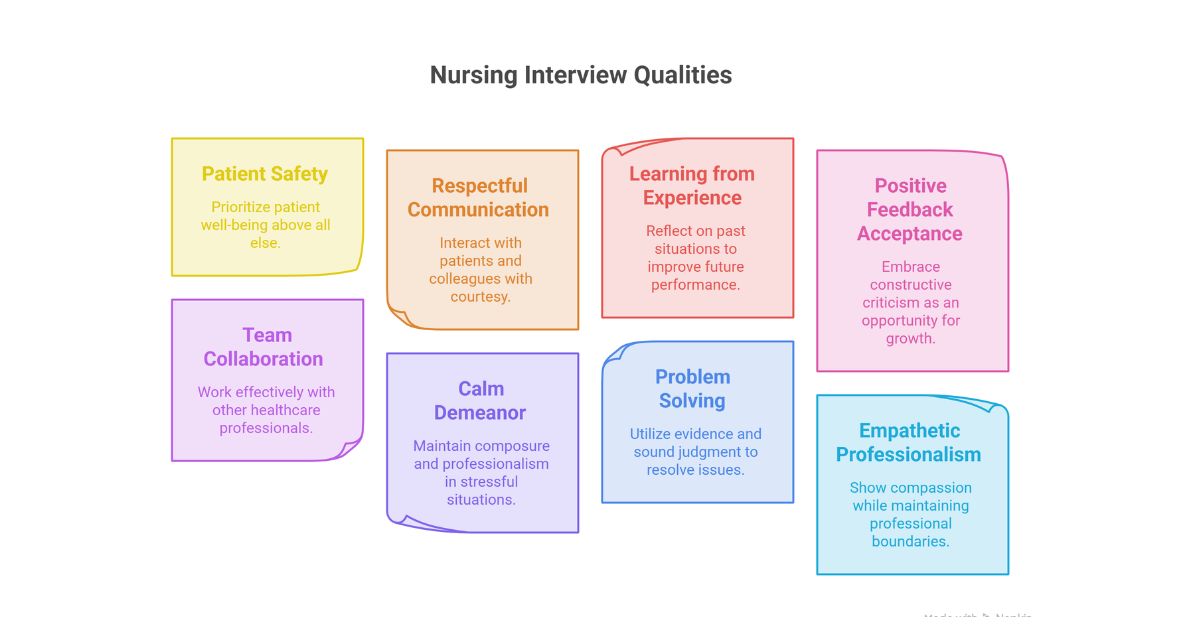
Many candidates believe nursing interviews are designed to test perfect answers. In reality, employers are looking for professional thinking.
Strong candidates consistently demonstrate that they:
- Put patient safety first.
- Communicate respectfully.
- Learn from experience.
- Accept feedback positively.
- Collaborate with colleagues.
- Remain calm during difficult situations.
- Solve problems using evidence and sound judgment.
- Show empathy without compromising professionalism.
Remember, interviewers aren’t expecting perfection—they’re looking for nurses who can grow, adapt, and contribute to a positive healthcare environment.
Key Takeaways from Questions 11–20
Behavioral and teamwork-focused nursing interview questions and answers reveal the qualities employers value beyond clinical expertise. Your responses should demonstrate:
- Compassion under pressure
- Effective communication
- Accountability
- Conflict resolution
- Team collaboration
- Patient advocacy
- Emotional intelligence
- Professional growth
The strongest answers are based on real experiences and clearly explain the situation, your actions, and the positive outcome.
Critical Thinking Questions
21. How Do You Respond to Emergencies?
Why do employers ask it
Emergencies require nurses to act quickly while remaining calm. Employers want to know whether you can prioritize patient safety under pressure.
What interviewers want to hear
- Rapid assessment
- Clinical judgment
- Team communication
- Knowledge of emergency protocols
Sample answer
During an emergency, I immediately assess the patient’s airway, breathing, and circulation while calling for appropriate assistance. I follow established emergency protocols, communicate clearly with the healthcare team, and continue monitoring the patient’s condition until the situation is stabilized.
Pro Tip
Mention following your facility’s emergency procedures rather than improvising.
Common mistakes to avoid
Avoid giving answers that focus only on technical tasks while overlooking teamwork and communication.
22. Tell Me About a Rapid Decision You Made.
Why do employers ask it
Critical thinking often requires making timely decisions with limited information.
What interviewers want to hear
- Observation skills
- Confidence
- Sound judgment
- Positive outcomes
Sample answer
While completing routine rounds, I noticed subtle changes in a patient’s breathing pattern and mental status. Although the vital signs were only slightly abnormal, I immediately reassessed the patient, notified the physician, and initiated appropriate monitoring. The patient received early treatment before the condition became critical.
Pro Tip
Highlight your assessment process rather than simply saying you acted quickly.
Common mistakes to avoid
Don’t exaggerate your role or imply that you ignored established protocols.
23. How Do You Stay Calm Under Pressure?
Why do employers ask it
Busy healthcare environments demand emotional control and effective prioritization.
What interviewers want to hear
- Organization
- Emotional resilience
- Time management
- Patient focus
Sample answer
“I stay calm by focusing on priorities instead of becoming overwhelmed by the entire workload. I communicate frequently with my team, organize tasks based on patient needs, and remind myself that staying composed helps both my patients and colleagues.”
Pro Tip
Demonstrate practical coping strategies rather than simply saying you’re naturally calm.
Common mistakes to avoid
Avoid claiming that stressful situations never affect you.
24. Describe Solving a Complex Patient Problem.
Why do employers ask it
Interviewers want evidence of analytical thinking and collaboration.
What interviewers want to hear
- Assessment
- Problem-solving
- Communication
- Patient advocacy
Sample answer
A patient experienced repeated falls despite standard precautions. After reviewing the patient’s history and discussing concerns with the interdisciplinary team, we identified medication side effects as a contributing factor. The treatment plan was adjusted, additional safety measures were implemented, and the patient’s fall risk decreased significantly.
Pro Tip
Choose examples that demonstrate collaboration rather than individual achievement.
Common mistakes to avoid
Don’t present yourself as making decisions beyond your professional scope.
25. How Do You Manage Competing Priorities?
Why do employers ask it
Every nursing shift requires balancing multiple responsibilities.
What interviewers want to hear
- Organization
- Flexibility
- Clinical prioritization
- Safe delegation
Sample answer
I begin every shift by identifying high-priority patients and reassessing priorities throughout the day as conditions change. I communicate openly with my team, delegate tasks appropriately, and remain flexible while ensuring every patient receives safe, timely care.
Pro Tip
Explain that priorities change continuously during a shift.
Common mistakes to avoid
Avoid suggesting that you rely solely on multitasking rather than prioritization.
Career Growth Questions
26. Where Do You See Yourself in Five Years?
Why do employers ask it
Healthcare organizations want candidates who are committed to long-term professional growth.
What interviewers want to hear
- Career goals
- Continuous learning
- Organizational commitment
Sample answer
In five years, I hope to become an experienced clinical nurse who mentors newer staff while continuing my professional education. I’m also interested in earning specialty certifications and contributing to quality improvement initiatives.
Pro Tip
Show ambition without implying you’ll leave the organization quickly.
Common mistakes to avoid
Don’t focus only on salary or promotions.
27. Why Should We Hire You?
Why do employers ask it
This question gives you the opportunity to summarize your value.
What interviewers want to hear
- Confidence
- Relevant experience
- Teamwork
- Patient-centered care
Sample answer
I bring strong clinical knowledge, excellent communication skills, and a genuine commitment to compassionate patient care. I’m a collaborative team member who adapts quickly, enjoys learning, and consistently puts patient safety first. I believe those qualities would allow me to contribute positively to your organization from my first day.
Pro Tip
Tailor your answer to the employer’s specific needs.
Common mistakes to avoid
Avoid comparing yourself, either positively or negatively, with other candidates.
28. How Do You Continue Learning?
Why do employers ask it
Healthcare evolves rapidly, making lifelong learning essential.
What interviewers want to hear
- Professional development
- Curiosity
- Commitment to evidence-based practice
Sample answer
I stay current by completing continuing education courses, attending professional workshops, reading nursing journals, and participating in hospital training sessions. I also enjoy learning from experienced colleagues during daily practice.
Pro Tip
Mention recent learning activities whenever possible.
Common mistakes to avoid
Don’t suggest that your nursing education ended after graduation.
29. What Motivates You as a Nurse?
Why do employers ask it
Motivation influences long-term performance and job satisfaction.
What interviewers want to hear
- Patient-centered values
- Professional purpose
- Compassion
Sample answer
I’m motivated by knowing that even small actions can improve someone’s health, comfort, or confidence during a difficult time. Seeing patients recover and knowing I contributed to their care reminds me why I chose nursing.
Pro Tip
Keep your answer authentic and personal.
Common mistakes to avoid
Avoid focusing primarily on financial rewards.
30. Do You Have Any Questions for Us?
Why do employers ask it
Thoughtful questions demonstrate preparation and genuine interest.
What interviewers want to hear
Questions about:
- Team culture
- Professional development
- Patient care standards
- Orientation
- Career growth
Sample answer
I’d like to learn more about your orientation program, opportunities for continuing education, and how your nursing teams collaborate across departments. I’m also interested in understanding what qualities make nurses successful within your organization.
Pro Tip
Prepare at least five questions before every interview.
Common mistakes to avoid
Never respond with, “No, I don’t have any questions.”
Nursing Interview Questions by Experience Level
Not every nursing interview is the same. Employers often tailor their questions to your experience and specialty.
New Graduate Nurse Interview Questions
Expect questions about:
- Clinical rotations
- Patient communication
- Adaptability
- Time management
- Willingness to learn
Employers understand you have limited experience, so they focus on your potential.
Experienced Registered Nurse Interview Questions
You’ll likely discuss:
- Leadership experience
- Clinical decision-making
- Mentoring junior nurses
- Quality improvement
- Patient outcomes
Use measurable achievements whenever possible.
ICU Nurse Interview Questions
Interviewers often explore:
- Ventilator management
- Hemodynamic monitoring
- Rapid response situations
- Critical care prioritization
- Family communication
ER Nurse Interview Questions
Expect questions about:
- Trauma care
- Triage
- Fast decision-making
- Multitasking
- Emergency communication
Travel Nurse Interview Questions
Focus areas include:
- Adaptability
- Working with new teams
- Flexibility
- Learning new systems quickly
- Managing short-term assignments
Nurse Practitioner Interview Questions
Common topics include:
- Clinical autonomy
- Diagnosis and treatment planning
- Evidence-based practice
- Leadership
- Interdisciplinary collaboration
Nursing Interview Mistakes That Cost Candidates the Job
Even highly qualified nurses can miss out on opportunities due to avoidable interview mistakes.
The most common include:
Giving Generic Answers
Avoid vague responses that could apply to any profession. Use real nursing examples whenever possible.
Not Using Real Examples
Behavioral questions require evidence. Personal experiences are much stronger than theoretical answers.
Speaking Negatively About Previous Employers
Stay professional, even if your previous workplace was challenging.
Poor Communication Skills
Speak clearly, maintain eye contact, and listen carefully before answering.
Forgetting Patient-Centered Care
Every answer should demonstrate your commitment to safe, compassionate care.
Lack of Preparation
Research the organization, review the job description, and practice common interview questions before your interview.
Quick Tip: Treat your interview the same way you would treat a patient assessment—prepare thoroughly, gather information, communicate clearly, and stay focused on achieving the best outcome.
Questions You Should Ask the Interviewer

Asking thoughtful questions demonstrates professionalism and a genuine interest in the role.
Consider asking:
Team Culture
- How would you describe the nursing team’s culture?
Orientation Program
- How long is the orientation process for new nurses?
Nurse-to-Patient Ratios
- What are the typical staffing ratios on this unit?
Professional Development
- What continuing education opportunities are available?
Career Advancement
- Are there leadership or speciality certification programs?
Scheduling Expectations
- How are schedules created, and how often do they rotate?
Avoid asking about salary, vacation, or benefits during the first interview unless the interviewer brings them up or you’re in the final stages of the hiring process.
Virtual Nursing Interview Tips
Many healthcare organizations now conduct initial interviews online.
To make a strong impression:
Technology Setup
Test your internet connection, camera, and microphone beforehand.
Camera and Lighting
Use natural lighting or a well-lit room. Position your camera at eye level.
Professional Environment
Choose a quiet, uncluttered space with minimal distractions.
Virtual Communication Tips
Maintain eye contact by looking into the camera, speak clearly, and avoid interrupting.
Follow-Up Email
Within 24 hours, send a brief thank-you email expressing appreciation for the interview and reaffirming your interest in the position.
FAQ: Frequently Asked Questions
What are the most common nursing interview questions?
Most nursing interviews include questions about your clinical experience, communication skills, teamwork, patient safety, critical thinking, conflict resolution, and career goals. Employers also commonly ask behavioral questions to understand how you’ve handled real workplace situations and whether you’re a good fit for their healthcare team.
How should I answer behavioral nursing interview questions?
The STAR method is one of the most effective approaches. Describe the Situation, explain your Task, outline the Action you took, and finish with the Result. Using real clinical examples demonstrates professionalism, problem-solving ability, and practical nursing experience.
What should I wear to a nursing interview?
Professional business attire is generally the safest choice unless the employer provides different instructions. Choose clean, conservative clothing, comfortable dress shoes, minimal accessories, and maintain a neat appearance to create a positive first impression.
How long does a nursing interview usually last?
Most nursing interviews last 30 to 60 minutes, though panel interviews or multiple rounds may take longer. Virtual screening interviews are often shorter and focus on your qualifications before moving to more detailed discussions.
Should I memorize my interview answers?
No. Memorizing responses can make your answers sound unnatural. Instead, understand the key points you want to communicate and practice discussing your experiences conversationally while remaining authentic and confident.
What qualities do healthcare employers value most in nurses?
Healthcare employers consistently value:
- Compassion
- Communication
- Critical thinking
- Professionalism
- Adaptability
- Accountability
- Teamwork
- Patient advocacy
- Ethical decision-making
- Commitment to continuous learning
These qualities often matter as much as technical nursing skills.
How can new graduate nurses perform well during interviews despite limited experience?
Employers understand that new graduates have limited clinical experience. Focus on your nursing school rotations, simulation labs, leadership activities, teamwork experiences, and examples that demonstrate your willingness to learn and adapt.
What questions should I ask before accepting a nursing position?
Consider asking about:
- Orientation length
- Nurse-to-patient ratios
- Scheduling flexibility
- Continuing education
- Career advancement
- Team culture
- Performance expectations
- Mentorship opportunities
These questions help you evaluate whether the organization supports long-term professional success.
How can I reduce nervousness before a nursing interview?
Preparation is the best confidence builder. Research the employer, review common nursing interview questions, practice answering aloud, prepare examples using the STAR method, organize your documents, and arrive early. Confidence grows from preparation rather than memorisation.
Conclusion
Preparing for nursing interview questions is about much more than rehearsing answers. Successful candidates understand what employers are truly evaluating—clinical judgment, communication, professionalism, compassion, adaptability, and a genuine commitment to patient care.
If you’re ready to take the next step, BluebixHealth is here to help. We connect qualified nursing professionals with trusted healthcare employers, provide personalized career guidance, and support you throughout the hiring process—helping you find opportunities where you can grow, succeed, and make a lasting difference in patient care.