
10 Best Nurse Staffing Services for Hospitals in 2026
Finding and retaining qualified nurses has become one of the biggest challenges facing hospitals today. This is where Best Nurse Staffing Services for Hospitals play a critical role.
Healthcare facilities must balance patient care, workforce shortages, compliance requirements, and rising operational costs—all while ensuring every shift is adequately staffed.
A reliable nurse staffing partner helps hospitals quickly access qualified nursing professionals, reduce hiring delays, maintain safe staffing levels, and improve patient outcomes.
Whether you need temporary coverage, travel nurses, direct hire placements, or emergency staffing support, choosing the right staffing partner can make the difference between operational stability and ongoing workforce challenges.
This guide explores how nurse staffing services work, why hospitals rely on them, and how to select the best provider for your organization.
What Are Nurse Staffing Services for Hospitals?
Hospitals operate in a fast-moving environment where patient needs can change overnight. Staffing shortages, seasonal demand spikes, employee leaves, and workforce turnover can all create gaps in patient care.
Nurse staffing services help healthcare facilities fill these gaps by connecting hospitals with qualified nursing professionals who are ready to work when and where they are needed.
Think of a nurse staffing agency as an extension of a hospital’s recruiting team. Instead of spending weeks or months searching for candidates, hospitals gain immediate access to a pool of pre-screened professionals.
Definition of Nurse Staffing Services
Nurse staffing services are specialized healthcare recruitment solutions that provide hospitals with licensed nursing professionals on a temporary, contract, travel, per diem, or permanent basis.
These services support healthcare facilities by:
- Filling open nursing positions
- Reducing recruitment timelines
- Improving workforce flexibility
- Supporting patient care continuity
- Addressing urgent staffing shortages
A quality nurse staffing agency focuses not only on filling positions but also on matching nurses with the right skills, experience, certifications, and cultural fit.
Types of Nursing Professionals Commonly Placed
Healthcare staffing services can provide a wide range of nursing professionals, including:
- Registered Nurses (RNs)
- Licensed Practical Nurses (LPNs)
- Certified Nursing Assistants (CNAs)
- ICU Nurses
- Emergency Room Nurses
- Labor and Delivery Nurses
- Operating Room Nurses
- Telemetry Nurses
- Behavioral Health Nurses
- Long-Term Care Nurses
- Home Health Nurses
- Travel Nurses
The ability to access specialized nursing talent quickly is one of the primary reasons hospitals partner with staffing agencies.
How Nurse Staffing Agencies Support Healthcare Facilities
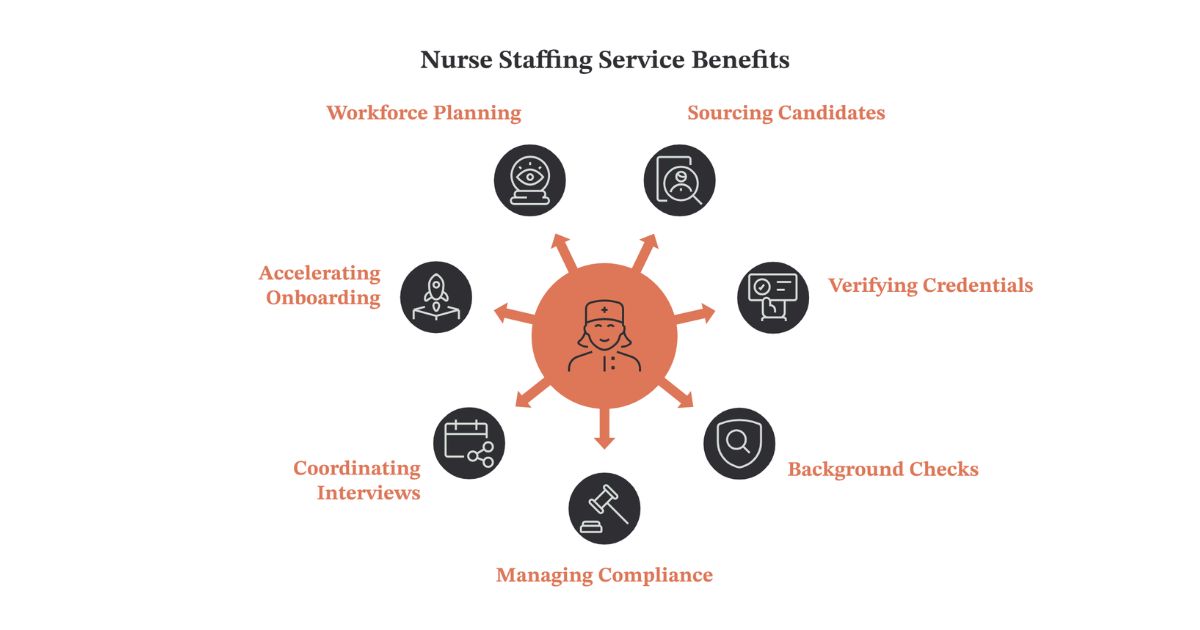
The best nurse staffing services do far more than provide resumes.
They help hospitals:
- Source qualified candidates
- Verify licenses and credentials
- Conduct background checks
- Manage compliance requirements
- Coordinate interviews
- Accelerate onboarding
- Provide workforce planning support
A strong staffing partner functions like a bridge connecting workforce needs with qualified healthcare professionals.
Why Hospitals Depend on Nurse Staffing Services
Hospitals face ongoing workforce challenges that directly affect patient care and operational performance.
Nurse staffing agencies help healthcare organizations overcome these challenges efficiently.
Addressing Ongoing Nursing Shortages
The healthcare industry continues to experience significant nursing shortages.
Factors contributing to these shortages include:
- Aging nursing workforce
- Increased healthcare demand
- Burnout-related departures
- Growing patient populations
- Expanding healthcare services
Hospitals often struggle to find enough qualified candidates through traditional hiring methods alone.
Nurse recruitment services provide access to larger talent pools and faster hiring processes.
Managing Patient Census Fluctuations
Patient volumes rarely remain consistent.
Hospitals may experience sudden increases due to:
- Seasonal illnesses
- Public health emergencies
- Local population growth
- Community events
- Natural disasters
Flexible staffing solutions help healthcare facilities scale workforce levels as patient demand changes.
Filling Critical and Hard-to-Fill Roles
Certain nursing specialties are particularly difficult to recruit.
Examples include:
- ICU Nurses
- ER Nurses
- OR Nurses
- Neonatal Nurses
- Behavioral Health Nurses
Specialized nurse staffing agencies maintain networks of highly qualified professionals who can fill these roles more quickly than internal recruiting teams.
Supporting Workforce Flexibility
Healthcare organizations increasingly rely on flexible staffing models.
This approach allows hospitals to:
- Reduce overtime costs
- Maintain safe staffing ratios
- Improve workforce agility
- Respond quickly to changing conditions
Flexible workforce solutions help organizations remain competitive while protecting patient care quality.
Reducing Staff Burnout and Overtime
Imagine a hospital unit operating short-staffed for weeks.
Existing nurses must work longer hours, cover extra shifts, and handle heavier patient loads.
Over time, this leads to:
- Burnout
- Turnover
- Reduced morale
- Lower job satisfaction
Reliable nurse staffing support helps distribute workloads more evenly and reduces excessive overtime demands.
Types of Nurse Staffing Services Hospitals Can Use
Every hospital faces different workforce challenges. The best staffing model depends on organizational goals, patient volume, specialty needs, and budget considerations.
Travel Nurse Staffing
Travel nurses accept temporary assignments in healthcare facilities across different locations.
Hospitals use travel nurse staffing when:
- Facing severe shortages
- Opening new departments
- Experiencing seasonal demand spikes
- Filling specialized clinical roles
Travel nurses bring valuable experience from diverse healthcare environments and can often begin assignments quickly.
Per Diem Nurse Staffing
Per diem nurses work on an as-needed basis.
This staffing model offers maximum flexibility and helps hospitals manage:
- Call-offs
- Vacation coverage
- Short-term demand increases
- Weekend staffing needs
Per diem staffing is particularly valuable for facilities seeking workforce flexibility without long-term commitments.
Temporary Nurse Staffing
Temporary nursing professionals work for a defined period.
Hospitals often use temporary staffing to:
- Cover leaves of absence
- Support short-term projects
- Manage patient surges
- Address recruitment delays
Temporary staffing provides immediate workforce relief while long-term hiring efforts continue.
Permanent Placement Services
Permanent placement services focus on identifying nurses for full-time employment.
The staffing agency handles:
- Candidate sourcing
- Screening
- Interview coordination
- Reference verification
- Recruitment support
This approach saves significant time for internal HR and recruitment teams.
Direct Hire Nurse Recruitment
Direct hire recruitment helps hospitals fill permanent nursing positions with highly qualified professionals.
Benefits include:
- Reduced vacancy duration
- Improved candidate quality
- Better retention outcomes
- Streamlined hiring processes
Direct hire services are particularly effective for leadership and specialty nursing positions.
Float Pool Staffing Solutions
Float pool nurses work across multiple units within a healthcare facility.
These professionals provide flexibility by covering:
- Staffing shortages
- Unexpected absences
- Patient census fluctuations
Hospitals often use float pools to improve workforce efficiency while maintaining continuity of care.
Rapid Response and Emergency Staffing
Unexpected staffing crises require immediate solutions.
Emergency nurse staffing services help hospitals respond quickly to:
- Natural disasters
- Disease outbreaks
- Sudden workforce shortages
- Patient surges
The best staffing partners maintain a pool of ready-to-deploy nursing professionals who can support healthcare facilities with minimal delay.
5. Key Benefits of Using the Best Nurse Staffing Services
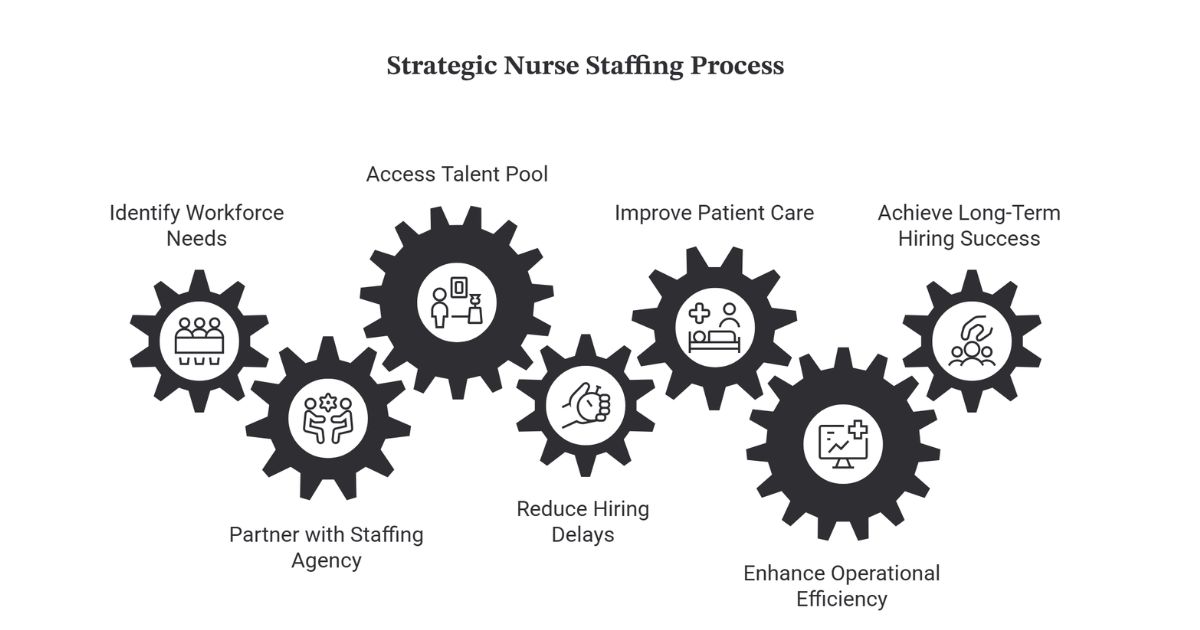
Partnering with a nurse staffing agency is no longer simply a temporary solution for workforce shortages.
For many hospitals, it has become a strategic workforce management tool that improves patient care, operational efficiency, and long-term hiring success.
The best nurse staffing services deliver far more than candidates. They provide access to talent, reduce hiring delays, and help healthcare facilities maintain high standards of care.
5.1 Faster Time-to-Fill Open Positions
Every day a nursing position remains vacant can place additional strain on existing staff.
Traditional recruitment often involves:
- Job posting management
- Resume screening
- Candidate sourcing
- Interview scheduling
- Background checks
- Credential verification
This process can take weeks or even months.
A nurse staffing agency already maintains a network of qualified candidates, significantly reducing hiring timelines.
Instead of searching for talent from scratch, hospitals gain access to professionals who are often ready to begin assignments immediately.
5.2 Access to Pre-Screened Qualified Nurses
One of the biggest advantages of healthcare staffing services is the quality of the candidates they provide.
Leading staffing agencies perform extensive screening that includes:
- License verification
- Skills assessments
- Employment history reviews
- Reference checks
- Compliance documentation
- Background screening
This process helps ensure hospitals receive credentialed nurses who meet clinical and regulatory standards.
Think of it like purchasing a vehicle that has already passed a complete safety inspection. The risk is lower, and confidence is higher.
5.3 Improved Patient Care Continuity
Patient care depends heavily on adequate staffing levels.
When hospitals operate with nursing shortages, patient care can suffer due to:
- Delayed treatments
- Longer response times
- Increased workload pressure
- Higher stress levels among staff
Reliable nurse staffing support helps maintain appropriate staffing ratios and ensures patients receive consistent, high-quality care.
A fully staffed unit can focus on patient outcomes rather than staffing concerns.
5.4 Reduced Recruitment Costs
Hiring nurses internally can be expensive.
Costs often include:
- Job advertising
- Recruitment software
- HR labor expenses
- Overtime pay
- Vacancy-related productivity losses
While staffing services involve an investment, they often reduce overall hiring costs by shortening vacancy periods and improving placement success rates.
The true cost of an empty nursing position is frequently much higher than organizations realize.
5.5 Better Workforce Planning
Hospitals that rely solely on reactive hiring often struggle to keep up with workforce demands.
Staffing partners help healthcare organizations:
- Forecast workforce needs
- Plan for seasonal demand
- Address anticipated retirements
- Build talent pipelines
- Prepare for growth initiatives
This proactive approach improves workforce stability and reduces the need for emergency hiring.
5.6 Increased Staff Retention
Nurse retention remains one of healthcare’s most important workforce challenges.
When units are consistently understaffed, employees may experience:
- Burnout
- Fatigue
- Reduced job satisfaction
- Increased turnover risk
Adequate staffing support helps create a healthier work environment.
Nurses who feel supported are more likely to remain with their employer long term.
5.7 Enhanced Regulatory Compliance
Healthcare facilities operate under strict regulatory requirements.
Staffing agencies help maintain compliance through:
- License monitoring
- Certification verification
- Continuing education tracking
- Documentation management
- Credential validation
This support reduces compliance risks while ensuring nurses meet facility and regulatory standards.
6. What Makes a Nurse Staffing Service the Best?
Not all staffing agencies deliver the same level of quality.
The best nurse staffing services distinguish themselves through experience, candidate quality, compliance expertise, responsiveness, and workforce solutions that align with hospital goals.
Success depends on trust, performance, and consistency.
6.1 Candidate Quality and Clinical Experience
Quality always comes first.
A staffing agency should focus on finding nurses who possess:
- Strong clinical skills
- Relevant certifications
- Specialty experience
- Positive employment histories
- Excellent patient care abilities
The best agencies prioritize candidate quality over simply filling positions quickly.
Hospitals benefit most when staffing partners provide nurses who can contribute immediately and confidently.
6.2 Credential Verification and Compliance Standards
Compliance is non-negotiable in healthcare.
A reliable staffing partner should verify:
- Active nursing licenses
- Certifications
- Educational credentials
- Work eligibility
- Professional references
- Background checks
Comprehensive healthcare credential verification protects both patients and healthcare organizations.
6.3 Speed of Placement
Hospitals rarely have the luxury of waiting months to fill critical nursing roles.
The best nurse staffing agencies combine speed with quality.
Fast placement capabilities often result from:
- Established talent networks
- Efficient recruitment systems
- Dedicated healthcare recruiters
- Advanced applicant tracking technology
The goal is rapid staffing without compromising standards.
6.4 Specialized Nursing Talent Pool
Healthcare facilities increasingly require specialized nursing professionals.
Top staffing providers maintain access to:
- ICU Nurses
- ER Nurses
- OR Nurses
- Labor and Delivery Nurses
- Telemetry Nurses
- Oncology Nurses
- Behavioral Health Nurses
A broad talent pool allows agencies to respond quickly to specialized staffing requests.
6.5 Communication and Responsiveness
Strong communication builds successful partnerships.
Hospitals should expect staffing agencies to:
- Respond promptly
- Provide regular updates
- Address concerns quickly
- Maintain transparency
- Offer ongoing support
Poor communication often creates delays and frustration during the hiring process.
The best agencies function as true partners rather than vendors.
6.6 Technology and Recruitment Process
Modern healthcare recruitment increasingly relies on technology.
Leading agencies use advanced systems for:
- Candidate sourcing
- Credential management
- Workforce analytics
- Scheduling support
- Compliance tracking
Technology helps improve recruitment efficiency while maintaining high-quality standards.
6.7 Reputation and Client Satisfaction
Past performance often predicts future performance.
Hospitals should evaluate:
- Client reviews
- Industry reputation
- Case studies
- Retention metrics
- Placement success rates
Positive client experiences indicate a staffing partner’s ability to deliver results consistently.
Questions worth asking include:
- How long have clients remained with the agency?
- What specialties do they support?
- How quickly do they fill positions?
- What is their retention rate?
6.8 Nationwide Staffing Capabilities
Many healthcare systems operate across multiple locations.
Nationwide staffing capabilities allow agencies to:
- Support multiple facilities
- Access larger candidate pools
- Fill positions faster
- Respond to regional shortages
For growing healthcare organizations, scalability becomes an important factor when selecting a staffing partner.
7. Essential Nursing Roles Hospitals Frequently Need
Different hospital departments require different nursing specialties.
A strong nurse staffing agency should have experience recruiting professionals across a wide range of clinical environments.
7.1 Registered Nurses (RNs)
Registered Nurses serve as the backbone of patient care.
Their responsibilities include:
- Patient assessments
- Medication administration
- Care coordination
- Patient education
- Clinical documentation
RN staffing remains one of the highest-demand areas of healthcare recruitment.
7.2 Intensive Care Unit (ICU) Nurses
ICU nurses care for critically ill patients who require continuous monitoring and advanced treatment.
These professionals possess specialized clinical expertise and are often among the most difficult roles to fill.
7.3 Emergency Room (ER) Nurses
ER nurses work in fast-paced environments where rapid decision-making is essential.
Hospitals frequently rely on staffing agencies to recruit experienced emergency nursing professionals who can handle high-acuity situations.
7.4 Labor and Delivery Nurses
Labor and delivery units require nurses with highly specialized experience in maternal and newborn care.
7.5 Medical-Surgical Nurses
Medical-surgical nurses care for patients recovering from illness, injury, and surgery.
Because these units often handle large patient volumes, staffing needs can fluctuate significantly.
7.6 Licensed Practical Nurses (LPNs)
LPNs support patient care under the supervision of registered nurses and physicians.
They play an important role in many hospitals and long-term care settings.
7.7 Certified Nursing Assistants (CNAs)
CNAs provide direct patient support and assist with daily care activities.
Although they are not licensed nurses, they remain essential members of the healthcare workforce.
7.8 Specialty Care Nurses
Many healthcare facilities require nurses with expertise in:
- Oncology
- Dialysis
- Cardiology
- Behavioral Health
- Pediatrics
- Telemetry
Access to specialty nurse recruitment services helps hospitals maintain high-quality care across specialized departments.
8. How to Evaluate Nurse Staffing Agencies Before Partnering
Selecting a staffing partner requires careful evaluation.
The right agency can improve hiring outcomes, while the wrong choice may create additional workforce challenges.
8.1 Reviewing Agency Experience
Healthcare staffing is highly specialized.
Look for agencies with:
- Proven healthcare expertise
- Industry-specific recruiters
- Strong placement history
- Experience serving hospitals similar to yours
Experience often translates into faster placements and higher-quality candidates.
8.2 Understanding Screening Procedures
Ask detailed questions about candidate screening.
A quality agency should have documented processes for:
- License verification
- Reference checks
- Background screening
- Skills validation
- Compliance reviews
Strong screening practices reduce hiring risk.
8.3 Assessing Compliance and Licensing Support
Healthcare compliance requirements continue to evolve.
Evaluate how agencies manage:
- Credential tracking
- License monitoring
- Documentation requirements
- Regulatory updates
Agencies with robust compliance programs provide added peace of mind.
8.4 Evaluating Placement Success Rates
Placement speed matters, but quality matters more.
Request information regarding:
- Average time-to-fill
- Retention rates
- Placement success metrics
- Client satisfaction data
These indicators reveal how effectively an agency delivers results.
8.5 Checking References and Testimonials
Client feedback provides valuable insights.
Review:
- Testimonials
- Online reviews
- Case studies
- Industry references
Consistent positive feedback often reflects strong service quality.
8.6 Measuring Communication Standards
Before partnering, assess how the agency communicates.
Key indicators include:
- Response times
- Transparency
- Accessibility
- Problem-solving approach
- Ongoing support
The strongest staffing relationships are built on open and consistent communication.
A staffing agency should be an extension of your internal hiring team rather than an outside vendor.
9. Common Challenges Hospitals Face Without Reliable Nurse Staffing Support
Healthcare organizations that struggle to maintain adequate staffing levels often face challenges that affect both patient care and business performance.
While staffing shortages may begin as operational issues, they can quickly affect employee satisfaction, patient outcomes, and financial stability.
9.1 Increased Vacancy Rates
Open nursing positions are becoming more difficult to fill.
Many hospitals face challenges such as:
- Increased competition for talent
- Nurse shortages across specialties
- Longer hiring timelines
- Geographic workforce limitations
When vacancies remain open for extended periods, existing staff must absorb additional responsibilities.
This creates a cycle where staffing shortages continue to worsen over time.
9.2 Higher Employee Turnover
Employee turnover often increases when staffing levels are inadequate.
Nurses working in understaffed units frequently experience:
- Increased workloads
- Emotional exhaustion
- Limited work-life balance
- Reduced job satisfaction
As experienced nurses leave, hospitals face additional recruiting costs and workforce instability.
Replacing one nurse is expensive. Replacing multiple nurses creates long-term workforce challenges.
9.3 Staff Burnout
Burnout has become one of healthcare’s most pressing workforce concerns.
Imagine a team constantly running a marathon without enough rest. Eventually, even the strongest runners become exhausted.
Signs of nurse burnout may include:
- Physical fatigue
- Emotional exhaustion
- Reduced engagement
- Increased absenteeism
- Higher turnover intentions
Reliable nurse staffing support helps distribute workloads more effectively and reduces pressure on existing teams.
9.4 Increased Patient Care Risks
Patient care quality depends heavily on appropriate staffing levels.
When hospitals operate short-staffed, risks may increase, including:
- Delayed patient care
- Longer response times
- Medication errors
- Reduced patient satisfaction
- Increased safety concerns
Adequate nurse staffing supports both clinical outcomes and patient experiences.
9.5 Revenue and Operational Impact
Staffing shortages can affect financial performance in several ways.
Common costs include:
- Overtime expenses
- Recruitment costs
- Lost productivity
- Contract labor expenses
- Reduced operational efficiency
Hospitals that invest in workforce planning and staffing partnerships often experience stronger operational stability and better financial outcomes.
10. Nurse Staffing Trends Shaping Hospitals in 2026
Healthcare recruitment continues to evolve. Understanding emerging nurse staffing trends helps hospitals prepare for future workforce needs and remain competitive in attracting top talent.
10.1 Rising Demand for Specialized Nurses
Healthcare facilities increasingly require nurses with advanced clinical expertise.
High-demand specialties include:
- Intensive Care
- Emergency Medicine
- Behavioral Health
- Oncology
- Telemetry
- Operating Room Nursing
As healthcare becomes more specialized, competition for experienced professionals continues to increase.
Hospitals that establish strong recruitment strategies today will be better positioned for future workforce demands.
10.2 Flexible Workforce Models
The traditional staffing model is changing.
Many healthcare organizations now combine:
- Permanent staff
- Travel nurses
- Per diem professionals
- Float pool resources
- Temporary assignments
Flexible workforce models help hospitals adapt quickly to changing patient volumes while maintaining quality care.
Think of workforce planning like building a diversified investment portfolio. Multiple staffing options create greater stability and flexibility.
10.3 AI-Assisted Healthcare Recruitment
Artificial intelligence is transforming healthcare hiring.
Modern recruitment technology helps agencies:
- Identify qualified candidates faster
- Match skills more accurately
- Reduce administrative work
- Improve candidate engagement
- Accelerate hiring decisions
While technology improves efficiency, human expertise remains essential when evaluating candidate fit and clinical experience.
10.4 Predictive Workforce Planning
Healthcare leaders increasingly rely on data to anticipate staffing needs.
Predictive workforce planning uses historical and real-time information to forecast:
- Patient census changes
- Seasonal demand increases
- Staffing shortages
- Retirement trends
- Recruitment needs
This proactive approach allows hospitals to address workforce challenges before they become critical problems.
10.5 Retention-Focused Hiring Strategies
Recruitment success is no longer measured solely by filling positions.
Healthcare organizations are placing greater emphasis on:
- Long-term retention
- Cultural fit
- Employee engagement
- Career development
- Workplace satisfaction
Finding the right candidate is important. Keeping them is even more valuable.
10.6 Credential Automation and Compliance Technology
Managing licenses and compliance requirements manually can be time-consuming.
Modern healthcare staffing technology helps automate:
- License tracking
- Certification monitoring
- Credential verification
- Compliance alerts
- Documentation management
Automation improves accuracy while reducing administrative burdens for healthcare organizations.
11. How Bluebix Health Helps Hospitals Build Stronger Nursing Teams
Finding qualified nurses quickly is one of the biggest challenges hospitals face today. Bluebix Health helps healthcare organizations overcome these challenges by providing reliable, flexible, and compliant nurse staffing solutions tailored to their workforce needs.
11.1 Access to Qualified Nursing Professionals
Bluebix Health connects healthcare facilities with experienced nursing professionals across a variety of specialties.
Our network includes:
- Registered Nurses (RNs)
- ICU Nurses
- ER Nurses
- LPNs
- CNAs
- Specialty Care Nurses
- Travel Nurses
Every candidate is carefully evaluated to ensure quality, professionalism, and clinical readiness.
11.2 Fast and Reliable Placement Process
Time matters when patient care is on the line.
Bluebix Health streamlines recruitment through:
- Efficient candidate sourcing
- Rapid screening procedures
- Accelerated interview coordination
- Fast onboarding support
Our goal is simple: help hospitals fill critical positions without unnecessary delays.
11.3 Thorough Candidate Verification
Trust is essential in healthcare staffing.
Bluebix Health conducts comprehensive candidate verification, including:
- License validation
- Credential reviews
- Background screening
- Reference checks
- Compliance documentation
This process helps ensure healthcare facilities receive qualified professionals who meet industry standards.
11.4 Flexible Staffing Solutions
Every healthcare organization has unique workforce needs.
Bluebix Health offers:
- Temporary staffing
- Travel nurse staffing
- Per diem staffing
- Direct hire recruitment
- Permanent placement services
Whether you need one nurse or an entire team, we help create solutions that fit your workforce goals.
11.5 Dedicated Client Support
Successful staffing partnerships depend on communication.
Bluebix Health provides responsive support throughout the recruitment process, helping clients navigate workforce challenges with confidence.
Our focus is not simply filling positions. Our focus is on helping healthcare organizations build stronger, more resilient nursing teams.
Conclusion
Choosing the best nurse staffing services for hospitals is about more than filling vacancies. It is about protecting patient care, supporting healthcare teams, reducing workforce challenges, and building long-term organizational success.
The healthcare landscape continues to evolve, and staffing demands are becoming increasingly complex.
Hospitals need trusted partners who can provide qualified nursing professionals quickly while maintaining high standards for quality, compliance, and patient care.
Whether your organization is addressing nursing shortages, preparing for future workforce needs, or seeking greater staffing flexibility, the right nurse staffing partner can make a significant difference.
Need Qualified Nurses Quickly Without Sacrificing Quality?
Contact Bluebix Health today to discuss your staffing needs and discover customized nurse staffing solutions built for your facility.
Frequently Asked Questions
How quickly can a nurse staffing agency fill urgent hospital vacancies?
Many agencies can provide qualified nurses within days, depending on specialty requirements, location, licensing needs, and candidate availability. Emergency staffing programs often accelerate placements for critical patient care situations.
Can nurse staffing services help reduce nurse burnout?
Yes. Staffing partners help distribute workloads, reduce excessive overtime, fill vacancies faster, and maintain safe staffing ratios, allowing existing nursing teams to focus on patient care without experiencing prolonged staffing pressure.
What screening processes should hospitals expect from a staffing agency?
Leading agencies verify licenses, certifications, work history, clinical skills, references, background checks, and compliance documentation before presenting candidates to healthcare facilities.
Are temporary nurses as qualified as permanent nursing staff?
Qualified temporary nurses often possess extensive clinical experience and specialized expertise. Reputable staffing agencies ensure all candidates meet licensing, credentialing, and competency requirements before placement.
What hospital departments benefit most from nurse staffing services?
ICU, ER, Labor & Delivery, Medical-Surgical, Telemetry, Behavioral Health, Long-Term Care, and Specialty Units often benefit significantly from flexible staffing support.
How can hospitals measure the success of a nurse staffing partnership?
Key performance indicators include time-to-fill, retention rates, patient satisfaction, overtime reduction, vacancy rates, compliance outcomes, and overall workforce stability.
What is the difference between travel nurse staffing and direct hire recruitment?
Travel nurse staffing addresses temporary staffing shortages, while direct-hire recruitment focuses on finding permanent nursing professionals who become long-term employees of the healthcare facility.
How do staffing agencies ensure regulatory compliance?
They maintain credential verification systems, monitor license expirations, conduct background screenings, and ensure candidates meet federal, state, and facility-specific requirements.
Can nurse staffing services support seasonal increases in patient volume?
Yes. Staffing agencies help hospitals rapidly scale nursing teams during flu seasons, emergencies, peak census periods, and unexpected workforce shortages.
What should hospitals ask before choosing a nurse staffing provider?
Hospitals should evaluate candidate quality, placement speed, compliance processes, specialty coverage, client references, communication standards, and long-term workforce support capabilities.