Medical Staffing Solutions: 10 Proven Ways to Hire Faster in 2026
Medical staffing solutions are no longer a luxury—they are a necessity in today’s healthcare environment. Hospitals, clinics, and care facilities face constant pressure from staff shortages, rising patient demand, and employee burnout.
The challenge is simple: how do you find qualified professionals quickly without compromising quality? This is where healthcare staffing solutions make a real difference.
By connecting employers with verified nurses, therapists, and clinical staff, medical recruitment services ensure continuity of care. If your goal is faster hiring, better talent, and reliable workforce support, understanding medical staffing solutions is the first step toward building a stronger healthcare team.
2. What Are Medical Staffing Solutions? (Expanded)
Medical staffing solutions are structured services designed to help healthcare organizations find, hire, and manage clinical and non-clinical staff efficiently. Think of them as a bridge between healthcare employers and qualified professionals.
2.1 Definition and Core Concept
At its core, medical staffing is about matching the right professional to the right role at the right time. It reduces hiring delays and ensures patient care is never compromised.
2.2 Types of Medical Staffing Services
Healthcare staffing is not one-size-fits-all. It includes multiple models:
- Temporary Staffing (PRN / Per Diem): Short-term coverage for shifts or peak demand
- Travel Nursing: Professionals working in different locations for set durations
- Contract Staffing: Fixed-term roles for projects or seasonal demand
- Direct Hire Placement: Permanent staffing solutions
- Locum Tenens: Temporary physicians or specialists filling critical gaps
2.3 Roles Covered in Medical Staffing
Medical staffing agencies provide access to a wide range of professionals:
- Registered Nurses (RN, ICU, ER, Med-Surg)
- Certified Nursing Assistants (CNA)
- Physical and Occupational Therapists
- Medical Assistants
- Allied Health Professionals
These services ensure healthcare organizations always have access to skilled talent when needed.
3. Why Healthcare Organizations Need Medical Staffing Solutions (Expanded, Focused)
3.1 Addressing Staff Shortages and Burnout
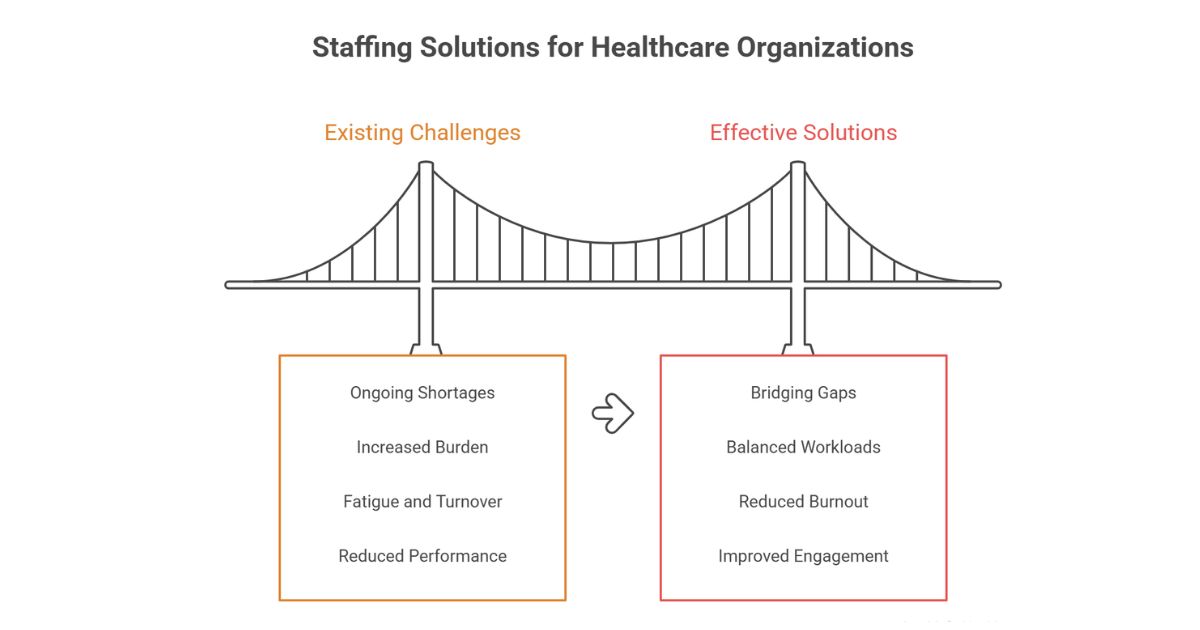
Healthcare organizations are under constant pressure to maintain adequate staffing levels. However, ongoing shortages of nurses, therapists, and allied health professionals make this difficult. When roles remain unfilled, existing staff are forced to take on extra shifts and responsibilities. Over time, this leads to fatigue, reduced performance, and higher turnover.
Medical staffing solutions help close these gaps quickly by providing access to qualified professionals on demand. Instead of relying solely on internal teams, organizations can bring in temporary or contract staff to balance workloads. This reduces burnout, improves employee morale, and helps retain experienced professionals. A well-supported workforce is more productive, more engaged, and better able to deliver consistent care.
3.2 Ensuring Continuous Patient Care
Healthcare operations cannot stop, even for a short time. Every role—whether it’s a nurse, therapist, or technician—directly impacts patient care. When a position is unfilled, it can delay treatments, increase patient wait times, and affect overall service quality.
Medical staffing solutions ensure that qualified professionals are available when needed. Whether it’s covering a last-minute absence or handling increased patient volume, staffing agencies provide immediate support. This ensures continuity in care delivery and maintains high standards of service. For healthcare providers, this reliability is essential to both patient outcomes and organizational reputation.
3.3 Reducing Overtime Costs
Overtime is often used as a quick fix for staffing shortages, but it comes at a high cost. Paying employees extra hours increases labor expenses and can lead to inefficiencies. In addition, overworked staff are more likely to make errors, which can result in further operational costs.
Medical staffing solutions offer a more controlled and cost-effective approach. By using flexible staffing models such as per diem or contract roles, organizations can meet demand without overloading their existing workforce. This helps control labor costs, maintain budget stability, and improve overall efficiency. Instead of reacting to shortages, businesses can plan staffing levels more strategically.
3.4 Improving Hiring Speed and Efficiency
Traditional hiring processes in healthcare can be slow. Screening candidates, verifying credentials, and completing onboarding can take weeks or even months. During this time, critical roles remain vacant, affecting operations and patient care.
Medical staffing agencies streamline this process by providing pre-vetted, ready-to-work candidates. These professionals have already passed background checks, credential verification, and compliance requirements. As a result, healthcare organizations can fill positions within days instead of weeks.
Faster hiring not only reduces downtime but also improves operational continuity. It allows organizations to respond quickly to changing demands, ensuring that staffing levels remain stable at all times.
4. Key Benefits of Medical Staffing Solutions
4.1 Faster Access to Qualified Talent
One of the biggest benefits of medical staffing solutions is speed. Healthcare employers often need qualified professionals quickly, especially when patient volume increases or staff members leave unexpectedly. A staffing agency already has access to a pool of screened candidates, which reduces the time spent searching, reviewing resumes, and starting from zero.
This is especially useful for roles like nurses, CNAs, medical assistants, therapists, and allied health professionals. Instead of waiting weeks to find the right person, healthcare organizations can connect with candidates who are already prepared for placement. Faster access to talent helps reduce staffing gaps, protect patient care, and keep daily operations running smoothly.
4.2 Flexible Workforce Management
Healthcare demand changes often. Some days, departments need more support because of patient volume, seasonal needs, employee leave, or unexpected absences. Medical staffing solutions give organizations the flexibility to adjust their workforce based on real-time needs. With flexible staffing models, employers can avoid both understaffing and overstaffing. This helps maintain the right balance between patient care needs and labor costs.
4.3 Reduced Hiring Risk and Compliance Support
Hiring in healthcare comes with serious responsibilities. Employers must ensure candidates have the right licenses, certifications, experience, and background checks before they work with patients. Any mistake in this process can create compliance risks and affect care quality.
A reliable medical staffing partner helps reduce this risk by managing key screening steps. This may include credential verification, background checks, license reviews, skills matching, and compliance documentation. As a result, healthcare organizations can hire with more confidence and reduce the chance of placing unqualified candidates.
4.4 Cost Savings and Operational Efficiency
Medical staffing solutions can help healthcare organizations control costs in several ways. When positions remain open, existing staff often work overtime, which increases labor expenses and contributes to burnout. Staffing support helps reduce that pressure by filling gaps at the right time.
It also lowers the cost of long hiring cycles. Internal teams spend less time sourcing, screening, and coordinating candidates. Fewer hiring mistakes also mean less money lost on turnover, retraining, and repeated recruitment. In the long run, staffing solutions improve efficiency by helping teams stay fully supported without unnecessary delays.
4.5 Scalability During Demand Surges
Healthcare organizations must be ready for sudden changes in demand. Patient volume can rise during flu season, public health events, staff shortages, facility expansions, or emergency situations. Without a scalable staffing plan, teams can become overwhelmed quickly.
Medical staffing solutions provide immediate workforce support when demand increases. Employers can add temporary, contract, PRN, or per diem staff without committing to permanent hires for short-term needs. This makes it easier to protect patient care, manage workloads, and keep operations stable during busy periods.
5. Types of Medical Staffing Models Explained
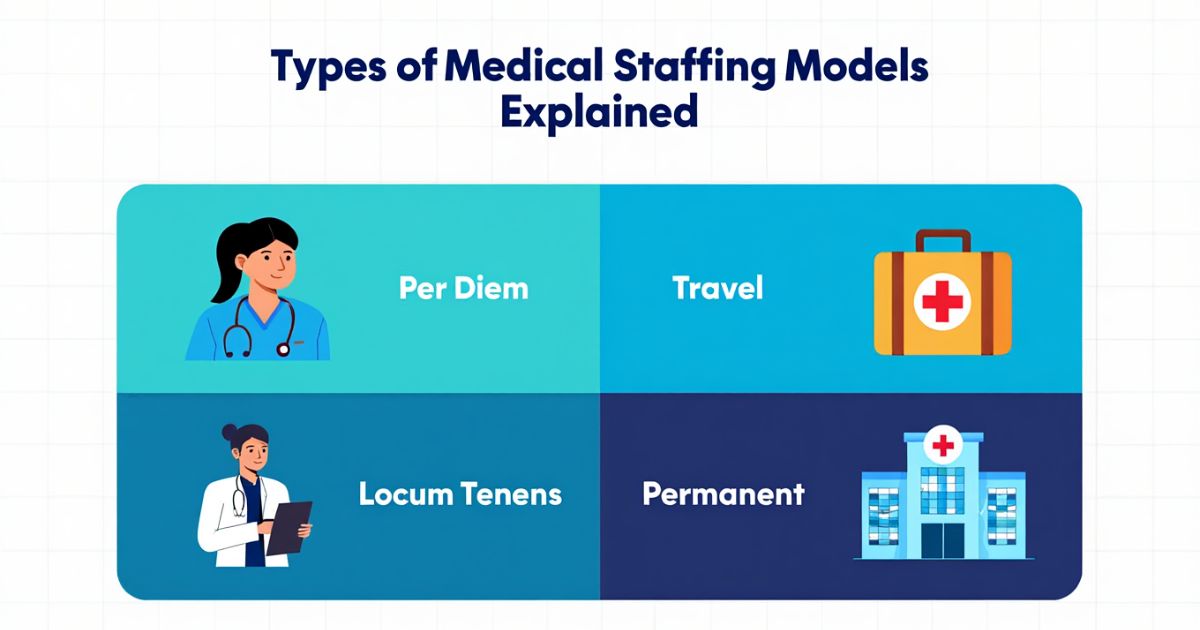
5.1 Temporary & Per Diem Staffing
Temporary and per diem staffing is designed for short-term coverage. It is most useful when healthcare organizations need immediate support due to employee absences, sudden patient volume increases, or seasonal demand.
Per diem staff work on an as-needed basis, often filling daily or shift-based gaps. Temporary staff may stay for a few days, weeks, or months depending on the requirement.
This model helps:
- Maintain staffing levels without long-term commitments
- Reduce overtime pressure on permanent staff
- Quickly respond to unexpected changes
It is a practical solution for keeping operations stable during short-term disruptions.
5.2 Travel Nursing Solutions
Travel nursing involves placing healthcare professionals in different locations for a fixed period, usually where there is a high demand or a nursing shortage of staff. These assignments can last several weeks or months.
This model is especially valuable for:
- Rural or underserved areas
- Facilities facing long-term staffing shortages
- Organizations managing seasonal demand increases
Travel nurses bring experience from different environments, which can improve adaptability and patient care quality. They also help maintain service levels in locations where hiring locally is difficult.
5.3 Direct Hire Staffing
Direct hire staffing focuses on permanent placement. This model is used when organizations want to build a stable, long-term workforce.
In this approach, staffing agencies help identify, screen, and present candidates who are a strong fit for the organization’s culture and long-term goals. Once hired, the employee becomes a full-time member of the organization.
This model is best for:
- Leadership roles and specialized positions
- Long-term workforce planning
- Improving employee retention and stability
It ensures that organizations invest in candidates who can grow with the team over time.
5.4 Locum Tenens Staffing
Locum tenens staffing is used primarily for physicians and specialized healthcare providers who work on temporary assignments. These professionals fill in when permanent staff are unavailable due to leave, transitions, or shortages.
This model helps:
- Maintain continuity in specialized care
- Avoid service disruptions in critical departments
- Provide flexibility in managing physician schedules
Locum tenens is especially important in healthcare settings where specialized expertise is required and cannot be easily replaced.
5.5 Contract-to-Hire Models
Contract-to-hire staffing allows employers to evaluate candidates before making a permanent hiring decision. Candidates are initially hired on a contract basis, giving both the employer and employee time to assess fit.
This model is useful for:
- Reducing hiring risk
- Testing skills and performance in real work conditions
- Ensuring cultural and team alignment
If the candidate performs well, they can be transitioned into a full-time role. This approach helps organizations make more confident and informed hiring decisions.
6. How to Choose the Right Medical Staffing Solution
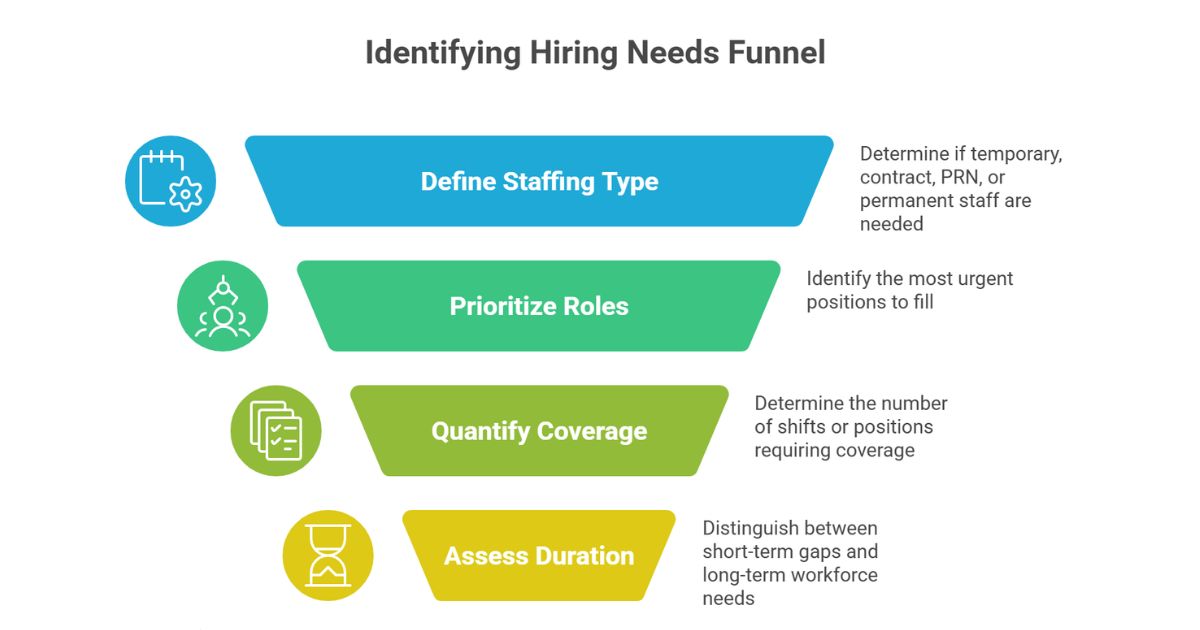
6.1 Identify Your Hiring Needs
Before choosing a medical staffing solution, define what type of support your organization needs. Not every staffing gap requires the same hiring model. Some facilities need short-term coverage, while others need long-term employees.
Start by asking:
- Do we need temporary, contract, PRN, or permanent staff?
- Which roles are most urgent?
- How many shifts or positions need coverage?
- Is this a short-term gap or a long-term workforce need?
Clear hiring needs help you choose the right staffing model and avoid wasting time on the wrong solution.
6.2 Evaluate Staffing Providers
A staffing provider should understand healthcare hiring, not just general recruitment. Look for a partner with experience placing nurses, caregivers, medical assistants, therapists, allied health professionals, and other clinical staff.
Check for:
- Healthcare staffing experience
- Strong candidate network
- Clear communication process
- Positive client feedback
- Ability to support urgent hiring needs
The right provider should act like an extension of your HR team, helping you hire faster without lowering quality.
6.3 Check Credentialing and Compliance Processes
Healthcare hiring requires strict verification. Candidates must have the right licenses, certifications, background checks, and role-specific qualifications before they begin work.
A reliable staffing partner should have a clear credentialing process that includes:
- License verification
- Certification checks
- Background screening
- Skills assessment
- Compliance documentation
This reduces hiring risk and helps your organization meet healthcare standards with confidence.
6.4 Assess Turnaround Time and Talent Quality
Fast hiring is important, but speed should never come at the cost of quality. A good medical staffing solution should provide candidates quickly while still ensuring they are qualified, reliable, and properly matched to the role.
Ask the staffing provider:
- How quickly can they submit candidates?
- Are candidates pre-screened?
- How do they match candidates to facility needs?
- What happens if a placement is not the right fit?
The best staffing partners balance speed with accuracy, helping you fill roles without creating new problems.
6.5 Compare Cost vs. Value
Choosing the cheapest staffing option can cost more in the long run if the candidates are not properly screened or if turnover is high. Instead of focusing only on price, compare the total value you receive.
Consider:
- Candidate quality
- Compliance support
- Hiring speed
- Reduced overtime costs
- Lower turnover risk
- Administrative time saved
A strong staffing solution should help your organization save time, reduce risk, and maintain patient care quality.
7. Industry-Specific Use Cases
7.1 Manufacturing & Production Facilities
In manufacturing, operations depend heavily on machines, systems, and timing. A small failure in a critical machine or supply chain process can stop the entire production line. This leads to delays, missed deadlines, and financial loss.
A structured approach to infrastructure planning helps manufacturing facilities focus on:
- Critical machinery: Identify and maintain equipment that directly affects production output
- Supply chain systems: Ensure steady availability of raw materials and components
- Maintenance schedules: Plan regular servicing to prevent unexpected breakdowns
- Backup systems: Prepare alternatives for high-risk assets
By prioritizing these areas, manufacturing companies can reduce downtime, maintain consistent production, and meet delivery commitments without disruption.
7.2 Healthcare Infrastructure Planning
In healthcare, infrastructure is directly connected to patient care. Unlike other industries, failures here can affect patient safety and treatment outcomes, not just business performance.
Healthcare organizations must prioritize:
- Patient care systems: Electronic health records, monitoring devices, and diagnostic equipment
- Staffing infrastructure: Availability of qualified nurses, doctors, and support staff
- Compliance systems: Adherence to healthcare regulations and standards
- Emergency readiness: Backup systems for critical care operations
A strong infrastructure plan ensures continuous care delivery, reduces risk, and maintains high standards of patient safety and service quality.
7.3 IT & Digital Infrastructure
For digital businesses, infrastructure is the foundation of operations. Systems must be reliable, secure, and scalable to support daily activities and customer interactions.
Key priorities include:
- Cloud systems: Scalable platforms for storing and accessing data
- Cybersecurity: Protection against data breaches and system attacks
- Data management: Ensuring data accuracy, availability, and security
- System uptime: Maintaining continuous access to services
Proper infrastructure planning helps IT-driven organizations avoid disruptions, protect sensitive information, and deliver consistent performance to users.
7.4 Supply Chain & Logistics
In supply chain and logistics, efficiency and timing are critical. Delays or disruptions in transportation or inventory management can impact the entire operation.
Key focus areas include:
- Transportation systems: Reliable fleet management and route optimization
- Warehousing: Efficient storage, inventory tracking, and order processing
- Vendor networks: Strong relationships with suppliers and backup options
- Tracking systems: Real-time visibility of shipments and inventory
By prioritizing these elements, logistics organizations can reduce delays, improve delivery performance, and maintain smooth operations across the supply chain.
8. Common Challenges and How to Overcome Them
8.1 Budget Constraints
Budget limitations are one of the most common challenges in infrastructure planning. Many organizations know they need upgrades, better systems, or stronger support, but they may not have enough budget to improve everything at once.
Solution:
Focus first on high-impact assets that directly affect operations, safety, productivity, or service delivery. Instead of spreading the budget across too many areas, prioritize the systems that create the greatest risk if they fail.
A practical approach includes:
- Ranking assets by business impact
- Separating urgent needs from future improvements
- Using phased investment plans
- Tracking ROI from each upgrade
This helps organizations improve critical areas without overspending.
8.2 Lack of Data or Visibility
Without clear data, it is difficult to know which systems are performing well and which ones are at risk. Many businesses still rely on manual tracking, outdated reports, or scattered information across departments.
Solution:
Use analytics tools, monitoring systems, and centralized dashboards to improve visibility. These tools help teams track performance, downtime, maintenance needs, and cost patterns.
Better data helps organizations:
- Identify weak points earlier
- Make faster decisions
- Plan maintenance more accurately
- Avoid reactive problem-solving
When leaders have the right information, infrastructure planning becomes more precise and reliable.
8.3 Resistance to Change
Employees and managers may resist new systems, processes, or technologies because they are comfortable with existing methods. Change can feel risky, especially when teams do not understand why it is needed.
Solution:
Educate teams early and explain the business value clearly. Show how the plan reduces downtime, improves workflows, saves costs, and makes daily work easier.
To reduce resistance:
- Involve key teams in planning
- Provide simple training
- Communicate expected benefits
- Share measurable ROI and performance results
When people understand the purpose, they are more likely to support the change.
8.4 Vendor and Procurement Delays
Infrastructure planning often depends on external vendors, suppliers, and service providers. Delays in equipment, software, repairs, or approvals can slow down implementation and affect operations.
Solution:
Build strong vendor relationships and maintain backup options. Procurement teams should identify reliable suppliers, negotiate clear timelines, and prepare alternatives for critical needs.
A strong vendor strategy includes:
- Approved backup suppliers
- Clear service-level agreements
- Early purchasing plans
- Regular vendor performance reviews
This reduces delays and keeps infrastructure projects moving on schedule.
9. Benefits of Implementing a Priority Infrastructure Plan
9.1 Improved Operational Efficiency
A priority infrastructure plan helps businesses keep their most important systems, assets, and processes running smoothly. When critical infrastructure is properly identified and maintained, teams face fewer delays and fewer unexpected disruptions.
This improves efficiency by:
- Reducing system downtime
- Preventing workflow bottlenecks
- Improving coordination between departments
- Keeping operations consistent
For example, if a production facility prioritizes key machinery, maintenance can be scheduled before breakdowns happen. This keeps work moving and reduces delays that affect output, delivery, and customer satisfaction.
9.2 Better Decision-Making
A priority infrastructure plan gives leaders clear information about what matters most. Instead of making decisions based on guesswork, managers can use data, risk levels, performance reports, and cost impact to guide their choices.
This helps businesses decide:
- Which assets need immediate attention
- Where to invest budget first
- Which systems create the highest risk
- What upgrades will deliver the most value
Better visibility leads to smarter planning. It also helps leadership, operations, HR, procurement, and finance teams work from the same priorities.
9.3 Cost Savings and ROI
Without a clear plan, businesses may spend money on low-priority upgrades while critical systems remain at risk. A priority infrastructure plan helps prevent waste by directing investment toward the assets that have the greatest impact.
It supports cost savings by:
- Reducing emergency repair costs
- Lowering downtime-related losses
- Avoiding unnecessary spending
- Extending the life of important assets
- Improving return on infrastructure investment
In simple terms, planned spending is usually cheaper than emergency spending. When businesses act before problems become serious, they protect both operations and budget.
9.4 Stronger Business Continuity
Business continuity depends on preparation. A priority infrastructure plan helps organizations stay operational during disruptions by identifying critical systems and creating backup plans before problems occur.
This includes:
- Backup equipment or systems
- Alternative vendors
- Emergency response plans
- Clear responsibility across teams
- Regular monitoring of high-risk assets
When disruption happens, the business can respond faster and recover with less damage. This is especially important for industries where delays affect customers, patients, production, or service delivery.
10. Tools and Technologies for Infrastructure Planning
10.1 Infrastructure Management Software
Infrastructure management software helps organizations track assets, systems, equipment, and maintenance activities in one place. Instead of managing information through scattered spreadsheets or manual records, businesses can use a centralized system to monitor infrastructure performance.
These tools help teams:
- Track asset condition and usage
- Schedule maintenance tasks
- Monitor system performance
- Store asset history and service records
- Identify which assets need repair, upgrade, or replacement
This improves control and reduces the chance of missing important maintenance or performance issues.
10.2 Data Analytics and AI Tools
Data analytics and AI tools help businesses make smarter infrastructure decisions. They collect and analyze performance data to identify patterns, risks, and future problems.
These tools can help:
- Predict equipment failures
- Identify high-risk assets
- Improve budget allocation
- Reduce unnecessary maintenance
- Support faster decision-making
Instead of waiting for systems to fail, businesses can act early. This makes infrastructure planning more proactive and cost-effective.
10.3 Workforce Planning Platforms
Infrastructure planning is not only about equipment and systems. It also depends on people. Workforce planning platforms help organizations match staffing needs with infrastructure requirements.
These platforms help teams:
- Forecast workforce demand
- Identify skill gaps
- Plan hiring based on operational needs
- Align employee availability with business priorities
- Support long-term workforce planning
For example, if a company invests in new technology, it may also need employees with the right skills to operate and manage it. Workforce planning tools help prepare for that need.
10.4 Cloud-Based Monitoring Systems
Cloud-based monitoring systems provide real-time access to infrastructure performance data. Teams can monitor systems, equipment, and digital infrastructure from different locations without relying only on on-site reporting.
These systems help businesses:
- Detect issues in real time
- Receive alerts before problems become serious
- Access performance data remotely
- Improve response time
- Support scalable operations
Cloud-based monitoring is especially useful for organizations with multiple locations, remote teams, or complex infrastructure networks.
11. Future Trends in Priority Infrastructure Planning (Expanded, Focused)

11.1 AI and Automation
AI and automation are transforming infrastructure planning from reactive to predictive. Systems can now analyze data, detect patterns, and identify risks before failures occur.
Key impact:
- Early detection of system issues
- Automated decision-making for maintenance and resource allocation
- Reduced manual intervention and faster response times
This improves reliability and minimizes operational disruptions.
11.2 Smart Infrastructure and IoT
Smart infrastructure uses IoT (Internet of Things) devices to connect systems, assets, and equipment. These connected systems provide real-time data and improve overall visibility.
Key impact:
- Continuous monitoring of infrastructure performance
- Real-time alerts for issues or inefficiencies
- Improved coordination between systems
This leads to better control, faster problem resolution, and higher efficiency.
11.3 Sustainability and Green Infrastructure
Businesses are increasingly focusing on sustainable infrastructure to reduce environmental impact and meet regulatory requirements.
Key impact:
- Energy-efficient systems and reduced resource consumption
- Lower operational costs over time
- Compliance with environmental standards
Sustainable infrastructure supports long-term business growth and responsibility.
11.4 Predictive Maintenance
Predictive maintenance uses data analytics to determine when systems need servicing—before failures occur.
Key impact:
- Reduced unexpected breakdowns
- Lower maintenance costs
- Extended asset lifespan
This approach ensures continuous operations and improves overall system performance.
12. Why Choose Bluebix Health for Medical Staffing Solutions
Choosing the right staffing partner directly affects your hiring speed, workforce quality, and patient care outcomes. Bluebix Health is built to support healthcare employers who need reliable, fast, and compliant staffing solutions without unnecessary complexity.
Bluebix Health focuses on a fast and reliable hiring process, helping organizations fill critical roles quickly. Instead of long hiring cycles, employers get access to candidates who are ready to work, reducing delays in operations and patient care.
Candidate quality is a top priority. Every professional is verified and qualified, ensuring they meet the required skills, experience, and role expectations. This reduces hiring risks and improves overall performance from day one.
Compliance is another key strength. Bluebix Health manages credentialing, background checks, and regulatory requirements, helping healthcare organizations stay aligned with industry standards without extra administrative effort.
Flexibility is essential in healthcare, and Bluebix Health offers multiple staffing models, including PRN, contract, and direct hire. This allows employers to adjust staffing levels based on demand without overcommitting resources.
Most importantly, solutions are tailored to each organization’s needs. Whether it’s short-term coverage or long-term workforce planning, Bluebix Health adapts to your goals and challenges.
13. Conclusion
Medical staffing solutions play a critical role in helping healthcare organizations manage workforce challenges, maintain patient care, and control costs. From faster hiring and access to qualified professionals to flexible staffing and reduced risk, these solutions provide clear operational advantages.
Organizations that use structured staffing strategies are better prepared to handle demand changes, reduce burnout, and improve overall efficiency. Choosing the right partner, such as Bluebix Health, ensures you get the speed, quality, and reliability needed to build a strong healthcare team.
If your goal is to improve hiring outcomes and maintain consistent patient care, now is the right time to adopt a smarter staffing approach.
FAQs
What makes a medical staffing solution effective?
An effective solution delivers qualified candidates quickly while ensuring compliance and reliability. It balances speed, quality, and cost, helping healthcare organizations maintain patient care without staffing gaps.
How quickly can staffing agencies fill urgent roles?
Many agencies can fill urgent roles within 24–72 hours, depending on role complexity. Access to pre-vetted talent pools significantly reduces hiring time.
Are staffing solutions cost-effective for small clinics?
Yes, they help avoid overtime costs, reduce hiring risks, and ensure efficient staffing. Even small clinics benefit from flexible staffing models.
What is the difference between travel nursing and per diem staffing?
Travel nursing involves longer assignments in different locations, while per diem staffing fills short-term or daily shifts based on demand.
How do staffing agencies ensure candidate quality?
Through background checks, credential verification, skill assessments, and compliance checks before placement.
Can staffing solutions help reduce employee burnout?
Yes, by filling staffing gaps and distributing workload evenly, reducing stress on permanent staff.
What roles are hardest to fill in healthcare staffing?
Specialized nurses, therapists, and critical care roles are often the hardest due to high demand and skill requirements.
How does technology improve medical staffing?
Technology speeds up candidate matching, automates processes, and improves communication between employers and candidates.
Is it better to use one agency or multiple staffing partners?
Using one reliable partner ensures consistency, but multiple partners can increase reach depending on hiring needs.
What should I look for in a staffing partner?
Look for speed, candidate quality, compliance support, industry experience, and transparent communication.