
7 Benefits of Direct Hire Staffing in Healthcare (Complete Guide)
Healthcare hiring can feel like trying to fill a bucket with a hole in the bottom. You find people, interview them, onboard them, and then the role opens again. That is why more employers are turning to direct hire staffing instead of relying only on short-term fixes.
In healthcare, where patient trust, schedule coverage, compliance, and continuity all matter, direct hire staffing gives employers a more stable path to long-term hiring. It helps organizations find qualified professionals for permanent roles, reduce turnover pressure, and build stronger teams that can support safe, consistent care over time.
Healthcare employers are not imagining the pressure. The U.S. Bureau of Labor Statistics projects healthcare occupations will add openings at a very high pace, with about 1.9 million openings each year on average from 2024 to 2034, while registered nurses alone are projected to have about 189,100 openings each year on average over the decade.
At the same time, HRSA projects ongoing nursing shortages, including projected shortages of registered nurses through 2038. That mix of demand, retirements, and workforce exits means employers need smarter hiring systems, not just faster job ads.
For hospitals, clinics, long-term care organizations, rehabilitation centers, home health providers, and medical groups, the real question is not only, “How do we fill this role?” It is, “How do we fill it with the right person, keep that person, and protect patient care while we do it?” That is where direct hire staffing becomes a strategic solution rather than just another recruiting tactic.
What Is Direct Hire Staffing?
Direct hire staffing means recruiting candidates for permanent or long-term positions within your organization. Instead of sending a clinician, caregiver, or support professional for a short assignment, a direct hire model is built around placing that person into your workforce as an employee of your organization. In simple terms, it is not renting talent for a shift. It is finding talent for a seat at your table.
A direct hire staffing service usually covers the front end of hiring: role intake, sourcing, screening, interviewing support, credential checks, reference checks, and shortlisting. The healthcare employer makes the final hiring decision, and the chosen candidate joins the employer directly.
That makes direct hire different from temporary staffing, travel assignments, contract staffing, and per diem models, which are often designed to solve urgent short-term coverage needs.
Think of it like this: temporary staffing is a bridge, but direct hire staffing is part of the road itself. The road has carried daily traffic for years. Both matter, but they serve different purposes. Healthcare organizations that mix these models wisely often create the strongest workforce plans.
Definition of direct hire staffing
In the healthcare setting, direct hire staffing is the process of identifying, evaluating, and placing qualified professionals into regular positions such as full-time, part-time, or other long-term employment arrangements.
This can include nurses, medical assistants, therapists, caregivers, allied health professionals, administrative staff, and even clinical leaders. The goal is to improve long-term fit, not just short-term availability.
How direct hire differs from temporary, contract, and per diem staffing
Temporary staffing usually helps cover vacations, seasonal demand, leave coverage, or sudden schedule gaps. Contract staffing often serves project-based or fixed-term needs. Per diem staffing is ideal when employers need flexibility for shifts that change frequently.
Direct hire, on the other hand, is best when the role is ongoing, and the organization wants continuity, loyalty, deeper team integration, and lower repeat hiring costs over time.
Why the model matters in healthcare hiring
In healthcare, continuity matters. Patients do not experience care as a series of staffing transactions. They experience it as one connected journey. AHRQ explains that care coordination is about organizing patient care activities and sharing information among participants so care is safer and more effective.
When employers build more stable teams, they are in a better position to protect that continuity and reduce the gaps that can undermine patient safety and the patient experience.
Why Healthcare Employers Use Direct Hire Staffing
Healthcare employers use direct hire staffing because many open roles are not really “quick-fill” jobs. They are mission-critical positions that affect shift coverage, team morale, patient satisfaction, compliance readiness, and daily operations. When a bedside nurse, therapist, or medical assistant role stays open too long, the burden does not disappear. It lands on the people already on the floor.
That pressure is especially important in the current workforce environment. HRSA projects national nursing shortages for years ahead, and the 2024 National Nursing Workforce Study reports that more than 138,000 nurses left the workforce since 2022, while nearly 40% say they intend to leave by 2029.
Even if those numbers change over time, the trend is clear: competition for talent is real, and retention matters as much as recruitment.
The need for stable, long-term clinical teams
Stable clinical teams support smoother communication, better handoffs, better familiarity with protocols, and stronger working relationships across departments. A team that knows each other well functions more like a practiced orchestra and less like a group of last-minute substitutes trying to stay on the same beat.
That does not make direct hire the answer to every vacancy, but it does explain why it is often the best answer for recurring openings and core roles.
Reducing vacancy pressure in hospitals, clinics, and care settings
Every open role creates visible and invisible costs. There is the obvious scheduling stress, but there is also the hidden drag: slower patient flow, overtime pressure, recruiter overload, rushed interviews, and a higher risk of poor-fit hires.
SHRM notes that time-to-fill remains a meaningful recruiting metric, and healthcare employers know that every extra day a role stays open can ripple across operations. Direct hire staffing helps reduce that pressure by bringing a focused process to sourcing and shortlisting.
Improving patient care continuity through better hiring decisions
When organizations make stronger long-term hiring decisions, they are not just filling labor needs. They are protecting continuity. AHRQ’s work on care coordination and continuity makes this point clear: better-organized, better-connected care supports safer and more effective outcomes.
Stable staffing does not solve every care challenge, but it supports the conditions in which better care can happen.
Supporting workforce planning instead of emergency hiring only
Emergency hiring is like cooking every meal in a rush. You may get food on the table, but you are not building a healthy kitchen. Direct hire staffing quality supports workforce planning by helping employers think ahead about role design, hiring priorities, retention risk, and candidate quality before the next crisis hits.
That is why so many health systems are pairing workforce strategy with more structured recruiting approaches.
Key Benefits of Direct Hire Staffing in Healthcare
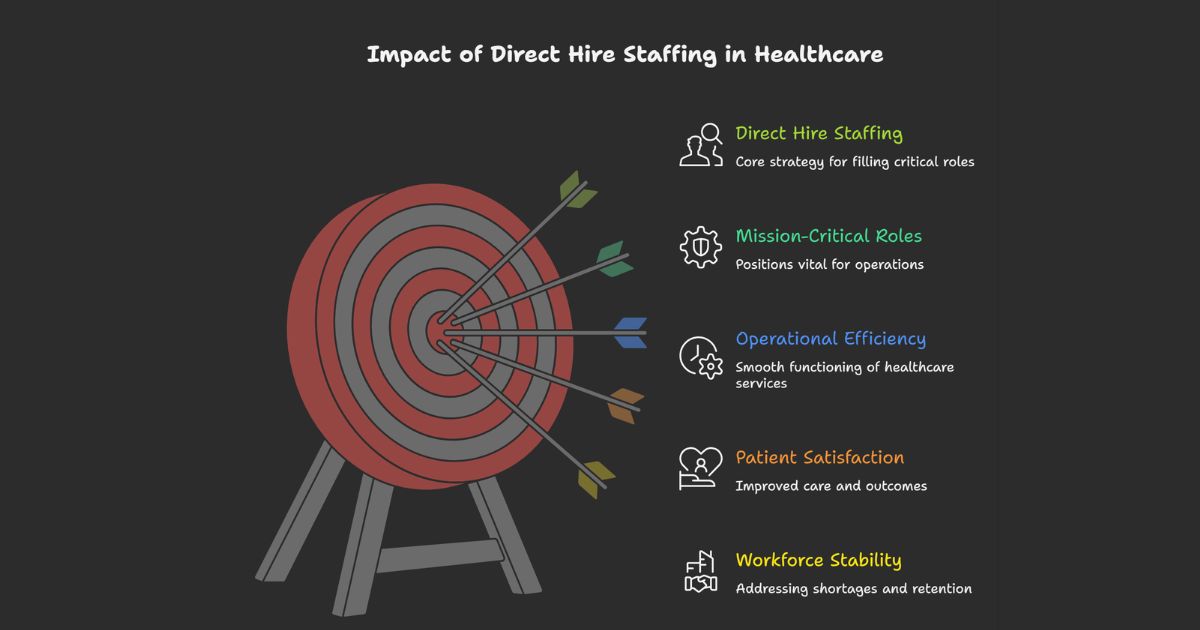
The biggest value of direct hire staffing is not speed alone. It is a better speed. Better speed means hiring fast enough to protect operations, but carefully enough to protect quality. For healthcare organizations, that balance matters more than ever.
Better retention and lower turnover
One of the clearest benefits of direct hire is the chance to improve retention by hiring for long-term fit, not just quick availability. SHRM notes that replacing employees can be costly, with estimates that can range from 50% to 200% of annual salary, depending on the role and level.
In healthcare, where training, credentialing, onboarding, and patient-facing readiness matter, turnover can be especially painful. A strong direct hire process reduces the odds of repeat vacancy cycles.
Stronger culture fit and team alignment
Skills matter, but fit matters too. A clinician may be technically strong and still struggle in a role if the pace, team style, patient population, or communication environment does not match. Direct hire staffing creates space to assess more than a résumé. It lets employers think about schedule realities, documentation expectations, leadership style, and team dynamics before the offer goes out.
Faster access to qualified, pre-screened talent
The right direct hire staffing agency does not start from zero every time. It builds pipelines, networks, role knowledge, and screening systems that help employers meet candidates who are already closer to the mark.
That means fewer weak submissions, fewer dead-end interviews, and better use of hiring manager time. In a market where recruiters are often asked to do more with less, that matters.
Less hiring burden for HR and medical staffing managers
Internal recruiters and HR teams often juggle many openings at once. In healthcare, that load can become even heavier when each role requires licensure checks, credential reviews, references, compliance documentation, and schedule coordination.
A direct hire staffing service takes a large share of that front-end burden off internal teams so they can focus on decision-making, candidate experience, and onboarding quality.
Higher trust through credential and background verification
Trust is not a marketing word in healthcare. It is an operating requirement. Employers need confidence that candidates meet role requirements, licensure expectations, and workplace standards.
A direct hire model works best when screening includes reference checks, license verification, work history review, and role-specific vetting. That does not replace the employer’s own standards, but it helps create a cleaner, safer funnel.
Who Should Use Direct Hire Staffing?
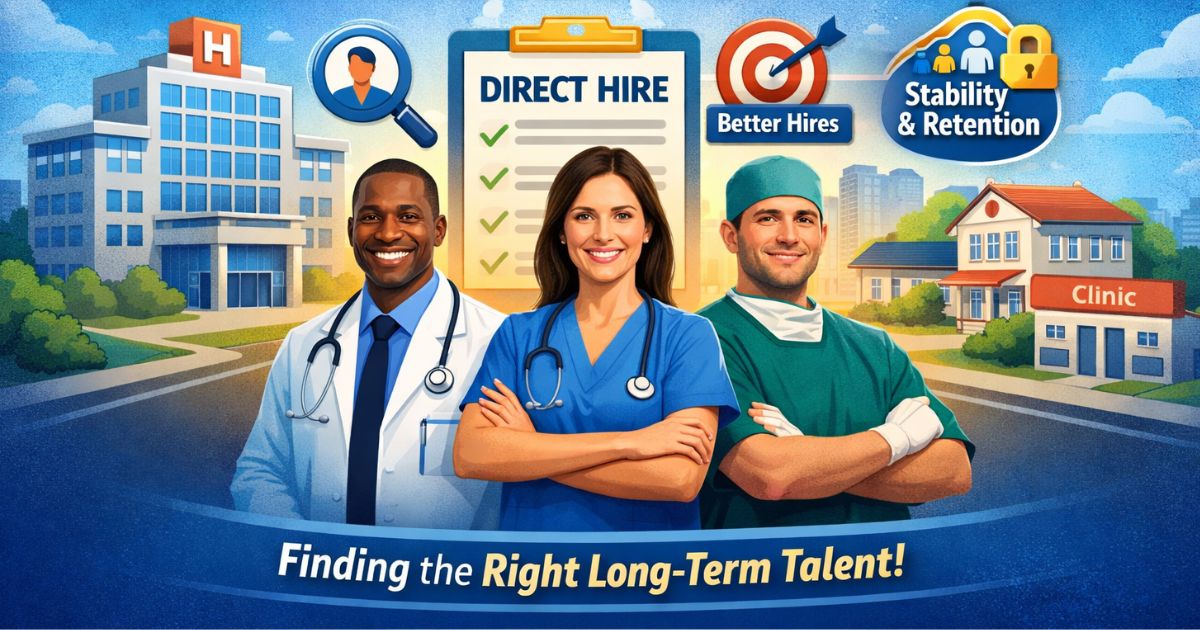
Direct hire staffing is not only for large hospitals. It can be useful anywhere a healthcare organization needs dependable talent in recurring or strategic roles. The question is less about company size and more about hiring goals. If you need stability, retention, and better-fit hires, direct hire is usually worth serious consideration.
Hospitals hiring for recurring full-time openings
Hospitals often need direct hire support for bedside nursing, specialty units, allied roles, lab support, care coordination, and hard-to-fill clinical positions. Since BLS projects large numbers of annual RN openings and HRSA projects ongoing shortages, hospitals that depend only on reactive hiring may struggle to keep pace. Direct hire gives them a more repeatable system for filling core roles.
Clinics and outpatient centers need dependable staff
Outpatient organizations usually need consistency just as much as hospitals do. A reliable medical assistant, front-desk coordinator, therapist, or nurse can shape patient flow, patient satisfaction, provider efficiency, and schedule stability. When one of those roles goes vacant, the entire day can feel like a traffic jam with one blocked lane.
Direct hire helps clinics fill these recurring positions with people built for long-term success.
Long-term care, rehabilitation, and home health organizations
Long-term care and home health settings depend heavily on trust, continuity, and relationship-based care. Rehabilitation organizations also rely on stable scheduling and patient familiarity. In environments like these, repeated turnover hurts more than workflow. It can damage the personal connection that supports good care. That makes direct hire especially valuable.
Healthcare employers are struggling with candidate quality or hiring speed
Sometimes the problem is not a lack of applicants. There are too many weak applicants. If your team spends hours screening people who are unqualified, unavailable, poorly matched, or slow to respond, your recruiting engine is burning fuel without moving the car. A direct hire staffing service can help by improving screening quality, narrowing the pool, and presenting stronger-fit candidates faster.
Common Healthcare Roles Filled Through Direct Hire Staffing
A direct hire staffing model works across a wide range of healthcare positions. The strongest fit is usually for recurring roles where the organization wants long-term reliability, and the employee needs to integrate fully into the team.
Registered nurses and licensed practical nurses
Registered nurses and LPN roles are among the most common direct hire placements because they are central to patient care and often difficult to keep filled. With BLS projecting about 189,100 RN openings each year and HRSA projecting shortages into the future, nurse recruitment remains one of the most important areas where structured direct hire support can help.
Certified nursing assistants and caregivers
CNAs and caregivers help support the daily care experience in hospitals, long-term care, assisted living, and home-based settings. These roles require reliability, empathy, and consistency. A résumé alone rarely tells the full story. Direct hire screening can help employers look at work ethic, communication style, schedule fit, and service mindset, not just availability.
Medical assistants and administrative support roles
Medical assistants, patient coordinators, front-office support staff, and other administrative healthcare employees are often the glue that keeps patient flow moving. When these roles are filled poorly, the patient experience can feel clunky and fragmented.
When they are filled well, visits become smoother, faster, and more organized. That is why these roles deserve careful direct hire attention, too.
Therapists, technicians, and allied health professionals
Allied health staffing is broad and important. It can include therapists, imaging staff, laboratory professionals, technicians, and more. These roles are often specialized enough that employers cannot rely on mass applicant volume.
They need targeted sourcing and smarter screening. A specialized direct-hire staffing service can help employers find those harder-to-reach candidates.
Leadership and hard-to-fill specialized clinical roles
Some openings hurt more than others. Nurse leaders, supervisors, case managers, specialty clinicians, and other experienced professionals can be hard to replace because they carry knowledge, workflow judgment, and team influence.
Direct hire is especially useful here because the cost of a poor fit is not just financial. It can slow departments, weaken morale, and disrupt care quality.
How the Direct Hire Staffing Process Works
A strong direct hire process should feel less like guesswork and more like a clinical workflow: gather the right inputs, assess accurately, move in the correct order, and document clearly. When this process is done well, speed and quality stop fighting each other.
Understanding the employer’s staffing needs
The process starts with intake. This means more than collecting a job title and pay range. A good staffing partner asks what the role really needs.
What skills are required? What shifts matter? What patient population is involved? What has made this role hard to fill before? Why did previous hires leave? This stage is where surface-level recruiting becomes true workforce problem-solving.
Building the job profile and hiring criteria
Once the need is clear, the next step is turning that need into a usable hiring profile. This includes essential qualifications, preferred background, soft skills, schedule requirements, reporting structure, credential needs, and deal-breakers. Too many employers skip this step or keep it vague.
That is like trying to bake a cake with some flour, maybe sugar, and see what happens. Clear criteria improve every step after this.
Sourcing, screening, and shortlisting candidates
This is where a direct hire staffing service earns its value. Sourcing should be targeted, not random. Screening should test more than keyword matches. In healthcare, that means checking role fit, communication, motivation, schedule alignment, patient-facing readiness, and long-term interest.
A shortlist should not just be a stack of names. It should be a curated group of people with a real chance to succeed in the role.
Credential checks, background verification, and compliance review
Healthcare hiring has more moving parts than many other industries. Licensure, certification, references, work history, background screening, and compliance readiness all matter.
The exact requirements vary by role and state, but the principle stays the same: good hiring is not just about “Can this person do the job?” It is also about “Can this person safely, legally, and reliably step into this environment?”
Interview coordination and offer management
Many hiring delays happen after the shortlist is already strong. Schedules drag. Feedback is late. Interviewers disagree. Offers take too long. SHRM notes that time-to-fill remains a major metric, and in healthcare, delay can mean losing top candidates to faster employers.
Direct hire staffing works best when interview steps are simple, decision-makers are aligned, and communication is fast.
Onboarding support for a smoother start
The hiring process does not end at “yes.” A direct hire placement is strongest when onboarding is organized, timely, and human. A messy start can turn a good hire into a shaky one. Employers should make sure paperwork, orientation, communication, and first-week expectations are clear so the new employee starts with confidence rather than confusion.
Direct Hire Staffing vs. Other Healthcare Staffing Models
Healthcare employers often use more than one staffing model. That is not a weakness. It is usually smart. The goal is not to choose one model forever. The goal is to match the model to the problem.
Direct hire vs. temporary staffing
Temporary staffing is excellent for urgent coverage, seasonal spikes, leave coverage, and short-term uncertainty. Direct hire is better for roles that are part of your long-term operating model. If a role keeps reopening every few months, that is often a sign the organization needs a stronger permanent hiring strategy, not another short-term patch.
Direct hire vs. contract staffing
Contract staffing can be a useful middle ground when a role has a known end date or when employers want flexibility before committing long-term. Direct hire is the better fit when the need is ongoing, and the organization wants to invest in retention, culture fit, and internal team growth. Contract staffing is a tool. Direct hire is an investment.
Direct hire vs. per diem staffing
Per diem models are valuable when patient volume shifts often and schedule agility matters more than long-term continuity. But per diem staffing usually does not solve underlying retention or workforce design problems. If the organization keeps leaning on per diem for roles that are truly permanent, it may be masking a deeper hiring issue.
When to choose each model based on hiring goals
Choose direct hire when the role is recurring, core to operations, hard to refill, or closely tied to patient continuity and team stability. Choose temporary or per diem when you need coverage flexibility, not a permanent addition. Choose contract staffing when the role has a fixed timeline or when there is still uncertainty about long-term structure.
The smartest employers do not ask, “Which model is best?” They ask, “Which model is best for this role, at this time, with this level of urgency?”
Signs Your Healthcare Organization Needs a Direct Hire Partner
Sometimes the need for a direct hire partner is obvious. Other times it hides in daily frustration. If your hiring team feels like it is working hard but not getting ahead, it may be time to change the system, not just work longer inside it.
Open roles stay vacant too long
If roles stay open for weeks or months, your costs are probably rising in ways that do not show up clearly on a spreadsheet. Overtime grows. Leaders get pulled into recruiting. Team morale falls. Candidate experience weakens. And in healthcare, patient access can suffer when capacity is constrained. That is often a sign you need specialized support.
Too many unqualified applicants slow down hiring
Applicant volume is not the same as hiring progress. If your team is buried under résumés from people who do not meet basic role requirements, your funnel is clogged. A direct hire staffing service can help filter earlier and better so your hiring managers spend time on qualified people, not paperwork.
Internal recruiters are overloaded
Healthcare recruiters often manage large requisition loads, complex credentialing requirements, and constant urgency from department leaders. When the load gets too heavy, quality can drop even when effort stays high. External direct hire support can reduce that pressure and improve execution.
Retention issues suggest poor candidate fit
If people leave quickly after being hired, the issue may not be compensation alone. It may be role clarity, schedule mismatch, culture mismatch, leadership mismatch, or poor pre-hire screening. Direct hire is not magic, but it gives employers a better chance to diagnose and solve these fit problems before the offer is signed.
What to Look for in a Direct Hire Staffing Agency
Not every staffing partner is built for healthcare. And not every healthcare recruiter is built for the kinds of roles you need to fill. Choosing the right partner matters. A weak partner adds noise. A strong partner adds traction.
Healthcare market expertise and role-specific knowledge
You want a partner who understands the difference between similar-sounding roles, knows how credentialing affects timelines, and can speak to hiring managers with credibility. In healthcare, role knowledge is not a “nice to have.” It is the foundation for accurate sourcing and screening.
Strong candidate screening and verification standards
Ask how the agency screens. Do they verify licenses? Review employment history? Check references? Explore shift fit? Evaluate communication? Confirm interest level? A true direct hire staffing service should make your shortlist cleaner, not just larger.
Clear communication and hiring transparency
A good staffing partner should communicate like a strong clinical teammate: clearly, quickly, and without surprises. You should know what the market looks like, what candidate objections are appearing, how long the search may take, and where bottlenecks are forming. Poor communication turns recruiting into fog. Good communication turns it into a map.
Speed, responsiveness, and quality of the shortlist
Fast is not enough. Fast and wrong is still wrong. The right agency moves quickly while protecting quality. That means fewer weak submissions, better candidate follow-up, and more disciplined shortlist curation. If the first three candidates are all obviously off-target, the problem is not the market. It is the process.
Ability to support niche and high-demand healthcare roles
Many healthcare roles are straightforward to define but hard to fill. Others are hard to define and even harder to fill. Your staffing partner should be able to support both common and specialized searches, especially if your organization hires across nursing, allied health, support, and leadership functions.
Cost of Direct Hire Staffing: What Employers Should Expect
Many employers ask the same question first: “What does direct hire staffing cost?” That is a fair question. But it is incomplete. A better question is, “What does not solving this vacancy cost us?”
How pricing typically works
Direct hire staffing fees are often structured around a placement fee model, though exact pricing varies by market, role difficulty, seniority, urgency, and guarantee terms. The agency does the work of sourcing, screening, and presenting candidates, and the employer pays when a hire is made or under another agreed-upon structure.
What matters most is not the fee alone, but what work the fee replaces and what risk it reduces.
Why should the cost be weighed against vacancy loss and turnover?
A vacant healthcare role creates operational cost, emotional cost, and service cost. Teams work harder. Overtime grows. Leaders spend more time interviewing. Patients may wait longer. And if the eventual hire is poor, the cycle begins again. SHRM’s turnover and recruitment cost guidance highlights how expensive hiring mistakes can become.
In many cases, the real cost is not the placement fee. It is the slow, repeated drain of vacancy and replacement.
The value of making the right hire the first time
A strong direct hire decision creates value beyond the job description. It supports smoother scheduling, stronger morale, better patient experience, lower recruiter strain, and less disruption. It also helps leaders focus on service, growth, and operations rather than living inside the hiring loop. The right hire is not just a filled seat. It is a restored system.
Challenges in Direct Hire Staffing and How to Solve Them
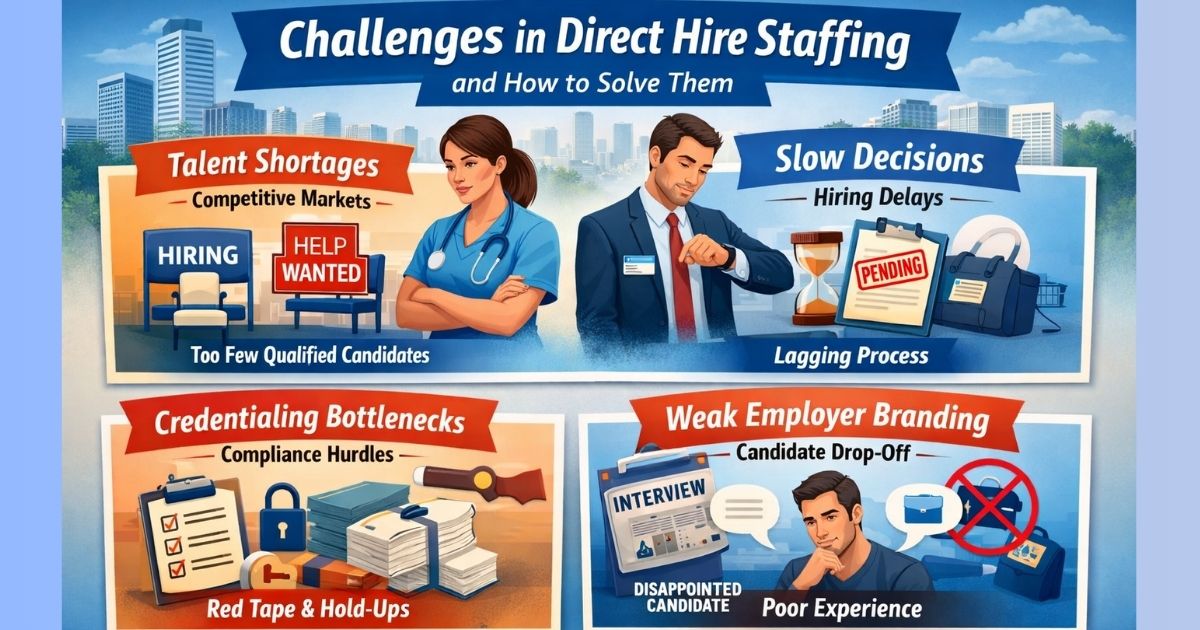
Direct hire staffing is powerful, but it is not effortless. Healthcare hiring has real obstacles, and strong employers face them directly instead of pretending they are not there.
Talent shortages in competitive markets
In many markets, there are simply not enough qualified professionals to meet demand. HRSA’s projections and NCSBN workforce data both point to continued pressure in the nursing supply. That means employers must compete on more than pay alone. Role clarity, responsiveness, schedule design, culture, onboarding quality, and employer reputation all matter.
Slow internal decision-making
Many employers lose strong candidates not because the shortlist was weak, but because the process was slow. Interviewers were not aligned. Feedback came late. Offers sat in approval. In a tight labor market, delay is often the same as rejection. The solution is simple to say and harder to do: fewer steps, faster feedback, and clear decision ownership.
Credentialing delays and compliance bottlenecks
Healthcare cannot ignore compliance, nor should it. But unclear processes, repeated document requests, or poor coordination can make the hiring path feel longer than it needs to be. One of the best fixes is building a defined pre-hire checklist and assigning clear ownership for each stage. A good process reduces delay without lowering standards.
Weak employer branding and candidate drop-off
Candidates evaluate employers, too. If communication is slow, job details are vague, or the interview experience feels disorganized, good candidates may walk away. The solution is not fancy branding language. It is a better candidate experience: clear outreach, honest expectations, respect for time, and timely follow-up.
Best Practices to Improve Direct Hire Results in Healthcare
The best employers treat hiring like patient care: they use standards, they reduce preventable errors, and they review results honestly. That mindset improves direct hire outcomes.
Write clearer job descriptions and must-have criteria
A vague role attracts vague applicants. A clear role attracts closer matches. Strong job descriptions explain duties, schedule, work setting, essential qualifications, certifications, reporting lines, and success expectations. The clearer the role, the cleaner the funnel.
Speed up interview scheduling and feedback loops
If your process takes too long, even good sourcing will not save it. Set interview blocks in advance. Decide who signs off. Limit avoidable rounds. Give feedback quickly. A hiring process should move like an ambulance, not a parade. Urgency does not mean recklessness. It means clear motion.
Prioritize candidate experience and communication
People remember how employers make them feel during the hiring process. Respect, clarity, and responsiveness matter. A candidate who feels informed is more likely to stay engaged. A candidate who feels ignored is more likely to disappear. That principle applies across nursing, allied health, caregiving, and support roles.
Align hiring with long-term workforce goals
Do not treat each opening like an isolated event. Look for patterns. Which roles reopen often? Which departments struggle most with turnover? Which shifts are hard to staff? Which managers lose candidates late? Direct hire works best when it is tied to workforce planning, not only emergency response.
Partner with a specialized healthcare staffing expert
A specialized partner can help employers see blind spots, adjust job-market expectations, improve candidate flow, and tighten the screening process. For organizations that need dependable nurses, caregivers, therapists, medical assistants, and other clinical professionals, a healthcare-specific staffing partner usually delivers better results than a generalist approach.
How Direct Hire Staffing Supports Better Patient Care
Patient care and staffing strategy are deeply connected. They are not the same thing, but they influence each other every day. AHRQ’s definition of care coordination makes that clear: safe and effective care depends on organized activities and the right information reaching the right people at the right time. Stable teams support that environment.
The connection between staffing stability and care quality
When teams are stable, communication tends to be cleaner, handoffs smoother, and workflows more familiar. That does not guarantee perfect care, but it reduces avoidable friction. It is much easier to run a reliable unit when the people in it know the systems, know the expectations, and know each other.
How dependable hiring reduces burnout on current teams
The Surgeon General’s materials on health worker burnout make clear that heavy workloads and workforce strain contribute to burnout and can drive health workers out of the profession. When employers fill core roles well and reduce chronic understaffing, they are not just plugging holes. They are protecting the people already carrying the load.
Why the right clinical fit improves patient trust and outcomes
Patients notice consistency. They notice when teams communicate well, when care feels coordinated, and when staff seem present instead of stretched thin. The right hire strengthens that experience. Over time, enough right hires can change the feel of an entire department. That is why direct hire staffing matters far beyond recruitment metrics.
How Bluebix Health Can Help Healthcare Employers
For healthcare employers, the value of a staffing partner is not just in finding candidates. It is in reducing noise, improving trust, and helping teams hire with more confidence.
BluebixHealth can support organizations that need qualified nurses, caregivers, medical assistants, therapists, and other clinical professionals by helping streamline sourcing, screening, and communication around direct hire needs.
For employers that value speed, verified talent, and easier hiring workflows, that kind of support can make the process feel less chaotic and more controlled.
A strong direct hire staffing service should help any healthcare company in three simple ways. First, it should save time by reducing weak applications and narrowing the shortlist. Second, it should improve quality by screening for role fit, schedule fit, and long-term interest.
Third, it should support trust by helping employers move through hiring with clearer communication and stronger candidate insight. Those are practical benefits, not buzzwords.
For organizations that are tired of repeated vacancies, rushed interviews, and preventable turnover, Bluebix Health’s value is in helping create a smoother, more dependable recruiting path.
In a market shaped by ongoing demand, workforce shortages, and burnout pressure, employers need hiring partners that understand the stakes.
Conclusion: Is Direct Hire Staffing the Right Solution for Your Organization?
If your healthcare organization needs long-term staff, recurring clinical coverage, better candidate quality, and a more stable team, direct hire staffing is often the right solution. It is especially useful when open roles keep returning, internal recruiters are stretched thin, candidate quality is inconsistent, or turnover keeps undoing your progress. In those cases, the goal is not merely to hire faster. It is to hire smarter.
The healthcare labor market remains under pressure. BLS projects large annual openings for nurses and healthcare occupations, HRSA projects ongoing shortages in nursing, and federal sources continue to highlight the impact of workforce strain and burnout on access and care delivery. That means every employer should think carefully about how permanent roles are filled and supported.
A good direct hire strategy helps you move from reactive staffing to intentional workforce building. It helps you reduce vacancy pressure, improve long-term fit, support stronger care continuity, and give your internal team room to breathe. And when the right staffing partner is involved, the hiring process becomes less like a fire drill and more like a well-run system.
If your organization is ready to build a stronger healthcare workforce, Bluebix Health can help you move beyond rushed hiring and toward a more reliable, better-screened, and more strategic approach. The right hire does more than fill a role. The right hire supports your team, your patients, and your future.
10 FAQ Section
What does direct hire staffing mean in healthcare?
Direct hire staffing means recruiting healthcare professionals for permanent or long-term positions within an organization. Instead of filling shifts temporarily, employers hire candidates as part of their regular workforce. This model helps build consistency, improve retention, and support stronger patient care across hospitals, clinics, and care facilities over time.
How is direct hire staffing different from temporary healthcare staffing?
Temporary staffing fills short-term gaps, urgent shifts, or seasonal demand. Direct hire staffing focuses on full-time or long-term placements that become part of the employer’s internal team. Healthcare employers choose direct hire when they want stability, a stronger culture fit, and reduced turnover rather than only immediate short-term coverage needs.
Is direct-hire staffing a good option for hiring nurses?
Yes. Direct hire staffing is often a strong option for registered nurses, licensed practical nurses, and specialty nursing roles when employers want long-term retention and dependable care delivery. It helps organizations find screened, qualified candidates who match schedule needs, clinical expectations, and team culture instead of only filling temporary gaps.
What types of healthcare facilities benefit most from direct hire staffing?
Hospitals, outpatient clinics, long-term care centers, rehabilitation facilities, home health agencies, and specialty practices can all benefit. It is especially useful for organizations with recurring vacancies, growth plans, or hard-to-fill roles where hiring the right long-term employee matters more than simply covering shifts for a short period.
Can direct hire staffing help reduce employee turnover?
Yes. A strong direct hire process improves retention by focusing on candidate quality, job fit, work expectations, and organizational culture. When healthcare employers hire more intentionally, they reduce costly turnover, improve team morale, and create a more stable staffing environment that supports both workers and patient care performance.
What should a healthcare employer look for in a direct hire staffing agency?
Look for healthcare-specific expertise, proven screening methods, credential verification, responsive communication, and success in filling similar roles. A strong agency should understand clinical hiring challenges, move quickly without sacrificing quality, and provide a shortlist of candidates who are qualified, reliable, and aligned with the employer’s staffing goals and values.
Does direct hire staffing only work for large hospitals?
No. Smaller clinics, physician groups, surgical centers, home health providers, and long-term care organizations also use direct hire staffing. Any healthcare employer that needs dependable full-time staff, better hiring efficiency, or improved candidate quality can benefit from a direct hire approach, regardless of organization size or hiring volume.
How long does the direct hire staffing process usually take?
The timeline depends on the role, market conditions, licensing needs, interview speed, and decision-making process. Some roles move quickly, while specialized healthcare positions take longer. Employers often shorten hiring time by using a staffing partner that pre-screens candidates, verifies credentials, and keeps communication moving throughout the recruitment process.
Is direct hire staffing worth the cost for healthcare organizations?
Often, yes. While there is a recruitment cost, the value comes from reducing vacancy time, lowering turnover, improving candidate quality, and saving internal team resources. For many healthcare employers, the long-term return is stronger than the cost of repeated hiring delays, poor-fit employees, or overworked internal recruitment teams.
How does direct hire staffing support better patient care?
Better hiring leads to more consistent staffing, less burnout, and stronger team collaboration. When healthcare organizations place qualified professionals in long-term roles, they improve continuity of care and reduce disruption. That stability can positively affect patient experience, operational efficiency, and trust in the care team across the organization.