
7 Essential Allied Health Staffing Solutions for Better Hiring
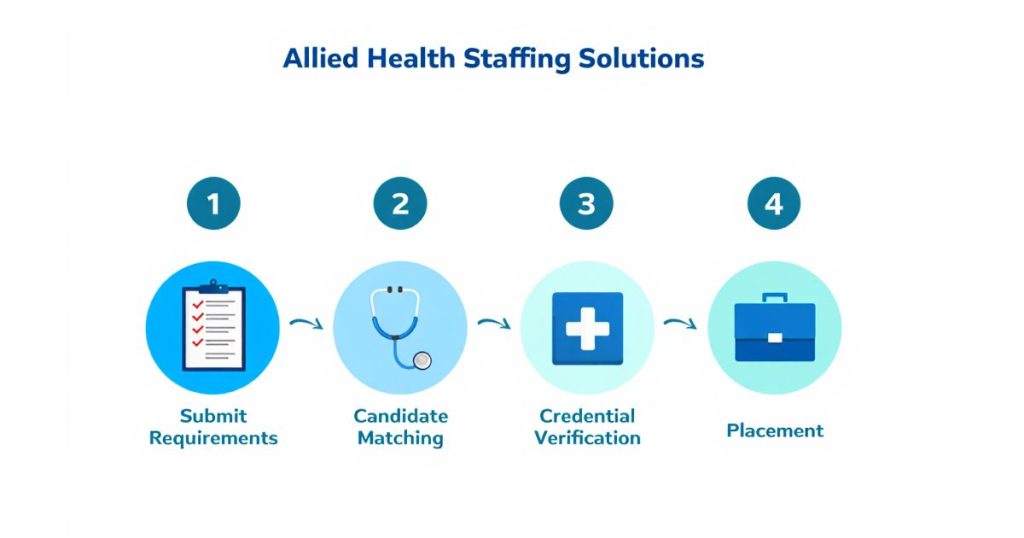
Allied health staffing solutions help healthcare employers hire qualified clinical support staff fast without skipping credentialing, skills validation, or compliance. In real life, that means fewer canceled appointments, fewer open shifts, and fewer we’ll figure it out moments that burn out your best people.
The goal isn’t just speed, it’s verified speed. When you have a reliable talent pipeline, clear communication, and a credentialing workflow that doesn’t stall, you protect patient care and stabilize your schedule. In the sections ahead, you’ll learn what allied health staffing is, who it covers, how it works end-to-end, and how to choose a partner you can trust.
2. What Are Allied Health Staffing Solutions?
Allied health staffing solutions are workforce services that help you recruit, screen, credential, and place allied health professionals and clinical support staff. That can be a single role (like a radiologic technologist) or an ongoing pipeline across multiple sites.
2.1 PRN, contract, temp, and permanent
Most employers use one or more of these models:
- Per diem / PRN staffing: shift-based coverage for schedule gaps, sick calls, or seasonal spikes (high-intent keywords: per diem staffing, PRN coverage).
- Contract staffing: a fixed-term assignment to stabilize coverage during vacancies, expansion, or leave (high-intent keywords: contract staffing, travel allied health).
- Temp-to-perm: “try-before-you-hire” when you want a real-world fit check.
- Direct hire / permanent placement: when you need a long-term team member and want sourcing muscle.
2.2 How allied health differs from nursing staffing
Allied health hiring often runs into a different set of hurdles:
- Narrow specialty requirements (modality, setting, patient type)
- Role-specific competencies (equipment, workflows, safety protocols)
- Credential variations (state licenses, registries, certifications)
In other words, nursing shortages hurt, but allied health gaps can quietly shut down entire service lines, imaging, rehab, respiratory, and labs, because those skills aren’t interchangeable.
2.3 Typical care settings served
Allied health staffing supports:
- Acute care hospitals (ED, ICU support, imaging, respiratory)
- Rehab and therapy centers (PT/OT/SLP, aides)
- Outpatient clinics (medical assistants, imaging techs, therapy)
- Long-term care and skilled nursing (therapy, respiratory, support roles)
3. Who Counts as Allied Health? Roles & Specialties to Know
Allied health is a big umbrella. A practical way to think about it: licensed or certified roles that support diagnosis, treatment, therapy, and patient function—often outside of RN/MD tracks.
Here’s a role map you can use when planning coverage.
3.1 Therapy & rehab roles (rehabilitation staffing)
- Physical Therapists (PT) and PT Assistants
- Occupational Therapists (OT) and OT Assistants
- Speech-Language Pathologists (SLP)
Demand stays strong: PT employment is projected to grow 11% (2024–2034) with ~13,200 openings per year.
OT is projected to grow 14% with ~10,200 openings per year.
3.2 Imaging & diagnostics (diagnostic imaging staffing)
- Radiologic and MRI Technologists
- Ultrasound Techs
- CT/MRI modality specialists
Radiologic and MRI technologists show ~15,400 openings per year on average (2024–2034).
3.3 Lab & respiratory (lab staffing)
- Clinical laboratory technologists/technicians
- Phlebotomy
- Respiratory Therapists
Respiratory therapist demand is projected at 12% growth (2024–2034) with ~8,800 openings per year.
3.4 Ambulatory & support (clinical support roles)
- Medical Assistants
- Patient care techs
- Surgical tech support (where applicable)
Medical assistants alone show very high churn + volume: ~112,300 openings per year on average (2024–2034).
Quick original demand pressure snapshot: If you add just five common allied roles—MA, Rad/MRI, PT, OT, and RT you’re looking at roughly 160,000 openings per year across those categories. That’s not a recruiting problem. That’s a systems problem, and it’s exactly why staffing solutions have become strategic, not optional.
4. The Real Problem: Why Allied Health Hiring Breaks Down (What You’re Really Trying to Fix)
When employers say, We can’t find people, what they often mean is:
- We can’t find qualified people fast enough.
- We can’t get them through credentialing on time.
- We can’t keep them engaged long enough to start.
Let’s break down why.
4.1 Hidden costs of vacancies
Open allied health positions don’t just create inconvenience. They create:
- Reduced throughput (fewer procedures, fewer visits, longer wait times)
- Overtime strain (more OT, more fatigue)
- Service line risk (imaging backlogs, delayed discharges without therapy)
Workforce strain is widely recognized as a serious operational issue. The American Hospital Association describes workforce challenges as a national emergency driven by factors like an aging workforce and pandemic stress.
4.2 The quality vs. speed tension
Rushed hiring causes silent failure. The person starts, struggles, quits—or worse, creates a safety risk. Speed matters, but the real win is speed with proof:
- clear competency match
- verified credentials
- start-ready documentation
4.3 Credentialing bottlenecks
Credentialing often becomes the bottleneck because it’s built like a relay race: recruiting hands off to compliance, compliance hands off to managers, managers hand off to onboarding. Each handoff is a delay.
A strong staffing solution runs credentialing like a parallel workflow (more on that in Section 7).
4.4 Communication gaps
When candidates don’t know what’s happening, they drift. When managers don’t know what’s coming, they lose confidence. And when HR doesn’t have visibility, everything feels urgent.
Some research points to communication gaps as a driver of drop-off; for example, Aptitude Research has highlighted candidate drop-off at the apply phase and the role communication can play.
5. Benefits of Allied Health Staffing Solutions (Why It Works)
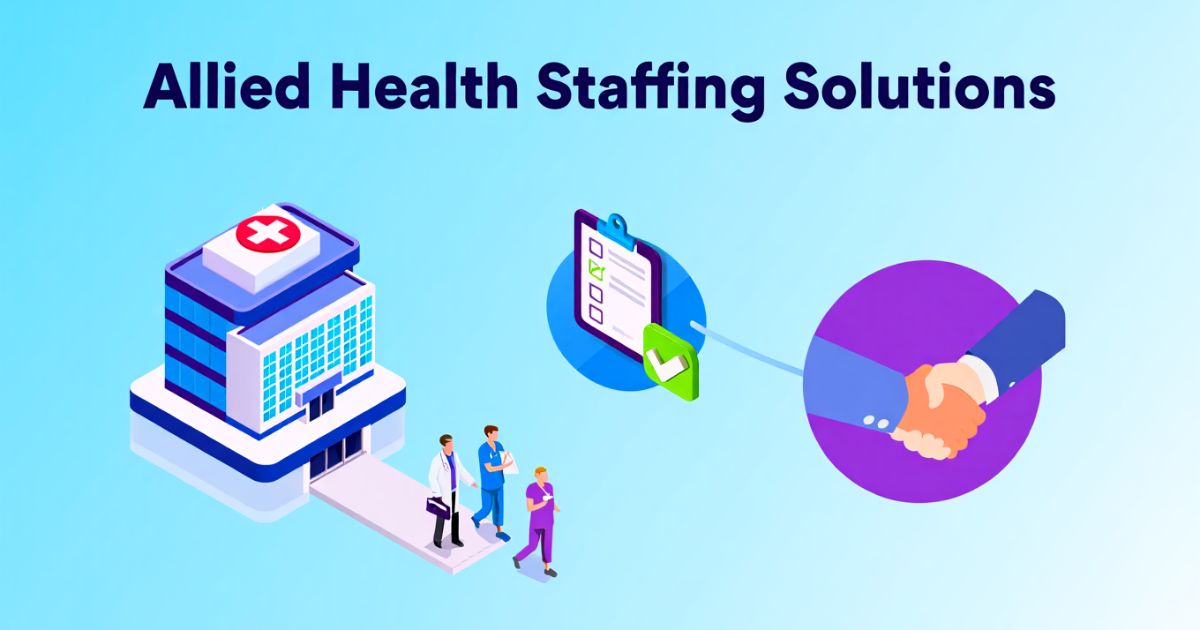
A staffing solution should feel like adding a well-trained pit crew to your hiring team, fast, precise, and repeatable.
5.1 Faster time-to-fill with ready pipelines
When a partner maintains curated talent pools, you don’t start from zero. You start from Here are three start-ready candidates who match your modality, shift, and setting.
5.2 Better quality through specialty screening
Great allied health screening looks like:
- role-specific questions (equipment, workflows, patient populations)
- scenario checks ( What do you do when)
- Reference validation focused on real performance (not generic praise)
5.3 Flex coverage models for real-world demand
Allied health demand isn’t steady—it spikes:
- seasonal peaks
- outpatient surges
- expansions
- leave coverage
PRN coverage gives you elasticity. Contract staffing gives stability. A hybrid approach gives both.
5.4 Reduced compliance risk
Healthcare compliance isn’t a nice-to-have. BLS data also shows how wide the wage bands and occupational mix are in healthcare, which affects screening and expectations across role types.
A healthcare staffing solution that documents verification (not just promises it) reduces risk.
5.5 Better hiring manager experience
Hiring managers want two things:
- qualified options
- clear communication
A single point of contact and consistent updates turn hiring from chaos into a dashboard.
6. Types of Allied Health Staffing Models (Choose the Right Fit)
Choosing the right staffing model is like choosing the right tool: a screwdriver can’t replace a wrench.
6.1 Per diem / PRN staffing
Best for:
- same-day gaps
- weekend coverage
- unpredictable call-outs
- surge clinics
6.2 Contract/travel allied staffing
Best for:
- longer coverage windows
- hard-to-fill specialties
- multi-site stabilization
6.3 Temp-to-perm (try-before-you-hire)
Best for:
- culture/fit-sensitive roles
- leadership-heavy outpatient teams
- High-turnover departments where you want proof before commitment
6.4 Direct hire / permanent placement
Best for:
- leadership roles
- niche specialties
- long-term growth plans
6.5 Managed programs (MSP/VMS)
If you work with multiple staffing vendors, a managed program can help standardize approvals, costs, and compliance tracking. A VMS is commonly described as the software layer that centralizes contingent workforce management.
6.6 Hybrid approach (recommended for multi-site employers)
Most healthcare organizations do best with:
- PRN bench for spikes
- contract coverage for stability
- direct hire for core team growth
7. How Allied Health Staffing Works: End-to-End Process (Step-by-Step)

Here’s the process that consistently produces fast, high-quality starts.
7.1 Intake & role calibration (must-have vs. nice-to-have)
The intake call is not paperwork—it’s strategy.
A simple skill-matrix approach:
- Must-have (license, modality, years, setting)
- Need-to-have (EHR, patient mix, shift)
- Nice-to-have (extra certs, float ability)
This prevents the #1 time-waster: vague requirements that invite wrong submissions.
7.2 Sourcing strategy by specialty
Sourcing isn’t one thing. It changes by role:
- Imaging often needs modality-specific targeting
- Therapy needs setting-fit (acute vs outpatient vs SNF)
- Medical assistants need speed + retention screening
7.3 Screening & clinical validation
Use a short, repeatable structure:
- 10-minute fit & logistics screen
- 15-minute clinical scenario screen
- reference check aimed at reliability + competence
7.4 Credentialing & compliance checklist (start-ready workflow)
Credentialing should run like a checklist you can audit—not a folder you hope is complete.
The Joint Commission defines primary source verification as verification of reported qualifications by the original source (or approved agent), with methods like direct correspondence, documented phone verification, or secure electronic verification.
7.5 Interview coordination + fast offers
Speed is a competitive advantage. Benchmarks vary, but healthcare time-to-hire is often measured in weeks, not days; for example, SmartRecruiters reports a median time to hire in healthcare of 41 days in its benchmark discussion.
Your edge comes from:
- pre-booked interview blocks
- same-day feedback expectations
- offer-ready packages (pay, shift, start date)
7.6 Onboarding + first-shift success plan
First-shift success is where retention begins:
- Confirm the schedule 72 hours before the start
- Send Day 1 map (location, contact, arrival time)
- ensure access (badge, system logins, EHR basics)
7.7 Ongoing check-ins & performance loop
A simple retention:
- Day 3 check-in
- Week 2 check-in
- Day 30 review with manager feedback
The workforce scan highlights the need to support workers and invest in training pathways and programs that bridge education to practice.
8. Credentialing & Compliance: What Verified Should Mean
Verified should mean you can answer: Would we pass an audit with this file?
8.1 Non-negotiables
At a minimum, validated documentation for:
- license/certification (and expiration)
- education (where required)
- relevant experience verification
8.2 Background checks & drug screens (real-world reality)
Facilities and states vary. The safest approach is to set a facility standard and require your staffing partner to meet it consistently (and document it).
8.3 Clinical competencies & skills checklists
A competency checklist should be role-specific:
- imaging: modality + safety workflows
- therapy: setting-specific caseload handling
- medical assistants: vitals, injections (where allowed), EHR workflow
8.4 Health requirements (TB, vaccines, fit testing)
Treat these like boarding passes. Without them, the start date slips.
8.5 Documentation + audit readiness
If a partner says they’re good, ask for the proof:
- credential checklist status
- PSV confirmation was required
- completed onboarding documents
9. How to Choose the Right Allied Health Staffing Partner (Buyer’s Guide)

You’re not buying resumes. You’re buying reliability.
9.1 Questions to ask before signing
Ask for specifics:
- How do you validate competencies for this role?
- What’s your average time-to-submit for imaging/therapy/MA?
- Show me what a complete credential file looks like.
9.2 What strong partners do differently
Strong partners:
- recruit by specialty (not any clinical role)
- move credentialing in parallel
- communicate like a project manager
- Use scorecards and SLAs
9.3 SLAs that matter
Include:
- time-to-submit (how fast they send qualified candidates)
- time-to-start (how fast they get someone start-ready)
- fill rate (how often shifts/roles are actually filled)
- no-show rate
- credentialing cycle time
9.4 Red flags
Watch for:
- unclear credentialing steps
- slow response times
- high early turnover with no root-cause analysis
- Spray and pray submissions that waste the manager’s time
9.5 Partner scorecard template (quick checklist)
Use a simple 1–5 rating across:
- Specialty screening quality
- Credentialing completeness
- Communication speed
- Start success rate
- Reporting transparency
10. What Employers Need to Understand
Staffing costs feel high when you only look at the invoice.
10.1 Common pricing models
- hourly bill rates for PRN/contract
- placement fees for direct hire
- conversion terms for temp-to-perm
10.2 What drives rates
Rates typically move with:
- specialty scarcity
- shift difficulty (nights/weekends)
- location
- urgency (last-minute coverage costs more)
10.3 Simple ROI math (original framework)
Use a basic vacancy cost estimate:
Vacancy cost per week ≈ (lost visits/procedures × margin) + overtime premium + manager time
Example (simple illustration):
- 10 missed therapy visits/week × $120 margin = $1,200
- OT premium hours = $800
- manager/admin drag = $300
Total ≈ $2,300/week
If staffing fills that gap faster, the ROI is often obvious, especially when healthcare job openings are projected at scale, and replacement demand is steady. If you are looking for Staffing companies plese read this blog top healthcare staffing company that will help you.
10.4 Contract terms that protect you
Look for:
- replacement policy
- clear conversion terms
- documented compliance standards
- performance reporting cadence
11. Technology That Makes Staffing Faster (Without Sacrificing Quality)

Technology should reduce friction, not add steps.
11.1 Speed enablers: ATS + talent pools
A strong ATS + segmented pools lets teams move from post and pray to “match and move.
11.2 Credentialing tech: digital document collection
Digital workflows help prevent the missing document spiral that delays starts.
11.3 Communication: SMS/email workflows
Fast, clear updates reduce candidate drift, especially between the interview and start.
11.4 Reporting dashboards
You want visibility into:
- where candidates are stuck (screening vs credentialing vs onboarding)
- time-to-start trends by role and site
12. KPIs to Track: How to Measure Staffing Success

If you only track roles filled, you miss the story.
12.1 Core metrics
- time-to-submit
- time-to-fill
- interview-to-offer
- offer-to-start
12.2 Quality metrics
- 30/90-day retention
- Manager satisfaction score
- incident/complaint signals (early warnings)
12.3 Efficiency metrics
- credentialing cycle time
- no-show rate
- rework rate (how often you reject submissions)
12.4 Monthly review cadence
Set a monthly 30-minute review with your partner:
- what improved
- What slowed down
- What roles need a deeper pipeline
13. Implementation Playbook: Roll Out Allied Health Staffing Solutions in 30–60 Days
This rollout is designed for busy staffing managers who need traction quickly.
13.1 Audit needs by specialty + site
List:
- top 10 hardest roles
- The highest overtime departments
- shifts with repeat gaps
13.2 Prioritize roles: urgent vs pipeline-build
Split roles into:
- Urgent: needs coverage in days/weeks
- Pipeline-build: needs continuous sourcing + retention focus
13.3 Standardize job intake forms
A one-page intake form cuts confusion:
- must-haves
- shift + schedule
- setting + patient mix
- start date target
- pay range (even a band)
13.4 Set compliance standards + turnaround targets
Write it down:
- required documents
- PSV requirements
- turnaround for each step
AHA Hospital workforce guidance emphasizes redesigning workforce models and investing in supportive strategies to stabilize teams. Your standards are part of that stability.
13.5 Launch, iterate, and scale
Run a 2-week pilot:
- pick 2–3 roles
- track time-to-submit and time-to-start
- Tighten intake based on submission quality
Then scale to other departments.
14. Common Mistakes (and How to Avoid Them)
14.1 Vague requirements → wrong submissions
Fix: role calibration + must-have list.
14.2 Slow feedback → candidate loss
Fix: 24–48 hour feedback rule with escalation.
14.3 Credentialing as “after sourcing.”
Fix: run credentialing in parallel.
14.4 No post-start support → early turnover
Fix: Day 3 + Week 2 check-ins.
15. Conclusion + Next Step
Allied health staffing solutions work when they deliver three outcomes at the same time: speed, trust, and start-ready verification. The demand landscape isn’t slowing; healthcare occupations overall are projected to keep generating massive openings each year, and many allied roles show strong replacement demand.
If your team is tired of urgent hiring that feels like firefighting, make the next step simple
FAQ
What’s the difference between “licensed” and “start-ready” in allied health staffing?
Licensed means they hold the credential. Start-ready means they’re cleared to work: license verified, background and health requirements completed, competencies matched, schedule confirmed, and onboarding done. Start-ready is the difference between “good on paper” and “actually on the floor Monday.”
How do I reduce cancellations in outpatient therapy caused by staffing gaps?
Treat therapy coverage like inventory: forecast demand by day and hour, build a PRN bench for predictable spikes, and lock a contract therapist for chronic gaps. Track missed visits weekly. If missed visits rise for two weeks, trigger pipeline-building immediately.
Why do imaging roles feel harder to fill than other allied jobs?
Imaging roles often require modality-specific skills, strict safety workflows, and familiarity with your equipment and pace. The candidate pool can be smaller, and credentialing often involves multiple verifications. The fix is specialty screening plus a standing pipeline—not last-minute sourcing.
What’s the simplest way to speed up credentialing without increasing risk?
Run it in parallel. The moment a candidate passes screening, start document collection and verification while interviews are scheduled. Use a checklist and one owner for follow-ups. You’re not skipping steps—you’re removing dead time between steps.
How should I write a job request so agencies send better candidates?
Use a “must-have / need-to-have” format. Must-have: license, setting, modality, shift. Need-to-have: EHR, patient mix, weekend rotation. Add the top two reasons people quit this role and what you’re doing to prevent it. Clarity attracts better matches.
What’s an SLA metric most employers forget—but shouldn’t?
Credentialing cycle time. Many teams track time-to-fill but ignore how long compliance takes. If credentialing adds 10–14 days, your “fast hiring” isn’t fast. Track it separately and require weekly reporting by role type so you can fix the bottleneck.
How do I compare two staffing partners without getting fooled by fancy promises?
Give both the same role with the same timeline. Compare: quality of the first three submissions, completeness of credential files, response time, and how they handle declines. The best partner isn’t the one with the best pitch—it’s the one with the cleanest process.
What causes candidates to disappear after a great interview?
Usually, there are uncertainties and delays: unclear start dates, slow offers, confusing onboarding, or poor communication. Tighten the offer timeline, confirm schedules early, and assign one person to keep the candidate informed. Silence is the fastest way to lose a good hire.
How can staffing solutions support retention, not just filling shifts?
Retention improves when placements match the real job: pace, setting, shift load, and expectations. Add post-start check-ins, early manager feedback, and quick fixes for day-one friction (badges, logins, unclear workflows). A staffing partner should own early success, not disappear after the start.
What should I ask for if I want verified candidates in writing?
Ask for a sample credential checklist and a definition of “verified” that includes primary source verification (when applicable), background screening, health requirements, and competency match. Then, require that the checklist status be included with every submission. If it’s not documented, it’s not verified.