Top Healthcare Staffing Companies in USA (2026 Guide for Employers & Nurses)
If you’re searching for the top healthcare staffing companies in USA, you’re probably facing one of two problems:
You can’t find enough qualified people, or you can’t find the right people fast enough.
Hospitals, clinics, home health agencies, and senior living communities are under huge pressure. At the same time, nurses, caregivers, and allied health professionals want flexible schedules, fair pay, and trusted employers.
That’s where the best healthcare staffing agencies come in.
In this guide, I’ll walk you through how healthcare staffing firms work, how to compare them, and how to choose the right partner, whether you’re an employer or a nurse.
2. What Are Healthcare Staffing Companies in the USA?
2.1 Simple Definition: What Is a Healthcare Staffing Agency?
A healthcare staffing agency is a company that connects healthcare employers with qualified clinical talent.
Think of it like a smart bridge:
- This includes various healthcare organizations, from hospitals and clinics to home-care providers, rehabilitation centers, nursing homes, and behavioral health facilities.
- On the other side: nurses, caregivers, CNAs, medical assistants, therapists, lab techs, and other clinicians.
The agency sits in the middle and:
- Recruits and screens candidates
- Matches them to open roles
- Handles contracts and often payroll or compliance tasks
Some are broad medical staffing companies, others are niche. travel nurse agencies, home health staffing, locum tenens, or caregiver staffing. The goal is simple: fill the right role with the right person at the right time.
2.2 How Do Healthcare Staffing Firms Work for Employers and Job Seekers?
For employers, healthcare staffing agencies:
- Take job requirements (skills, shift patterns, location, pay range)
- Source candidates from their databases and job boards
- Verify licenses, experience, and references
- Present a shortlist, then coordinate interviews or quick placements
- Manage contract terms (per diem, travel, temp, temp-to-perm, direct hire)
For job seekers, agencies:
- Help build or polish resumes
- Recommend roles that match skills and preferences
- Explain pay packages (hourly, stipends, bonuses), housing for travel, and benefits
- Support credentialing and onboarding
- Provide ongoing assignments or long-term placements
In short, employers get ready-to-work talent, and clinicians get curated opportunities with less job-hunting stress.
3. Why Healthcare Staffing Agencies Matter in 2026: Key Benefits for Employers
By 2026, healthcare staffing will no longer be “nice to have.” It’s a lifeline.
The U.S. faces ongoing shortages of nurses, home health aides, and other critical workers, and the global healthcare staffing market is projected to reach tens of billions of dollars as demand grows.
At the same time, the aging population and rise in chronic conditions mean hospitals and home health agencies must do more with fewer people.
For employers, the top healthcare staffing companies in USA provide four big advantages:
- Speed: They can fill urgent shifts, seasonal spikes, or new unit openings faster than internal teams.
- Quality: They maintain large pools of pre-screened nurses, caregivers, and allied health professionals.
- Flexibility: They offer per diem, contract, travel, and temp-to-perm solutions.
- Risk reduction: They help manage compliance, credentialing, and worker classification.
Let’s break down the key benefits.
3.1 Filling Hard-to-Hire Roles Faster
Some roles are notoriously hard to fill: ICU, ER, OR, behavioral health, rural clinics, and night-shift positions. Posting a job and waiting rarely works.
Top agencies already have talent pipelines:
- Travel nurses who enjoy challenging assignments
- Allied health professionals open to relocation
- Caregivers willing to work evenings, weekends, or live-in roles
Instead of hoping candidates show up, you tap into a ready-made network. That can shave weeks off hiring timelines and keep beds open, not closed.
3.2 Access to Pre-Screened, Qualified Clinicians & Caregivers
Credentialing is one of the biggest headaches in healthcare hiring.
Reliable staffing firms:
- Verify state licenses and certifications
- Check work history, references, and disciplinary records
- Run background checks and, when needed, drug screens
- Confirm vaccinations and health clearances
For employers, this means less risk and less admin. You’re not starting from zero with every candidate; you receive profiles that are already vetted.
This is especially important in home health, hospice, and senior care, where aides and nurses work in patients’ homes and must be highly trustworthy. Top agencies understand this and build compliance into their process.
3.3 Cost, Compliance, and Risk Reduction for Healthcare Facilities
On the surface, agency rates can look higher than direct hires. But when you factor in:
- Recruiting costs
- Job ads and sourcing tools
- Time spent on interviews and reference checks
- Overtime for existing staff
- Burnout and turnover
A good healthcare staffing partner can actually lower the overall cost per filled shift.
Many facilities also rely on agencies to:
- Keep up with changing labor laws and regulations
- Ensure clinicians are properly classified (W-2 vs 1099, where applicable)
- Maintain documentation for audits and accreditation
- Reduce legal risk around mis-hiring or compliance gaps
In a complex regulatory environment, the right agency acts like a safety net, catching issues before they reach your patients or regulators.
4. Why Nurses, Caregivers, and Allied Health Professionals Benefit from Staffing Companies
Staffing agencies aren’t just for employers. For many clinicians, they’re a career accelerator.
4.1 More Job Options and Flexible Schedules
Imagine your career as a menu instead of a fixed plate.
With top healthcare staffing companies, nurses and caregivers can:
- Choose from hospitals, clinics, SNFs, home health, and schools
- Pick shifts (days, nights, weekends) that fit family life
- Try different specialties or settings without long-term commitment
- Accept local contracts or explore travel assignments
Instead of staying stuck in one unit, you can test-drive workplaces and discover where you thrive. That flexibility is especially valuable in 2026, when burnout and work-life balance are top concerns across the industry.
4.2 Better Pay Transparency and Contract Types (Travel, Per Diem, Local)
Many clinicians feel lost when it comes to pay packages.
Quality staffing agencies bring clarity:
- Travel nursing & travel allied: weekly pay, housing stipends, travel reimbursements, completion bonuses
- Per diem / PRN: higher hourly rates, flexible shifts
- Local contracts: stable schedules, often with benefits
- Direct hire: traditional employment, benefits, and long-term growth
Top agencies clearly break down:
- Taxable vs non-taxable income
- Overtime rates
- Bonuses and penalties (cancellation, missed shifts)
That level of transparency builds trust and helps clinicians make informed decisions, not guesses.
4.3 Licensing Support, Training, and Career Growth
Moving between states or specialties can feel like climbing a mountain without a map.
Many of the best healthcare staffing companies now help with:
- Multi-state nursing licenses (e.g., NLC states)
- Credential renewals and CE tracking
- Skills training, specialty certifications, or onboarding modules
- Interview coaching and resume support
Some agencies even offer career path planning, helping clinicians move from bedside roles into leadership, education, or telehealth.
In short, a good healthcare staffing partner doesn’t just find you a job. It helps you build a long-term, flexible, and sustainable career.
5. Types of Healthcare Staffing Services Explained
Not all staffing solutions are the same. Understanding the main staffing models helps employers and clinicians pick the best fit.
5.1 Per Diem & PRN Staffing
Per diem or PRN staffing is like having an on-call backup bench.
- Shifts are usually short-term and flexible
- Ideal for census spikes, staff call-outs, or seasonal demand
- Great for clinicians who want part-time or extra income
Per diem is common in hospitals, clinics, and long-term care facilities that need quick coverage without committing to full-time hires.
5.2 Travel Nursing & Travel Allied Assignments
Travel nurse staffing agencies and travel allied firms place clinicians on contracts (often 8–13 weeks) across the country.
These assignments:
- Help hospitals cover staffing gaps in high-demand or rural areas
- Offer nurses and techs higher pay and housing stipends
- Provide professional variety and adventure
Travel roles are a key part of how the top healthcare staffing companies in the USA support national coverage.
5.3 Temp-to-Perm & Direct Hire Placement
Some agencies place candidates on a temp-to-perm basis:
- Clinician starts as a contractor
- If both sides are happy, the facility can hire them permanently
Others specialize in direct hire, where the agency sources and screens candidates, but the clinician joins the facility’s payroll from day one.
This model is popular for leadership roles, hard-to-fill specialties, or permanent expansion.
5.4 Specialty & Niche Healthcare Staffing (Home Health, Long-Term Care, Behavioral Health)
Specialized agencies focus on:
- Home health & hospice staffing
- Senior care & caregiver staffing
- Behavioral and mental health
- Rehab, PT/OT, speech therapy
These niche firms understand specific regulations, patient populations, and scheduling patterns, which can dramatically improve match quality and retention.
6. How to Evaluate the Best Healthcare Staffing Companies in the USA
With so many medical staffing agencies and healthcare recruitment companies in the market, how do you choose?
6.1 Key Criteria: Specialization, Coverage, and Reputation
Start with the basics:
- Specialization
- Do they focus on nurses, caregivers, allied, locums, or all of the above?
- Do they understand your setting (acute care, outpatient, home health, SNF)?
- Geographic coverage
- Can they support you in all your locations and states?
- For clinicians, do they offer roles where you want to live or travel?
- Reputation
- Check reviews from clinicians and employers
- Look at awards, industry rankings, and case studies
- Ask peers what their experience has been
A company doesn’t need to be the largest to be “top” for your needs, but it does need depth in your specific area.
6.2 Quality & Screening: How Agencies Vet Their Candidates
Strong agencies take quality and safety seriously.
Ask:
- What’s your process for verifying licenses and certifications?
- Do you check references and previous employers?
- How do you handle background checks and drug screens?
- Who on your team is clinically trained and reviews candidates?
Look for agencies with clinical leadership involved—such as nurse leaders or medical directors who help define standards. Some firms highlight their in-house clinical teams and quality protocols as a core differentiator.
If the answers sound vague, rushed, or “trust us,” that’s a red flag.
6.3 Pay Rates, Fees, and Contract Terms: What Employers & Candidates Should Check
For employers:
- Ask for transparent bill rates and what’s included
- Understand overtime rules and minimum hours
- Review cancellation terms and replacement guarantees
For clinicians:
- Compare pay rates across agencies for similar roles
- Ask how often you’re paid and how taxes are handled
- Understand overtime, bonuses, and stipends
Clarity here protects both sides, avoids disputes, and builds long-term partnerships.
6.4 Technology, Support, and Communication: What Makes an Agency Easy to Work With
In 2026, digital tools will make a huge difference.
Look for agencies that offer:
- Online portals or mobile apps for shifts and jobs
- Real-time communication with recruiters or support teams
- Easy document upload and credential tracking
Smooth tech plus human support equals less friction for everyone.
7. Top Healthcare Staffing Companies in the USA: Overview & Comparison
Instead of a strict ranking, think of “top” in terms of fit: national scale, travel nurse focus, home health strength, or tech innovation.
Below are categories and examples of well-known healthcare staffing players (based on public information and industry coverage).
7.1 National Full-Service Healthcare Staffing Leaders
These companies offer broad multi-specialty, multi-setting staffing solutions nationwide. They tend to support large health systems, regional networks, and multi-site organizations.
- AMN Healthcare – A major national healthcare staffing and workforce solutions provider offering nursing, allied health, locum tenens, and workforce technology. Many hospitals rely on AMN for total talent management—not just individual placements.
- CHG Healthcare – Known as one of the largest physician staffing organizations in the U.S., CHG also provides advanced practice and allied clinicians, plus telehealth talent. This makes them a strong choice for systems needing a mix of in-person and virtual care roles.
- Amergis Healthcare Staffing – Focuses on recruiting, training, and managing clinical professionals for hospitals, schools, and community settings. Amergis emphasizes clinical quality and culture fit, with clinical specialists involved in support and oversight.
- Large integrated networks and regional leaders – In addition to the names above, there are regional networks, local agencies, and integrated recruitment services highlighted in independent lists of top healthcare staffing firms.
Who they’re best for:
- Large hospitals and health systems need high-volume, multi-specialty staffing
- Employers who want strategic workforce partners, not just transactional vendors
- Organizations interested in analytics, MSP/VMS models, and enterprise agreements
7.2 Top Travel Nursing & Allied Health Staffing Firms
Travel staffing is its own world. The best travel nursing agencies combine strong client networks with clinician-first support.
Examples include:
- Aya Healthcare – A leading travel nursing and allied staffing company with one of the largest job marketplaces and a tech-forward platform. Aya offers travel, per diem, and permanent roles, plus employer-side software and marketplace solutions.
- Medical Solutions – Often ranked highly in independent travel nurse agency evaluations, recognized for strong support and a traveler-friendly culture.
- Axis Medical Staffing, Trustaff, TNAA/TotalMed – Regularly appear on lists of top travel nursing agencies, known for personalized recruiter support and nationwide opportunities.
Who they’re best for:
- Hospitals needing temporary coverage for spikes, seasonal demand, or hard-to-fill specialties
- Rural and underserved facilities that struggle to attract permanent staff
- Nurses and allied clinicians who want adventure + higher earnings through travel contracts
7.3 Top-Rated Staffing Firms for Home Health, Senior Support, and Caregiver Roles
Home health, private duty, and caregiver staffing require a different approach, more one-to-one, more home-based, and often more emotionally demanding.
Examples include:
- Interim HealthCare – A large home health and hospice provider that also offers medical staffing. They support home-based care, post-acute transitions, and facility staffing needs.
- BrightStar Care – Provides in-home care and medical staffing through a large franchise network, serving both families and healthcare organizations.
- Arcadia Home Care & Staffing, Safro Staffing, National Recruiters – These firms emphasize home health recruitment and supplemental staffing for home health agencies and senior care providers.
Who they’re best for:
- Reliable field staff are essential for home health and hospice providers.
- Senior living communities and assisted living facilities.
- Families seeking in-home caregivers through agency-managed services.
7.4 Emerging & Tech-Driven Healthcare Staffing Platforms
A major 2026 trend is the rise of digital and tech-driven staffing platforms and gig-style shift marketplaces. Hospitals now partner with on-demand platforms to fill shifts, similar to “Uber for nursing,” though unions sometimes raise concerns about over-reliance on gig workers.
These emerging players use:
- AI-powered matching to connect clinicians and jobs.
- Mobile apps that let nurses pick up shifts in seconds.
- Integrated credentialing, digital onboarding, and automated reminders.
Bluebix Health fits into this new wave as a tech-enabled healthcare staffing solution focused on the U.S. market:
- Designed for healthcare employers who need fast, reliable access to nurses, caregivers, and allied staff
- Built for HR teams and staffing managers who want more applicants and better-quality candidates
- Focused on easy communication, streamlined workflows, and a smoother recruitment experience
If you want a modern platform rather than a purely traditional agency—and you value speed, transparency, and technology—an emerging provider like Bluebix Health can be a strong fit.
8. Which Healthcare Staffing Company Is Right for You? Solutions for Different Needs
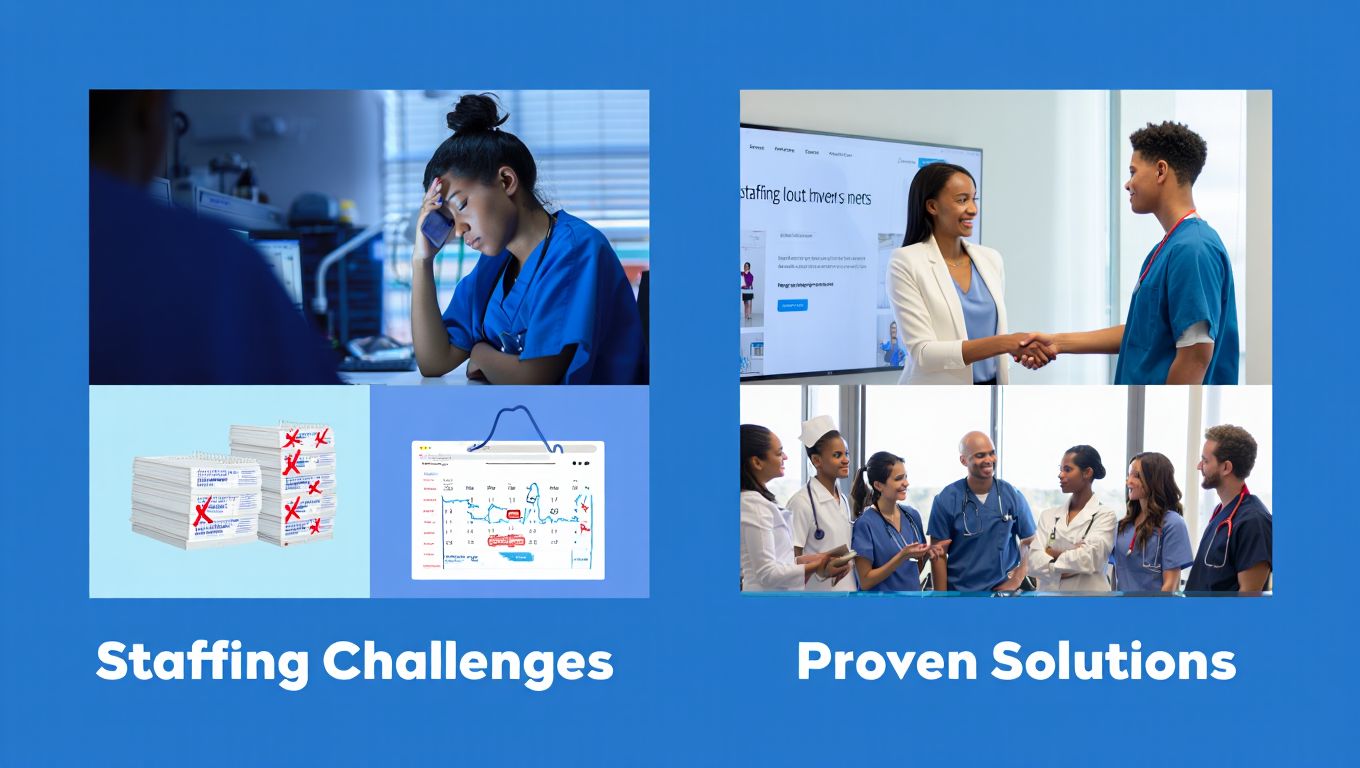
Choosing a staffing partner is like choosing a specialist doctor; you don’t just want good, you want the right kind of good.
8.1 For Hospitals & Clinics Needing Continuous Staffing Coverage
Hospitals, EDs, ICUs, ORs, and outpatient centers that struggle with ongoing vacancies often need:
- National or regional full-service agencies for scale
- Strong travel and per diem options
- Support with workforce planning and analytics
If you’re in this group, look for:
- A partner like AMN, CHG, or another full-service leader with experience in your state or specialty
- The ability to integrate with your scheduling systems or MSP/VMS tools
- A clear plan for reducing overtime and burnout among your core staff
You’re not just filling shifts—you’re stabilizing your whole care environment.
8.2 For senior living communities and home care providers in need of trustworthy caregiving staff
Home health agencies, hospices, assisted living, and memory care communities need compassionate, consistent caregivers.
If that’s you:
- Consider providers like Interim HealthCare, BrightStar Care, Arcadia, Safro, or similar home health specialists in your region.
- Ask how they screen caregivers for reliability, bedside manner, and safety
- Ensure they understand your specific documentation and visit requirements
You want an agency that treats caregivers as professionals, not just “extra hands,” because that respect translates into better retention and better patient experience.
8.3 For Nurses, Caregivers & Allied Professionals Seeking Better Opportunities
If you’re a clinician, your decision might start with one simple question:
Do I want stability, flexibility, or growth right now?
- For stability, look at agencies with strong local contracts or direct hire placement
- For flexibility & extra income: explore per diem and short local assignments
- If you’re aiming for career growth and excitement, look for reputable travel nurse agencies and travel allied companies that offer honest pay details and solid feedback.
Also consider tech-enabled platforms like Bluebix Health if you want faster applications and modern communication instead of endless phone calls and outdated portals.
8.4 Decision Checklist: What Does the User Really Want? and Matching It to the Right Agency
Before you choose, ask:
- What’s my primary goal—speed, quality, cost, flexibility, or growth?
- Do I need a generalist agency or a specialist (travel, home health, locums)?
- How important is technology (apps, portals, automation) to my team or me?
- Do I feel heard and respected by this agency’s recruiters or account managers?
When the answers line up, you’ve likely found the right healthcare staffing partner for your situation.
9. Step-by-Step: How to Start Working With a Healthcare Staffing Company

9.1 For Employers: How to Sign Up, Share Requirements & Start Receiving Candidates
- Clarify your needs
- What roles? How many shifts per week? Which locations?
- What’s your ideal start date and contract length?
- Shortlist 2–3 agencies
- Include at least one large national provider and one tech-driven or niche firm (such as Bluebix Health for U.S. caregiver and clinical staffing).
- Set up a discovery call
- Share your pain points honestly (turnover, overtime, rural location, specialty gaps).
- Ask how they’ve solved similar problems for other facilities.
- Agree on terms
- Finalize bill rates, service level expectations, and communication channels.
- Start with a pilot
- Try a limited number of roles or units first.
- Review performance after 30–60 days, then scale up what works.
9.2 For Applicants: How to Register, Submit Your Resume, and Increase Your Chances of Quick Placement
- Choose your focus
- Decide if you want local work, travel, per diem, or a permanent role.
- Create a clean, updated resume
- List licensure, certifications, and recent experience clearly.
- Include EMR systems you know and any specialties (ICU, home care, pediatrics).
- Register with 1–3 agencies
- Fill out online profiles fully.
- Upload documents (license, ID, certifications) promptly.
- Be responsive
- Answer calls and messages quickly.
- Complete skills checklists and onboarding tasks as soon as possible.
- Ask questions about pay and expectations
- Clarify shifts, floating policies, and scheduling rules.
Agencies like Bluebix Health aim to simplify this with centralized job listings and streamlined communication, so you spend more time working and less time chasing updates.
9.3 Common Mistakes to Avoid When Choosing or Using a Staffing Agency
- Only looking at pay rate and ignoring culture and support
- Signing contracts without reading cancellation or overtime terms
- Registering with too many agencies and then ignoring half of them
- Not being honest about availability, skills, or preferences
- For employers: not giving feedback on candidates, leaving agencies to “guess” what you want
Avoid these traps, and your staffing partnership will feel more like teamwork and less like chaos.
10. How to Find Healthcare Staffing Opportunities and Available Roles Across the USA
10.1 By using staffing agency websites, mobile apps, and leading job boards
Most top healthcare staffing companies in USA now use:
- Online Healthcare job portals on their websites
- Mobile apps for shift selection and travel assignments
- Integrations with major job boards
Travel nurse agencies like Aya Healthcare and others provide large digital marketplaces where clinicians can browse thousands of jobs by state, specialty, and pay package.
For employers, these same platforms mean your openings can reach huge talent pools fast. For clinicians, they provide visibility and transparency, no more guessing what’s available.
10.2 Utilizing LinkedIn, trusted referrals, and focused healthcare community platforms
Don’t underestimate:
- LinkedIn – great for leadership roles, specialized clinicians, and HR professionals
- Professional groups and forums – specialty nursing associations, allied health groups
- Referrals – many agencies offer referral bonuses
Employers can build a presence in these communities, while clinicians can follow agencies and organizations to see new jobs early and understand the culture better.
10.3 How Bluebix Health Connects Employers and Job Seekers in One Place
Bluebix Health focuses on making the connection between healthcare employers and job seekers as simple as possible:
- U.S.-focused roles across nursing, caregiving, and allied health
- A digital-first approach so employers can post needs quickly
- A straightforward path for clinicians to discover and apply to jobs in one place
For HR teams and staffing managers who want more qualified applicants and for clinicians who want trusted, verified opportunities, Bluebix Health aims to be that central meeting point.
11. Future Trends in Healthcare Staffing: 
11.1 Using AI-driven solutions, automated processes, and digital platforms to enhance healthcare recruiting
By 2026, over two-thirds of healthcare staffing firms are expected to rely on AI-powered tools to streamline recruiting—screening resumes, matching candidates, and verifying credentials.
We’re seeing:
- Automated candidate ranking based on skills and availability
- Digital credentialing and compliance management
- Chatbots and virtual assistants answering candidate questions 24/7
In home health, AI and automation help agencies better manage scheduling, reduce no-shows, and personalize care coordination.
Tech-driven platforms like Bluebix Health sit right in this trend, using automation to make hiring faster and more transparent for both sides.
11.2 Growing Demand for Home Health, Allied Health & Rural Staffing
The U.S. elderly population is growing fast, and many people prefer care at home. Yet more than half of U.S. counties have lost home health agencies in recent years, leaving serious service gaps—especially in rural areas.
This drives demand for:
- Home health nurses and caregivers
- Therapists (PT, OT, speech) for home-based rehab
- Allied health professionals in outpatient and community settings
Staffing firms that specialize in home health and rural staffing will play an even larger role in connecting clinicians to communities that need them most.
11.3 Work-Life Balance, Burnout & Flexible Work Models
Burnout is a major factor in the staffing crisis, especially for nurses and caregivers.
In response, employers and agencies are:
- Offering more flexible schedules and shift-based models
- Supporting gig-style shifts through digital platforms (though this raises policy and union debates)
- Focusing more on mental health, wellness resources, and sustainable workloads
Clinicians increasingly choose opportunities that respect their lives outside of work. Agencies and platforms that support healthy schedules and listen to staff feedback will stand out as employers of choice.
12. Conclusion: Choosing the Right Healthcare Staffing Partner in the USA
Finding the top healthcare staffing companies in USA is not about chasing a single #1 winner. It’s about finding the right match for your goals.
- If you’re a hospital or clinic, focus on agencies that offer reliable coverage, strong quality controls, and workforce planning.
- If you’re a home health or senior care provider, prioritize partners who understand in-home care and caregiver retention.
- If you’re a nurse, caregiver, or allied professional, look for agencies that offer transparent pay, flexible options, and real career support.
Traditional industry leaders, travel nurse specialists, home health experts, and tech-driven platforms like Bluebix Health all have a role to play.
The best next step?
Define what you truly want speed, quality, flexibility, or growth, and then choose the agency that proves it can deliver on that promise.
13. Frequently Asked Questions (FAQ)
13.1 What is the difference between a healthcare staffing agency and a traditional recruiter?
A healthcare staffing agency usually manages the whole placement process, sourcing, screening, onboarding, and often payroll or scheduling. A traditional recruiter typically focuses on finding candidates for permanent roles, with less involvement after the hire.
13.2 How much do healthcare staffing companies charge employers?
Agencies charge a bill rate that covers the clinician’s pay, taxes, benefits, and their service fee. Exact costs vary by role, location, and urgency. Many employers find the total cost is comparable to or lower than in-house hiring when all factors are included.
13.3 Do nurses and caregivers pay any fees to work with a staffing agency?
Reputable healthcare staffing agencies do not charge job seekers placement fees. They’re paid by employers. If you’re ever asked to pay for “job access,” proceed carefully and verify that the agency is legitimate and compliant with local regulations.
13.4 How long does it usually take to fill a healthcare position through an agency?
It depends on role and location. Per diem shifts may be filled in hours or days. Travel assignments and specialized roles may take 1–4 weeks. Leadership or niche positions can take longer, but agencies still tend to move faster than traditional hiring.
13.5Which healthcare roles are most in demand in the USA right now?
High-demand roles include registered nurses (ICU, ER, OR), home health and personal care aides, respiratory therapists, behavioral health professionals, and allied health clinicians in outpatient and rural settings.
13.6 Is it better to work directly with a hospital or through a staffing agency?
It depends on your goals. Direct employment offers stability and long-term benefits. Staffing agencies offer flexibility, variety, and often higher short-term pay (especially in travel or per diem roles). Many clinicians use both at different stages of their careers.
13.7 How can employers make sure candidates are properly licensed and background-checked?
Work with agencies that have clear credentialing and quality processes. Ask for details on license verification, background checks, and clinical oversight. You can also perform your own final checks before onboarding to strengthen your compliance.
13.8 Can international healthcare professionals use US staffing agencies to find jobs?
Yes—some agencies specialize in international recruitment, helping nurses and other clinicians navigate immigration, licensing, and relocation. For example, firms like Avant Healthcare Professionals focus on bridging global talent into U.S. healthcare systems.
13.9 How do travel nursing and per diem assignments actually work?
Travel nursing involves fixed-term contracts (often 8–13 weeks) in different locations, with housing stipends and higher pay. Per diem roles are local, shift-based assignments that offer flexibility and higher hourly rates but less long-term guarantee.
13.10 Why consider a tech-driven agency like Bluebix Health over a traditional staffing firm?
Tech-driven platforms like Bluebix Health use digital tools, automation, and streamlined communication to make hiring faster and easier. Employers get quicker access to qualified candidates; clinicians enjoy simpler applications, transparent roles, and smoother, more modern experiences.