

10 Physical Therapist Staffing Strategies for Faster Hiring
Physical therapist staffing is no longer a simple hiring task. For many healthcare employers, it is a daily pressure point tied to patient outcomes, revenue, scheduling stability, and team burnout. A missing PT is not just an empty job slot.
It can mean delayed starts of care, overloaded clinicians, frustrated patients, and lost referrals. That is why more hospitals, rehab clinics, skilled nursing facilities, home health agencies, and long-term care providers are rethinking how they approach therapy hiring.
If you are a healthcare employer, HR leader, staffing manager, or recruiter, you likely want the same things: speed, trust, qualified candidates, clean credentialing, and a smoother hiring process.
You do not want another stack of resumes that looks good on paper but falls apart in interviews, onboarding, or retention. You want real solutions.
This guide explains what physical therapist staffing means, why demand keeps rising, what hiring models work best, and how to build a stronger process from sourcing to retention.
It also shows how physical therapist recruitment services and experienced physical therapy staffing agencies can help healthcare organizations hire better, faster, and with less risk.
What Is Physical Therapist Staffing?
Physical therapist staffing is the process of finding, evaluating, hiring, and retaining licensed physical therapists for healthcare organizations.
At its core, it is about matching the right therapist to the right care setting, patient population, schedule, and team culture.
That may sound simple, but in practice, it is more like putting together a puzzle where every piece affects the outcome. A candidate may have strong orthopedic skills but limited experience in post-acute care.
Another may be excellent clinically, but not comfortable with the documentation speed required in a high-volume outpatient setting. A third may be perfect on paper but unavailable for the shifts your team actually needs covered.
Physical therapist staffing also covers more than full-time permanent hires. It can include direct hire, travel, contract, contract-to-hire, per diem, and urgent coverage models. In many organizations, it also extends to broader rehab staffing strategies that involve PTAs, rehab aides, and interdisciplinary coordination.
Healthcare employers search for physical therapist staffing solutions because they need more than a job post. They need a dependable way to keep therapy services running. That includes sourcing candidates, validating licensure, reviewing clinical fit, managing interviews, handling compliance, and reducing time-to-fill.
In short, physical therapist staffing is not only about hiring a therapist. It is about protecting patient care, keeping schedules stable, and helping a rehab program perform the way it should.
Why Physical Therapist Staffing Matters in Healthcare
Physical therapists play a central role in recovery, mobility, pain management, fall prevention, and return-to-function plans.
They are often the clinicians who help patients move from “I cannot do this” to “I can manage again.” That makes them essential across hospitals, outpatient clinics, home health, sports medicine, and post-acute care.
The demand side is not slowing down. According to the U.S. Bureau of Labor Statistics, employment of physical therapists is projected to grow 11% from 2024 to 2034, with about 13,200 openings each year on average. That is much faster than the average for all occupations.
For employers, that growth creates a simple reality: competition will remain strong. Even if your organization has a good reputation, you are still competing against large health systems, outpatient chains, travel assignments, specialty practices, and employers with faster processes.
Physical therapist staffing matters because therapy access affects much more than staffing charts. It influences:
Patient flow.
Length of stay.
Referral capture.
Team morale.
Patient satisfaction.
Revenue tied to therapy services.
In settings like skilled nursing facilities, therapy is part of the care model itself. MedPAC notes that SNFs provide short-term skilled nursing care and rehabilitation services such as physical therapy, occupational therapy, and speech-language pathology for patients recovering from surgery, stroke, infections, and similar conditions.
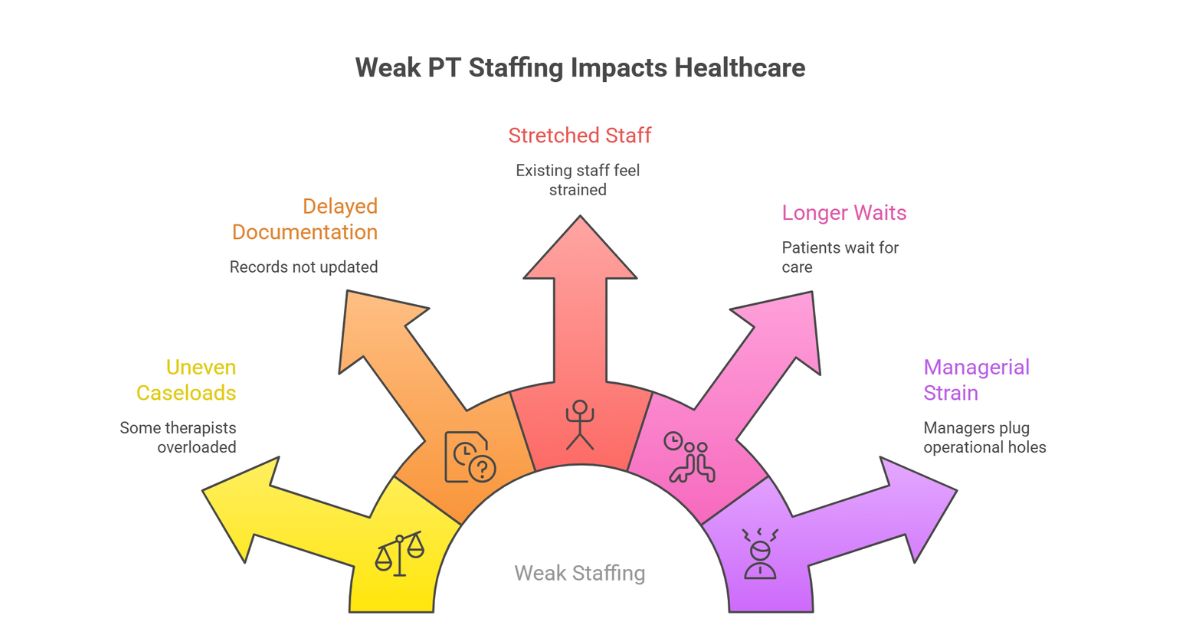
When PT coverage is weak, the impact spreads quickly. Caseloads become uneven. Documentation gets delayed. Existing staff feel stretched. Patients wait longer. Managers spend time plugging holes instead of improving operations. What starts as one vacancy can feel like a crack in a dam.
That is why physical therapist staffing is not just an HR task. It is a business, care delivery, and growth issue.
Common Physical Therapist Staffing Challenges Employers Face
Most employers do not struggle because they do not care. They struggle because the market is tight, the workflow is messy, or the hiring process is slower than the competition.
One major challenge is supply pressure. APTA reported in 2025 that new workforce forecasts project physical therapist shortages through 2037, warning that supply gaps could threaten timely access to care unless action is taken.
HRSA’s workforce projections are also sobering: the agency projects a shortage of 60,610 physical therapists in 2038.
The second challenge is time-to-fill. PT candidates often move quickly. A great therapist may apply, interview, and accept within days if another employer is more organized. Slow approvals, unclear compensation, and scheduling gaps cost employers strong candidates every week.
The third challenge is competition. Travel roles can attract candidates who want flexibility or higher short-term earnings.
Large health systems may offer stronger benefit packages. Rural employers may face relocation barriers. Smaller clinics may lose candidates simply because they cannot move as fast.
Credentialing and compliance delays are another major problem. Licensure checks, work history review, references, immunization records, and onboarding paperwork can stretch longer than expected.
If the process feels heavy and communication is weak, candidates may drop out before the start date.
Then there is burnout. Existing therapists often cover open caseloads while the organization hires. That sounds manageable for a few weeks, but over time, it can increase frustration, reduce quality, and trigger even more turnover.
It becomes a treadmill: one vacancy creates pressure, pressure creates burnout, burnout creates another vacancy.
There are also setting-specific challenges. A home health employer may need therapists comfortable with autonomy and travel between patients. An SNF may need strong post-acute experience. An outpatient clinic may want speed, manual therapy confidence, and documentation discipline.
Hiring gets harder when the role requires a narrow mix of clinical skill and operational fit.
Many employers also write weak job descriptions. They list generic duties, skip what makes the role attractive, and forget that candidates are shopping too. In a competitive market, vague jobs get vague results.
Types of Physical Therapist Staffing Models
There is no single best staffing model for every organization. The right option depends on your patient volume, urgency, budget, turnover risk, and long-term goals. Good physical therapist staffing is about choosing the model that fits the problem, not forcing every need into the same hiring lane.
Direct Hire Physical Therapist Staffing
Direct hire is the strongest choice when you need long-term stability. The therapist joins your organization as an employee, typically full-time or part-time. This model works well when you want stronger culture fit, lower long-term turnover, and better continuity of care.
Direct hire is like planting a tree rather than renting shade. It takes more effort upfront, but it creates deeper roots. If your organization values retention, internal development, and stable patient relationships, this model often makes the most sense.
Temporary Physical Therapist Staffing
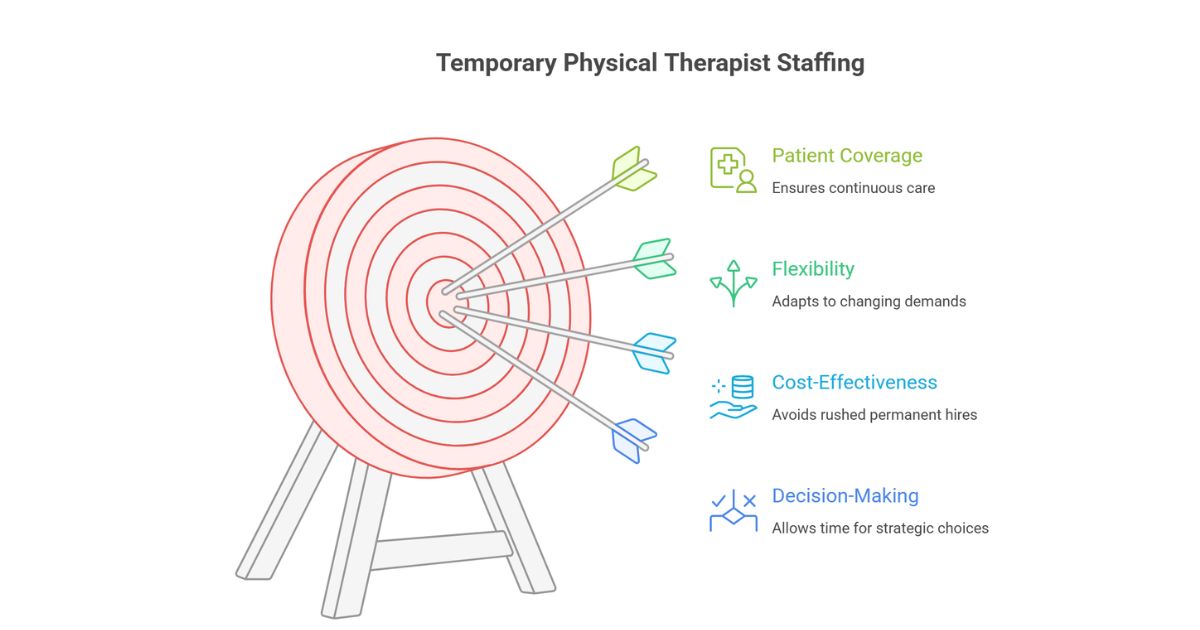
Temporary staffing is helpful when you face sudden gaps, leaves of absence, census spikes, or new service lines that are not yet predictable. It allows you to maintain patient coverage without rushing into a permanent hire.
This option is especially useful when the cost of delay is high. It buys breathing room. It helps your team stay functional while leadership decides whether the need is seasonal, short-term, or permanent.
Contract-to-Hire Therapy Staffing
Contract-to-hire gives both sides a trial period. The therapist works for a set period, and if the fit is strong, the role converts to permanent employment. This can reduce risk in settings where culture fit, pace, or specialty skill matters a lot.
For employers, this model answers an important question: Can this person do the work here, not just in theory, but in our real environment?
Travel Physical Therapist Staffing
Travel staffing supports urgent or hard-to-fill coverage, especially in rural markets, underserved regions, or specialty programs. It can be effective when local talent is limited or when the gap is too urgent for a standard permanent search.
The trade-off is often cost and turnover. Travel assignments solve immediate access problems, but they are not always the best long-term answer if your goal is deeper retention and culture continuity.
Per Diem and Seasonal Coverage
Per diem or flexible coverage works when volume changes week to week. It is useful for outpatient centers with seasonal demand, facilities managing PTO overlap, or organizations that need backup support without full weekly schedules.
This model is not ideal for every setting, but it is helpful where flexibility matters more than full-time coverage.
Choosing the Right Model
Use direct hire when you want retention.
Use temporary staffing when coverage is urgent.
Use contract-to-hire when fit is uncertain.
Use travel staffing when geography or timing is the biggest barrier.
Use per diem when your demand is variable.
The smartest employers often use more than one model at the same time. A permanent core team plus flexible backup coverage is often more stable than relying on one hiring method alone.
Where Physical Therapists Are Needed Most
Physical therapists are needed across the care continuum, but the hiring challenge changes by setting.
Hospitals
Hospitals need PTs for acute care mobility, post-surgical recovery, discharge planning support, and patient progression. These roles often demand strong collaboration with nurses, case managers, and physicians. Employers usually want therapists who can move quickly, prioritize safely, and document efficiently in fast-paced environments.
Outpatient Rehabilitation Clinics
Outpatient clinics often need PTs who can manage volume, build rapport, drive treatment plans forward, and support patient retention. The right fit here is not only clinical. It is also relational and operational. Employers need therapists who can balance care quality with productivity.
Skilled Nursing Facilities
SNFs rely heavily on rehab services, including physical therapy, for post-acute and transitional care. These roles often involve medically complex patients, longer recovery arcs, and team coordination with nursing and case management. MedPAC’s reports underline how central rehab services are within the SNF model.
Home Health Agencies
Home health PT staffing is a different animal. Employers need therapists who are independent, organized, comfortable traveling between homes, and confident in making clinical decisions without constant hallway support. Strong communication and self-management matter as much as technical skill.
Assisted Living and Long-Term Care
In these settings, employers often look for therapists who understand falls, frailty, functional mobility, chronic conditions, and quality-of-life goals. The pace may be different from acute care, but the need for judgment and patience is high.
Sports Medicine and Orthopedic Practices
These organizations often prioritize musculoskeletal expertise, active patient education, return-to-function planning, and strong engagement skills. Culture fit matters a lot because patients in these settings often expect high-touch communication.
In every setting, the employer’s real question is the same: can this therapist succeed with our patient mix, our pace, and our workflow?
What Employers Should Look for in a Qualified Physical Therapist
Hiring a PT is not only about checking the license box. A strong therapist is part clinician, part communicator, part problem-solver, and part teammate.
First, assess clinical fit. Does the candidate have the hands-on experience your setting requires? A therapist who thrives in outpatient orthopedics may not be the best match for an acute care or SNF role. Specialty alignment matters.
Second, look at the patient population experience. Has the therapist worked with stroke patients, post-surgical cases, geriatrics, pediatrics, sports injuries, or home health populations similar to yours? Skill grows fastest when the setting is familiar.
Third, test communication. Can the candidate explain treatment plans clearly? Can they build trust with patients, families, and interdisciplinary teams? Therapy is a relationship-driven profession. A therapist who cannot connect will struggle, even with strong clinical knowledge.
Fourth, review documentation habits and EMR familiarity. Employers often underestimate this point. A therapist who is great with patients but chronically behind on notes can create operational stress, billing delays, and compliance issues.
Fifth, confirm professionalism and reliability. Does the candidate show up prepared? Are references consistent? Do they seem adaptable, coachable, and steady under pressure?
Finally, verify every required item carefully. BLS and APTA data point to sustained demand, which makes it even more important not to lower standards in a hurry. Fast hiring should never mean sloppy hiring.
A practical framework is this: hire for license, setting fit, communication, documentation, and staying power. That five-part lens often reveals more than a resume alone.
How to Build an Effective Physical Therapist Staffing Strategy
An effective staffing strategy starts with one truth: reacting late is expensive. The best employers do not wait until a therapist resigns to think about pipeline, coverage, or role design. They plan before the pain gets sharp.
Assess Your Gaps Clearly
Start with a simple diagnosis. Where are you short today? Is the issue volume, geography, specialty skill, weekend coverage, or turnover? Are delays happening in sourcing, interviews, approvals, or onboarding?
Too many teams use broad language like we need more PTs. That is not a staffing strategy. It is a symptom. A better statement is: We need one outpatient PT in Dallas with dry needling experience and one home health PT in a 30-mile radius with weekend flexibility.
Specificity speeds hiring.
Forecast Demand Before It Hits
Use referral trends, census patterns, PTO calendars, new service lines, and seasonal demand to estimate staffing needs 60 to 120 days ahead. This is where workforce planning turns from guesswork into management.
Think of staffing like weather planning. You do not control the storm, but you can still bring an umbrella before the clouds break.
Write Better Job Descriptions
Most PT job ads are bland. They list duties everyone already knows and fail to answer the candidate’s real questions:
What is the patient mix?
What is the caseload expectation?
What schedule look like?
What support exists?
What makes this team worth joining?
A stronger ad improves conversion because it respects the buyer, and in this case, the candidate is the buyer too.
Tighten Time-to-Hire
Great therapists do not wait forever. Review your process step by step. How many days pass between application and first contact? Between the interview and the decision? Between the offer and the credentialing start?
Set internal service standards. For example:
- Candidate outreach within 24 hours
- interview scheduling within 72 hours
- decision within 48 hours of the final interview
- The onboarding checklist was launched the same day as acceptance
This is where many employers lose talent. Not because the compensation is terrible, but because the process feels heavy.
Use a Simple Hiring Scorecard
Create a scorecard with five metrics:
time-to-fill, days-to-start, offer acceptance rate, credentialing accuracy, and 90-day retention.
This gives you an original, practical view of whether your staffing strategy is actually working. If time-to-fill is low but 90-day retention is poor, the process is fast but not accurate. If candidate quality is good but days-to-start are long, onboarding is the bottleneck.
Improve Candidate Experience
Candidates remember how you made them feel. Clear communication, fast updates, honest role details, and organized scheduling matter. Even strong compensation cannot always rescue a sloppy experience.
Add Staffing Partners Where Needed
Many organizations do not need help with every role. They need help with the hardest roles, the urgent roles, or the markets where internal sourcing is thin. This is where physical therapist recruitment services can extend reach and reduce internal strain.
A smart staffing strategy is not about doing everything yourself. It is about building the fastest, cleanest path from open need to a successful start.
Benefits of Partnering With a Physical Therapist Staffing Agency
A strong staffing partner does more than send resumes. The right agency reduces noise, brings market insight, and creates speed without sacrificing fit.
Faster Access to Qualified Candidates
Agencies often maintain active therapy talent networks and know how to reach passive candidates, not just job board applicants. That matters in a market where some of the best PTs are working and are only open to the right opportunity.
Better Screening Before the Interview
Good agencies save hiring teams time by handling early-stage review. That includes resume screening, role alignment, availability checks, compensation discussion, and basic credential validation. Your managers spend less time sorting and more time choosing.
Flexibility When Demand Changes
Some weeks, you need a permanent hire. Other times, you need urgent contract coverage. Agencies can help employers move across models without rebuilding the process from scratch every time.
Reduced Administrative Burden
Hiring managers and HR teams already juggle labor planning, interviews, approvals, compliance, and onboarding. An experienced staffing partner helps absorb sourcing pressure and keeps the process moving.
Support With Hard-to-Fill Markets
Rural coverage, specialty programs, new locations, and urgent backfills are often where internal teams get stuck. Agencies that understand rehab hiring can widen the funnel faster.
Better Operational Stability
Open PT roles cost more than recruiters sometimes admit. They affect productivity, morale, patient access, and manager time. A good partner helps reduce those hidden costs by filling roles sooner and more accurately.
This is why many employers work with physical therapy staffing agencies even when they also recruit internally. It is not surrender. It is leverage.
For organizations that need fast, reliable support, Bluebix Health can help simplify the search. A focused healthcare staffing partner can assist with sourcing, screening, credentialing coordination, and matching therapists to the right care settings so teams can stay focused on patient care instead of chasing resumes.
How the Physical Therapist Hiring Process Works

A strong hiring process should feel less like a maze and more like a bridge. It should move candidates from interest to start date with as little friction as possible.
Intake and Role Definition
The process should begin with a real intake, not a rushed email. Clarify setting, schedule, patient mix, required experience, compensation range, reporting structure, and start urgency. This avoids wasted sourcing.
Candidate Sourcing and Outreach
This stage may include job boards, internal databases, referrals, direct outreach, and agency networks. The goal is not just more applicants. It is a better fit for applicants.
Screening and Clinical Fit Review
Early calls should confirm licensure, years of experience, setting familiarity, schedule alignment, pay expectations, and relocation willingness if relevant. A second layer can review specialty strengths and documentation comfort.
Interview Coordination
Interviews should be timely and focused. Ask practical questions:
How do you manage high caseloads?
How do you adapt treatment plans when progress stalls?
What EMRs have you used?
How do you handle difficult patient engagement?
The goal is to reveal how the therapist thinks, not just what they memorized.
Credentialing and Compliance
This is where delays often happen. Keep a checklist ready for licensure verification, background checks, references, work authorization, immunization or health requirements, and any site-specific documentation. Organized compliance work prevents last-minute surprises.
Offer Management
Offers should be clear, timely, and competitive. Ambiguous details create candidate hesitation. Spell out compensation, schedule, benefits, expected productivity, and start timeline.
Onboarding and Follow-Up
A signed offer is not the finish line. It is the handoff. Smart employers maintain communication through the start date and through the first 30 to 90 days. That reduces ghosting, improves readiness, and supports retention.
Cost Factors in Physical Therapist Staffing
The cost of physical therapist staffing is not limited to salary or bill rate. It includes visible costs and hidden costs.
Visible costs may include:
recruitment spend
agency fees
sign-on bonuses
travel or relocation support
credentialing and onboarding expenses
When employers compare direct hire and temporary staffing, they often focus only on rate. That is too narrow. A higher-cost short-term solution may still be cheaper than leaving a role open for months.
For example, if an open PT role slows referrals, delays discharge progress, or causes other staff to reduce hours or leave, the vacancy cost can quietly exceed the fee you were trying to avoid.
A better question is not, “What is the cheapest way to hire?” It is, “What is the most cost-effective way to restore stable care and retain the team?”
Quality and retention matter here. A fast but poor hire creates rework. A slow but perfect search may cost too much in the meantime. The goal is balanced efficiency.
That is why experienced physical therapist recruitment services focus on fit, speed, and process discipline together. Cost control is not about squeezing every dollar. It is about reducing waste.
How to Choose the Right Physical Therapist Staffing Partner
Not every staffing partner is built the same. Some are broad resume vendors. Others understand healthcare workflows, credentialing pressure, rehab settings, and the realities of therapy hiring.
Here is what to look for.
Healthcare and Rehab Experience
Choose a partner that understands the environments you hire for. Acute care, outpatient, SNF, home health, and long-term care all require different types of PT talent. A general recruiter may miss those differences.
Screening Standards
Ask how candidates are sourced, screened, and qualified before they reach you. Do they confirm licensure? Do they assess setting fit? Do they discuss compensation and schedule expectations upfront? Strong pre-screening saves time.
Speed and Communication
Ask how quickly they present candidates, how often they update you, and what the escalation process looks like when a role becomes urgent. In staffing, silence is expensive.
Coverage and Flexibility
Can they support permanent hires only, or also temporary and contract needs? Can they help in rural or hard-to-fill markets? Range matters.
Transparency
A trustworthy partner is clear about what they can and cannot do. They do not oversell weak pipelines or hide risks. They tell you the truth about market conditions, timelines, and compensation realities.
Retention Mindset
Ask what happens after placement. Do they check in? Do they help manage risks before a candidate falls off? Do they track quality outcomes?
A useful question list is simple:
How do you define a qualified PT candidate?
How fast can you move?
What settings do you recruit for most often?
How do you reduce fallout between offer and start?
What do you do if the fit is not right?
For employers that want a smoother process, Bluebix Health offers healthcare-focused support built around speed, trust, clear communication, and candidate quality. The value is not only access to talent. It is a cleaner path to hiring the right people.
Best Practices to Improve Physical Therapist Retention After Hiring
Hiring is only half the job. A great placement that lasts for four months is not a success story. Retention needs as much attention as recruiting.
Start with compensation and schedule clarity. Therapists are more likely to stay when expectations are transparent from day one. Surprises damage trust.
Next, invest in onboarding. A therapist should not feel dropped into the deep end on day one. Strong onboarding includes EMR training, productivity expectations, patient flow guidance, documentation support, and a real point of contact.
Workload matters too. Manageable caseloads and realistic productivity expectations help prevent early burnout. If the job feels unsustainable, no recruitment strategy can save it for long.
Growth also matters. Therapists want to feel they are moving forward, not standing still. Offer mentorship, specialty development, leadership pathways, or continuing education support where possible.
Culture is the glue. People stay where they feel respected, heard, and supported. A positive manager often retains more staff than a flashy sign-on bonus.
Use retention checkpoints at 30, 60, and 90 days. Ask:
What is going well?
What feels unclear?
What barriers are you facing?
What support would help you succeed faster?
This turns retention from hope into management.
Future Trends in Physical Therapist Staffing
The next few years will likely reward employers who plan early and move fast.
Demand for rehab services will continue to rise as the population ages and more patients seek mobility, recovery, and function-focused care. BLS projects strong growth in PT employment, while APTA and HRSA both point to ongoing supply pressure and projected shortages.
Team-based rehab staffing will also matter more. BLS projects 16% growth from 2024 to 2034 for physical therapist assistants and aides, suggesting that employers may increasingly think in terms of full therapy teams rather than isolated PT roles.
Other trends include:
faster hiring expectations
greater use of flexible staffing models
stronger emphasis on compliance-ready candidates
data-driven workforce planning
More competition for therapists in underserved markets
Some organizations will also explore hybrid support models, telehealth-related rehab workflows, and more specialized therapy roles tied to orthopedics, geriatrics, neuro rehab, and post-acute recovery.
The employers that win will not be those who post more jobs. They will be the ones who create better hiring systems.
Why Physical Therapist Staffing Is a Strategic Growth Decision
Physical therapist staffing affects more than coverage. It shapes growth.
If you want to expand a clinic, improve referral capture, shorten patient wait times, protect care quality, and reduce staff burnout, therapy hiring has to work. A weak staffing engine slows all of that down.
This is why staffing should be treated as a strategic function. The right PT hire can help improve throughput, patient experience, interdisciplinary coordination, and long-term stability. The wrong hire, or no hire, does the opposite.
In many organizations, leadership treats therapy recruiting like maintenance. Something breaks, so the team fixes it. But the better view is this: staffing is infrastructure. It is the road your care model drives on. If the road is cracked, every other system feels slower.
That is where a partner like Bluebix Health can make a real difference. By helping employers source qualified therapists, reduce hiring delays, support verification steps, and improve fit, the platform becomes more than a staffing website. It becomes part of the solution.
For healthcare employers that want speed, trust, easier communication, and stronger candidate quality, working with a focused healthcare staffing partner can reduce friction and improve outcomes at the same time.
Conclusion
Physical therapist staffing is one of the clearest examples of how hiring quality affects care quality. When PT roles stay open too long, the damage spreads across patients, staff, scheduling, and revenue. When the process is strong, organizations move faster, teams feel more stable, and patient care becomes more consistent.
The market remains competitive. Federal projections show strong demand, and major workforce forecasts continue to warn about future shortages. That means employers cannot rely on old hiring habits.
The better path is to use a clear staffing strategy, choose the right hiring model, tighten time-to-fill, improve candidate experience, and work with trusted partners when needed.
If your organization needs help finding qualified therapy talent faster, Bluebix Health can support your hiring goals with healthcare-focused staffing solutions built around speed, trust, and better-fit candidates. Visit bluebixhealth.com to explore a simpler way to hire and retain the professionals your care teams need.
FAQ
What makes physical therapist staffing different from general healthcare staffing?
Physical therapist staffing is more specialized because employers must match licensure, setting experience, patient population fit, documentation ability, and team style. It is not just about filling a job. It is about finding a therapist who can perform well in a specific rehab environment and stay long enough to add value.
When should a healthcare employer use temporary physical therapist staffing?
Temporary staffing works best during sudden vacancies, family leave, census increases, seasonal demand, new program launches, or hard-to-fill searches. It keeps therapy services moving while the employer evaluates long-term needs. It is often the fastest way to protect patient coverage without rushing into a permanent decision.
How can physical therapist recruitment services help fill roles faster?
Physical therapist recruitment services improve speed by expanding sourcing reach, contacting passive candidates, pre-screening for fit, confirming interest early, and keeping the process organized. They reduce internal workload and help employers avoid long gaps between sourcing, interviews, offers, and onboarding.
What should employers verify before hiring a physical therapist?
Employers should verify active licensure, education, work history, references, documentation habits, setting-specific experience, and any required compliance items. They should also confirm availability, compensation expectations, and schedule alignment. A fast hire still needs a clean verification process to reduce risk and improve long-term fit.
Is direct hire or contract staffing better for physical therapists?
It depends on the goal. Direct hire is better for long-term retention, team continuity, and culture building. Contract staffing is better for urgent coverage, uncertain demand, or short-term operational gaps. Many employers combine both models to create a stable core team with flexible backup support.
Why are physical therapist roles hard to fill in some markets?
Some markets face limited talent supply, stronger employer competition, rural location barriers, or specialized care demands. Roles also become harder to fill when hiring processes are slow or job offers are unclear. In many cases, speed, communication, and realistic role design matter as much as compensation.
How do open physical therapist jobs affect a healthcare facility?
Open PT jobs can delay care, increase staff workload, reduce scheduling capacity, slow discharges, and weaken patient experience. They also consume manager time and may affect revenue tied to therapy services. One vacancy can create pressure across the whole rehab operation if it stays open too long.
What qualities make a physical therapist a strong long-term hire?
A strong long-term hire combines clinical skill, patient-centered communication, documentation discipline, professionalism, adaptability, and culture fit. The best therapists do not only treat well. They collaborate well, stay organized, and help the team function smoothly under real-world conditions.
How can employers improve retention after hiring a physical therapist?
Employers improve retention by setting clear expectations, offering structured onboarding, keeping workloads realistic, providing support from managers, and creating room for growth. Regular check-ins during the first 90 days are especially helpful. Retention improves when therapists feel supported, respected, and set up to succeed.
What should employers ask before choosing among physical therapy staffing agencies?
Ask how candidates are screened, what settings the agency knows best, how fast it can move, how it handles compliance steps, and what support it offers after placement. The right partner should be transparent, responsive, and able to present candidates who fit both the job and the culture.