
10 Essential Healthcare Staffing Solutions for Employers
If you’re searching for healthcare staffing solutions for employers, you’re probably dealing with the same painful mix: open shifts, tired teams, and patient demand that doesn’t slow down. You don’t just need more applicants. You need the right people, credentialed, reliable, and ready to work, without spending weeks in back-and-forth emails.
This guide breaks down what staffing solutions really mean in healthcare, which models fit which situations, how to avoid costly quick fixes, and how to launch a staffing plan in 30 days. Think of it as your hiring GPS: clear directions, fewer wrong turns, and faster arrivals.
2. Healthcare Staffing Solutions Explained: What They Are and Why Employers Use Them
Healthcare staffing isn’t just about filling a shift. It’s about keeping patient care stable while protecting your team from burnout and your organization from compliance risk. A strong staffing solution combines clinical staffing, smart processes, and verification so you can hire quickly without rolling the dice.
When employers partner with a medical staffing agency (or build an internal staffing system), they’re usually trying to solve a clear business problem: How do we keep coverage safe and predictable even when hiring is hard?
Staffing solutions can be short-term (fill gaps today), medium-term (build a pipeline), or long-term (reduce turnover and stabilize workforce planning). The best ones act like a shock absorber for your healthcare workforce; they absorb the bumps so patient care doesn’t.
2.1 What counts as a staffing solution in healthcare
A staffing solution can include one or a combination of the following:
- A partner that supplies qualified clinicians (temporary, per diem, travel, permanent, locum tenens)
- A screening and credentialing process (licenses, background checks, skills checks)
- A workflow that speeds up hiring (intake forms, fast interviews, clear approvals)
- Technology that reduces friction (ATS/VMS integration, scheduling tools, SMS updates)
- A rehire-ready talent pool of proven workers
In simple terms, a staffing solution is the system that moves you from We have an open shift to A verified clinician is on-site and ready.
2.2 The core problems staffing solves (shortages, turnover, seasonal surges)
Healthcare hiring pressure usually comes from a few repeat offenders:
- Shortages in high-demand roles (RNs, CNAs, specialty nurses, therapists)
- Turnover that creates constant vacancies and retraining costs
- Seasonal surges (flu season, census spikes, new unit openings)
- Last-minute call-outs that trigger overtime and safety concerns
- Slow internal hiring loops (too many steps, unclear ownership, delayed approvals)
Staffing solutions help you respond in hours or days, not weeks, while keeping your compliance and quality standards intact.

2.3 Who this guide is for: hospitals, clinics, long-term care, and home health
This is for healthcare employers who need fast, dependable coverage:
- Hospitals and health systems
- Clinics and urgent care centers
- Long-term care and skilled nursing facilities
- Home health and hospice organizations
If you’re accountable for staffing ratios, patient experience, and hiring outcomes, you’re in the right place.
3. What Employers Really Want: Speed + Trust + Verified Talent
LSI keywords: verified candidates, credential verification, background checks, rapid hiring
Let’s be honest: most employers don’t wake up thinking, “I want a staffing vendor.” They think, “I need this shift covered, and I can’t risk a bad hire.”
That’s why the winning formula is speed + trust + verified talent.
Speed matters because every day a role is open has a cost: overtime, burnout, patient throughput issues, and manager time spent scrambling. But speed alone can backfire if quality drops.
Trust matters because clinical work is high-stakes. You need confidence that the person walking into your unit is properly licensed, appropriately skilled, and aligned with your standards.
Verified talent matters because “available” is not the same as “ready.” Employers want verified candidates who have passed credential verification, background checks, and role-specific requirements—so onboarding is smooth, and risk is low.
3.1 Fast time-to-fill without sacrificing quality
Fast hiring is not about rushing. It’s about removing friction:
- Clear job profiles and must-have skills
- Same-day interview scheduling for urgent needs
- Pre-verified talent pools (already screened and credentialed)
- Simple approvals with defined decision-makers
A good benchmark: you should be able to go from requisition to first qualified submissions quickly, without compromising verification. Speed comes from preparation, not shortcuts.
3.2 Trust signals: licensing, references, skills check, immunization records
Trust is built with proof, not promises. Strong partners document:
- Active license verification (state boards)
- Certifications (BLS/ACLS/PALS as required)
- Reference checks and work history validation
- Skills checklists (unit fit matters)
- Immunization records and TB/fit testing (per policy)
- Exclusion checks (where required)
- Drug screening (per facility requirements)
These trust signals protect patients, protect your team, and protect your facility.
3.3 Easy communication and scheduling (SMS, Teams/Slack, candidate availability)
Speed collapses when communication is messy. The best staffing solutions make scheduling simple with:
- SMS updates for confirmations
- Fast status tracking (submitted → interviewing → cleared)
- Clear availability from candidates
If your team uses Teams or Slack, tight updates reduce the Where are we on this? chaos.
4. Types of Healthcare Staffing Solutions (and When Each One Fits)

Different problems need different tools. A screwdriver is great—until you need a wrench. Same with staffing. Below are the main models employers use and when they work best.
4.1 Temporary / contract staffing for urgent coverage
Temporary staffing (often called contract staffing) is built for urgency: sick calls, coverage gaps, short-term projects, and sudden census spikes. It’s especially useful when:
- You need coverage this week, not next quarter
- You’re protecting staff from overtime overload
- You’re stabilizing a unit while recruiting permanent hires
The best use of contract staffing is strategic, not endless patchwork. Pair it with clear expectations: shift requirements, unit experience, documentation standards, and orientation basics.
Pro tip: Ask for best-fit submissions rather than first available. A fast mismatch still costs you time, just in a different place.
4.2 Per diem staffing for day-to-day flexibility
Per diem staffing is your flex layer, ideal when demand moves up and down daily. It helps when:
- Your schedule changes often
- You need weekend or night coverage
- You want to reduce reliance on overtime
- You’re managing predictable variability (like appointment volume swings)
Per diem works best with an always-on pool and fast confirmations. Think of it like a fire station: you don’t build it during the fire. You maintain readiness so coverage is available when the call comes in.
4.3 Travel staffing for high-need roles and locations
Travel nurse staffing supports hard-to-fill roles and locations, especially when local supply can’t meet demand. Travel staffing fits when:
- You have specialty shortages (ICU, ER, OR, L&D)
- You’re in a rural or high-competition region
- You’re opening a unit or expanding services
Travel staffing is powerful, but onboarding and unit fit matter even more. Great travel clinicians still need clear workflows, documentation expectations, and a smooth first week to succeed.
4.4 Permanent placement for long-term stability
Permanent placement is about stability and retention. It’s best when:
- The role is core to operations
- The unit needs continuity of care
- You want to lower long-term staffing costs
- You’re planning for growth, not just coverage
Permanent hiring typically takes longer than temporary coverage, so it pairs well with interim staffing. A smart approach is bridge staffing: use contract coverage now while your partner builds a pipeline of Direct Hires in parallel.
4.5 Locum tenens for physician/APP coverage
Locum tenens supports physician and advanced practice provider coverage (physicians, NPs, PAs). It fits when:
- You have provider gaps due to leave or recruitment lag
- You need specialty coverage to maintain service lines
- Your schedules require flexible blocks
Because provider credentialing can be more complex, speed depends on clean paperwork, clear privileging steps, and proactive timelines.
4.6 Hybrid models: internal float pool + external partners
Many employers use a hybrid: an internal float pool for routine gaps and an external partner for spikes, specialties, and backfills. This approach reduces agency dependence while keeping a safety net for unpredictable demand.
5. Roles Employers Commonly Hire Through Staffing Partners
Most employers use staffing partners for the roles that directly affect patient flow and safe coverage. These roles also tend to have the highest urgency when vacancies hit.
5.1 Nursing: RN, LPN/LVN, ICU/ER specialties
Nursing roles are the heartbeat of healthcare staffing:
- LPN/LVN support in long-term care, clinics, and transitional care
- Specialty nurses where onboarding time is costly, and mistakes are high-risk
Unit fit is critical. An RN is not a universal plug-and-play. Good partners match specialty experience, shift comfort, and documentation strength, not just licensure.
5.2 Long-term care & home health: CNA, caregivers, HHA
For LTC and home health, continuity and reliability are everything:
- CNA coverage for daily patient needs
- Caregivers and HHA support for ADLs, safety, and comfort care
- Consistent attendance reduces family complaints and staff stress
Because these roles often have high turnover, caregiver staffing solutions that include retention support (rehire lists, scheduling stability, quick re-matching) are a major advantage.
5.3 Allied health: PT/OT/SLP, radiology, lab techs
Allied health drives throughput and outcomes:
- PT/OT/SLP for rehab and discharge readiness
- Radiology techs for imaging capacity
- Lab techs for turnaround times and clinical decision speed
These roles benefit from clear competency checks and schedule transparency, especially when coverage impacts discharge bottlenecks.
5.4 Clinic support: medical assistants, phlebotomists
Clinics often staff for speed and patient experience:
- Medical assistants for rooming, vitals, and workflow support
- Phlebotomists for the lab collection capacity
A single missing MA can slow an entire clinic day—so rapid hiring and quick onboarding matter.
6. Benefits of Healthcare Staffing Solutions for Employers

A strong staffing solution doesn’t just fill seats. It protects operations, patient outcomes, and your employer brand.
6.1 Reduce understaffing and protect patient care quality
Understaffing creates a domino effect: longer response times, delayed meds, missed charting, higher fall risk, and stressed teams. Staffing solutions help you maintain safer staffing ratios and steadier coverage.
When units have reliable coverage, care teams can do what they’re trained to do—not just survive the shift. That consistency supports patient satisfaction and helps leaders focus on improvement instead of firefighting.
6.2 Cut burnout, overtime, and last-minute call-outs impact
Overtime is like using a credit card for staffing; you can do it, but interest piles up. Exhausted staff lead to:
- More call-outs
- More turnover
- More safety events
Staffing support helps reduce overtime and spreads the workload more evenly. Even a small reduction in overtime hours per week can improve morale and retention. And retention is the long game that lowers costs.
6.3 Improve hiring pipeline volume and candidate quality
Hiring slows down when your pipeline is thin. Staffing partners expand volume and improve quality by:
- Sourcing continuously (not only when you post)
- Pre-screening and shortlisting
- Sending candidates who meet the must-have requirements
With better pipeline flow, managers spend time interviewing real fits, not sorting through mismatches.
6.4 Scale for expansions, new units, or flu season spikes
Healthcare demand isn’t flat. A scalable staffing solution supports:
- New service lines
- Expansion phases
- Seasonal spikes (flu season, winter respiratory surges)
- Coverage during internal training or onboarding waves
This is workforce scalability in action: you flex up without breaking your core team.
6.5 Lower administrative burden for HR and recruiters
Recruiting teams drown in logistics: chasing documents, rescheduling interviews, and managing credentialing timelines. A good partner reduces that load through:
- Clean candidate packets
- Completed verification steps
- Clear status updates and replacement policies
- Reporting that shows what’s working and what isn’t
When HR has fewer manual tasks, they can focus on strategy: retention, workforce planning, and better hiring decisions.
7. The Hidden Costs of Quick Fix Staffing (and How to Avoid Them)
Fast staffing can be a gift or a trap. Quick fix staffing usually fails in four ways: quality misses, credentialing gaps, compliance risk, and financial leakage.
7.1 Quality misses: mismatched skills and unit fit
A mismatch isn’t always obvious on paper. A clinician can be licensed but still be a poor fit if they:
- Lack unit-specific experience
- Struggle with your EMR
- Need heavy supervision
- Don’t match pace or patient acuity
Avoid this by requiring role-specific screening questions and unit-fit checks. Ask for examples: Tell me about your last ER shift volume, or which ventilators have you managed? The goal is simple: fewer surprises on day one.
7.2 Credentialing gaps: licensing, BLS/ACLS, exclusions, references
Credentialing is not a box-check exercise; it’s risk control. Common gaps include:
- Expired certifications (BLS/ACLS/PALS)
- Unverified work history
- Incomplete references
- Missing immunization or TB documentation
- Unchecked exclusion lists (where required)
- Inconsistent background checks across states
To avoid this, require a standard verified packet and define what cleared means before anyone steps onsite. If a partner can’t explain their credentialing process clearly, that’s your warning light.
7.3 Compliance risk: HIPAA, OSHA, facility policies, documentation
Temporary staff still creates compliance exposure:
- HIPAA privacy handling
- OSHA safety standards
- Facility policies (infection control, incident reporting)
- Documentation requirements and scope of practice
Quick fixes skip orientation and assume they’ll figure it out. That’s like handing someone the keys to a car without explaining the brakes. A short, consistent onboarding checklist protects your facility and helps temps succeed faster.
7.4 Financial leakage: overtime vs agency vs vacancy cost
The real cost debate isn’t agency vs not agency. It’s vacancy cost vs coverage cost.
Here’s a simple example model (replace with your numbers):
- Open RN position causes 24 overtime hours/week at time-and-a-half
- OT rate: $60/hour → OT cost = 24 × $60 = $1,440/week
- Over 10 weeks: $14,400 (not counting burnout and turnover risk)
Now compare to a temporary coverage plan that reduces overtime and stabilizes the unit. Even if bill rates look higher upfront, the total cost can be lower when you reduce OT, manager time, and turnover.
8. How to Choose the Right Healthcare Staffing Partner (Employer Checklist)
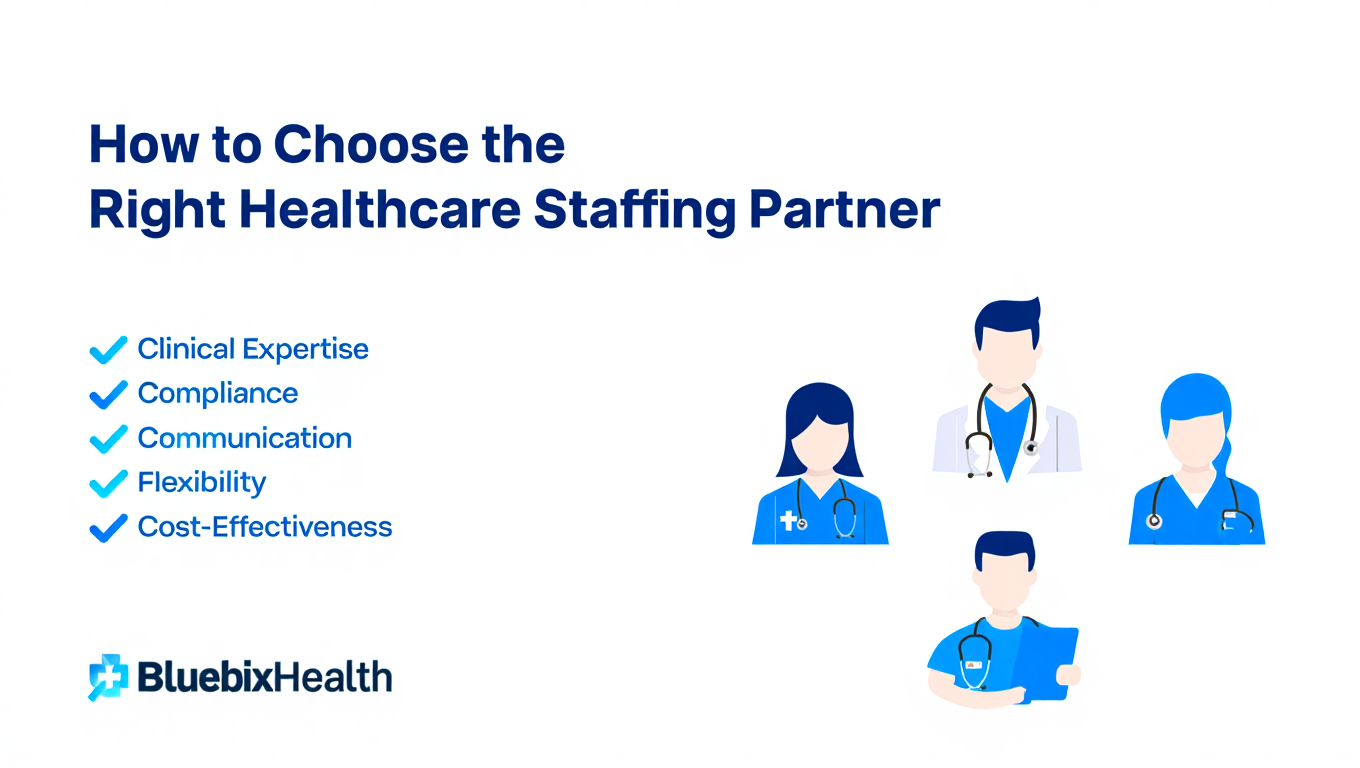
Choosing a staffing partner is like choosing a pilot. You don’t pick the one who says, Trust me. You pick the one with training, checklists, and a proven system.
Use this checklist to evaluate any healthcare recruiter or agency.
8.1 Screening standards: skills testing + behavioral fit
Ask how candidates are screened before submission:
- Unit experience validation (not just RN, but ICU/ER/OR specifics)
- Skills checklists tied to your setting
- Scenario-based questions (What do you do first when…?)
- Behavioral fit screening (communication style, reliability, teamwork)
- Attendance and reliability history (no-shows kill trust fast)
Also, ask about their quality loop: Do they collect manager feedback after shifts? Do they remove poor performers quickly? A partner who measures quality improves over time.
8.2 Verification process: licenses, background checks, immunizations, drug screening
Verified should mean documented proof. Require clarity on:
- License verification steps and frequency (initial + ongoing)
- Background checks (type, jurisdictions, recency)
- Drug screening process (timelines, panel type where relevant)
- Immunization and TB documentation handling
- CPR and advanced cert verification (BLS/ACLS/PALS)
- Reference checks (how many, from whom, and what’s asked)
- Exclusion checks and audit trails, where applicable
Ask for a sample (redacted) credentialing checklist. If they can’t show it, they likely don’t have it.
8.3 Speed benchmarks: time-to-submit, time-to-fill, replacement policy
Speed without measurement is just hope. Ask for:
- Time-to-submit: How fast after a requisition do you get qualified profiles?
- Time-to-fill: how fast do shifts get confirmed and covered?
- Fill rate: how often do they successfully fill requested shifts?
- Replacement policy: what happens if someone cancels or no-shows?
Put it into a simple SLA. Even a one-page SLA improves accountability and reduces confusion during urgent needs.
8.4 Communication: single point of contact, escalation path, transparency
Communication is where partnerships win or fail. Look for:
- A single point of contact who owns outcomes
- Clear escalation steps for urgent gaps
- Transparent status updates (not vague, working on it)
- Fast response expectations (especially for nights/weekends if you operate 24/7)
Ask directly: If a clinician cancels two hours before shift, what happens next—and who calls whom?
8.5 Tech & workflow fit: ATS/VMS integration, scheduling tools, reporting
- ATS and VMS integration options
- Scheduling tools and the shift confirmation process
- Candidate document collection and e-signature
- Reporting dashboards (fill rate, time-to-fill, cancellations, spend)
Even simple integration, like clean candidate packets and consistent status tags, can save hours each week.
8.6 Pricing clarity: bill rates, markup, overtime rules, cancellation terms
Pricing must be predictable. Confirm:
- Bill rates by role and shift
- Any markups or differentials
- Overtime rules and holiday rates
- Cancellation terms and notice windows
The goal is no surprises, because surprises break trust.
9. How to Implement a Staffing Solution in 30 Days (Step-by-Step)
A staffing solution works best when you roll it out like a project, not a panic button. Here’s a practical 30-day path.
9.1 Week 1: Define demand (roles, shifts, unit needs, must-have skills)
Start with clarity:
- Which roles are hardest to fill? (RN, CNA, MA, therapists)
- Which shifts break your schedule most often?
- Which units are highest risk if short-staffed?
- Must-have vs nice-to-have skills (be strict on must-haves)
This is basic workforce planning. If you define the target well, everything downstream moves faster: screening, submissions, interviews, and onboarding.
9.2 Week 1–2: Build an intake workflow (job profiles, pay bands, approvals)
Speed dies when the intake is messy. Create a simple requisition intake:
- Standard job profile templates (role, unit, shift, start date)
- Pay bands or bill rate ranges are pre-approved
- Named approvers (no committee approvals in urgent hiring)
- Interview availability blocks (so scheduling is instant)
Think of intake like ordering from a menu. If the menu is clear, the kitchen moves fast.
9.3 Week 2: Align screening + credential requirements
Define what qualified means:
- Required certifications by role
- Minimum experience for specialty units
- Immunization and TB policy requirements
- Background check expectations
- Facility-specific onboarding steps
Then share one clear checklist with your staffing partner. This prevents last-minute document chases and reduces almost-ready candidates.
9.4 Week 2–3: Launch sourcing + fast interview loop (same-day scheduling)
Now move fast:
- Same-day interview slots for urgent roles
- Short structured interviews (10–20 minutes) focused on unit-fit
- Offer decisions within 24 hours for priority needs
- Keep a bench list of approved candidates ready to schedule
This is where rapid hiring becomes real. The trick is consistent fast loops every time, not only when leadership is stressed.
9.5 Week 3–4: Onboarding plan (facility orientation, EMR access, badge, policies)
Onboarding is where staffing succeeds or fails. Create a first-day success kit:
- Facility orientation mini-module (30–60 minutes)
- Badge access and unit entry process
- EMR access steps (and who owns them)
- Policy highlights (HIPAA, infection control, incident reporting)
- Point person for the first shift (no temp should feel lost)
A smooth onboarding is like a good runway; landings become safer and calmer.
9.6 Day 30: Review metrics + optimize
At day 30, review:
- Time-to-submit and time-to-fill
- Fill rate and cancellation/no-show rate
- Manager satisfaction
- Cost impact (OT reduction, vacancy coverage)
Then adjust: tighten screening questions, improve intake, refine shift communication, and expand your proven rehire pool.
10. Credentialing and Compliance: What Verified Should Mean
In healthcare, verified must mean more than they emailed a document. It should mean the information was checked, documented, and is audit-ready.
10.1 Minimum verification set by role (licenses, certifications, references)
At a minimum, role-based verification should include:
- Licensing board verification for clinical licenses
- Certification verification (BLS/ACLS/PALS as required)
- Identity confirmation and work eligibility
- Work history validation (especially for high-acuity roles)
- Professional references (ideally supervisor-level)
- Background checks aligned to role and policy
For providers, you may also need privileging steps depending on your organization’s process. The goal is consistent standards that support Joint Commission readiness and internal audits.
10.2 Common pitfalls: expired certs, incomplete immunization records
Most credential issues are boring—but expensive:
- BLS expired last month
- ACLS is not aligned with your policy
- Immunization records are missing dates or boosters
- TB documentation incomplete
- Name mismatch across documents
- Out-of-date background checks
Avoid this by requiring a complete credential packet before scheduling. We’ll get it later, but we can’t onboard them, and your shift is still uncovered.
10.3 Documentation and audit-readiness
Audit readiness means:
- You can show what was verified
- When it was verified
- Who verified it
- Where the proof came from
Ask your staffing partner for documentation practices and retention timelines. If your facility is ever questioned, clean documentation is your safety net.
10.4 Protecting patient data and privacy (HIPAA basics for temps)
Temporary staff must follow HIPAA the same as permanent staff:
- No casual sharing of PHI
- Secure logins and logout habits
- Proper disposal of printed materials
- No photos or messages containing patient identifiers
A short HIPAA refresher during onboarding prevents the I didn’t know risk.
11. Technology That Makes Staffing Faster and Safer

Technology won’t fix a broken process, but it will amplify a good one.
11.1 Talent pipelines: always-on pools vs post and pray
Posting jobs and waiting is post and pray. It’s slow and unpredictable. A modern staffing solution uses a talent pipeline:
- Pre-qualified candidate pools by role and shift
- Rehire lists of proven temps
- Ongoing outreach and relationship building (talent CRM)
Always-on pipelines are like keeping your pantry stocked. When demand hits, you cook dinner—not run to the store.
11.2 Automated matching: skills, location, availability, shift preferences
Matching gets faster when you standardize data:
- Skills and certifications are tagged properly
- Location radius and commute preferences
- Availability calendars
- Shift preferences and specialty experience
Automated matching reduces manual sorting and helps recruiters submit better-fit candidates faster, especially for per diem and high-volume needs.
11.3 Real-time communication: SMS/Teams/Slack updates, status tracking
Real-time updates stop delays:
- Candidate confirmed
- Credentialing in progress
- Cleared and ready
- On-site check-in
Whether it’s SMS or integration with Teams/Slack, fast communication prevents last-minute surprises.
11.4 Reporting dashboards for HR and staffing managers
Dashboards should answer:
- How fast are we filling?
- Where do we lose candidates?
- Which units have the most cancellations?
- What’s the cost impact?
Clear reporting turns staffing from chaos into a manageable system.
12. Measuring Success: KPIs Employers Should Track
Track a small set of KPIs that map to what you care about: speed, reliability, quality, and cost.
12.1 Speed metrics: time-to-submit, time-to-fill
Two speed metrics matter most:
- Time-to-submit: How fast you receive qualified candidate profiles after a request
- Time-to-fill: How fast the role/shift is confirmed and covered
Speed improves when your intake workflow is clean, and your partner has an active pipeline. If time-to-submit is slow, the pipeline is likely thin, or your requirements aren’t clear.
12.2 Reliability metrics: fill rate, no-show rate, replacement rate
Reliability metrics protect operations:
- Fill rate: % of shifts filled out of shifts requested
- No-show rate: % of confirmed shifts that fail coverage
- Replacement rate: How often replacements are needed and how fast they’re provided
A staffing partner can look fast but still be unreliable. Reliability is where trust is earned.
12.3 Quality metrics: manager satisfaction, 30/60/90-day performance
Quality metrics keep staffing from becoming churn:
- Manager satisfaction scores after shifts
- Unit-fit feedback (skills, communication, pace)
- 30/60/90-day performance for permanent placements
- Rehire rates for temps (a strong signal of quality)
If quality is low, tighten screening questions and unit-fit matching, not just sourcing volume.
12.4 Cost metrics: vacancy cost avoided, overtime reduction, cost-per-hire
Cost metrics should include:
- Overtime hours reduced
- Vacancy cost avoided (lost throughput, manager time, burnout impact)
- Cost-per-hire (especially for permanent roles)
A practical rule: evaluate cost with outcomes. Cheaper coverage that increases no-shows or burnout is not cheaper.
13. Building Long-Term Stability: Retention and Workforce Planning
Staffing is not only about hiring. It’s about keeping good people and planning ahead so you’re not always in crisis mode.
13.1 Fixing churn drivers: scheduling, workload, onboarding quality
Turnover often comes from the same roots:
- Unstable schedules
- Workloads that feel unsafe or unfair
- Weak onboarding that leaves staff unsupported
- Lack of growth or recognition
Your retention strategy should start with the basics:
- Improve schedule predictability where possible
- Reduce chronic overtime
- Strengthen onboarding (especially the first 30 days)
- Listen to frontline feedback and act on patterns
When teams feel supported, they stay longer, and staffing becomes easier.
13.2 Blended workforce strategy: core staff + float pool + partners
A stable model blends:
- Core permanent staff for continuity
- Internal float pool for routine gaps
- External staffing partners for spikes and specialties
This reduces agency dependence while maintaining coverage safety. It also protects staffing ratios during seasonal surges.
13.3 Creating a rehire-ready system for proven temps
One of the smartest moves employers make is building a rehire-ready list:
- Track top-performing temps
- Offer them first access to shifts
- Keep credentials up to date
- Maintain a quick re-onboarding path
This turns temporary staffing into a reliable bench. Instead of starting from scratch each time, you’re reactivating proven talent faster, safer, and more consistently.
14. Where to Find Healthcare Staffing Solutions (and What to Ask First)

When employers search for a top healthcare staffing agency near me, they’re often looking for immediate help. But the best results come from choosing the right source for your needs.
14.1 Sources: specialized agencies, platforms, internal referral engines
Common sources include:
- Specialized staffing agencies focused on healthcare roles
- Regional and national staffing partners for broad coverage
- Talent platforms for per diem and rapid scheduling
- Internal referral engines (employee referrals, alumni networks)
- Partnerships with schools and training programs (longer-term pipeline)
Many employers use more than one source, especially if they hire across nursing, allied health, and clinic roles.
14.2 Questions to ask in the first call (screening, speed, compliance, reporting)
Use these first-call questions to filter quickly:
- How do you screen candidates for unit fit?
- What does your credentialing process include?
- What are your time-to-submit and time-to-fill benchmarks?
- What’s your fill rate and no-show rate?
- How do you handle cancellations and replacements?
- Can you support our roles and shifts (nights/weekends/specialties)?
- What reporting do you provide (weekly/monthly)?
Good partners answer clearly. Great partners show proof.
14.3 Red flags: vague verification, slow response, limited role coverage
Watch for red flags:
- We verify everything without explaining how
- Slow response times or unclear ownership
- No reporting or only vanity metrics
- Limited coverage for your critical roles or shifts
- No replacement policy
If they can’t run a clean process before you sign, they won’t run one after.
15. Conclusion: A Practical Next Step Plan for Employers

You don’t need a perfect staffing system to get better results; you need a clear plan and a partner (or process) you can trust.
15.1 Quick recap + recommended path: assess needs → choose model → set KPIs
Here’s the simplest path forward:
- Assess needs: Identify your most painful roles, shifts, and units.
- Choose the right model: Temporary, per diem, travel, permanent placement, locum tenens, or a hybrid with a float pool.
- Define verified: Set credentialing and compliance standards upfront.
- Implement fast workflows: Clean intake, quick interviews, structured onboarding.
- Track KPIs: Time-to-submit, time-to-fill, fill rate, no-shows, quality, and cost impact.
When you treat staffing like a system, not a scramble, you get stability.
15.2 Call to action: request qualified applicants and streamline hiring
If your teams are stretched and your open shifts keep stacking up, it’s time to simplify. The right healthcare staffing solution brings you verified candidates, faster time-to-fill, and clearer communication without sacrificing quality.
Ready for a smoother hiring experience? Request qualified applicants through Bluebixhealth and build a staffing pipeline that keeps your units covered, your managers supported, and your patients cared for, today and long-term.
10 FAQs
1. How do I prove a staffing partner’s candidates are actually “verified”?
Ask for their exact verification checklist (licenses, certifications, references, exclusions, background checks) and whether they provide audit-ready documentation. Require timestamped proof, renewal tracking, and a clear process for handling expiring credentials before a shift is ever confirmed.
2. What’s the smartest way to reduce agency dependency without risking coverage gaps?
Use a blended model: strengthen core hiring, build an internal float pool, and keep an external partner for spikes and hard-to-fill roles. Track fill-rate and overtime weekly. Over time, convert high-performing temps to permanent roles to stabilize staffing.
3. Why do fast hires sometimes fail in the first two weeks?
Usually it’s unit mismatch, unclear expectations, or weak onboarding—not just candidate quality. Fix it by sharing unit culture and patient acuity upfront, standardizing orientation, and assigning a single point-of-contact for temps during the first 3–5 shifts.
4. What staffing metrics matter more than time-to-fill?
Time-to-submit, shift fill rate, no-show rate, replacement rate, and manager satisfaction are often more revealing. A partner can fill fast but still create chaos. Reliable coverage with fewer call-offs and better unit fit usually beats speed alone.
5. How should pricing be compared across staffing vendors?
Compare total cost impact, not just bill rates: cancellation terms, overtime rules, replacement guarantees, and vacancy cost avoided. Ask for a transparent markup structure and whether rates change by specialty, shift, or urgency. The cheapest rate can be the most expensive outcome.
6. What’s the biggest compliance risk with temporary clinical staff?
Incomplete credentialing and inconsistent policy training. Employers should require documented license checks, exclusion screening, immunization verification, and HIPAA/policy acknowledgment. Also, clarify who is responsible for tracking renewals—your team or the staffing partner, before onboarding begins.
7. Can staffing solutions improve applicant quality, not just volume?
Yes, if the partner runs structured screening, skills validation, and role-specific matching. “More applicants” isn’t helpful if they’re unqualified. Ask about pass rates, specialty pipelines, and how they evaluate soft skills like communication, adaptability, and patient empathy.
8. When does per diem staffing outperform travel staffing?
Per diem often wins for local flexibility and consistent shift coverage, especially for routine gaps and call-outs. Travel staffing is better for extended shortages, rural/remote coverage, or specialized units. Many employers use per diem to stabilize daily operations and travel for critical shortages.
9. How do I prevent communication breakdowns between managers, HR, and the staffing provider?
Set one intake format (role, shift, must-haves), one response SLA, and one escalation path. Use shared status tracking (even a simple dashboard) and require confirmation checkpoints: submission received, interview scheduled, credentials verified, start confirmed, first-shift check-in.
10. What should I do with a temp clinician who’s “fine,” but not a great fit?
Act quickly and respectfully. Document specific issues, give the partner immediate feedback, and request a replacement under the agreed policy. Also, ask the vendor to adjust future matching criteria (unit style, pace, patient acuity) so the next candidate fits better.