
Healthcare Staffing Solutions for Urgent Hiring Needs
Healthcare staffing solutions are no longer a backup plan. For many employers, they are now part of the main hiring strategy. Hospitals, clinics, long-term care facilities, and home health agencies are trying to do more with tighter teams, rising patient demand, and growing pressure to hire qualified people quickly.
The labor market explains why: BLS projects about 1.9 million openings per year across healthcare occupations from 2024 to 2034, including about 189,100 RN openings annually, while NCSBN reports more than 138,000 nurses burnout the workforce since 2022 and almost 40% say they intend to leave by 2029.
If you are a healthcare employer, medical staffing manager, HR lead, or recruiter, you are likely not searching for theory. You are searching for answers. You want to know how to fill open shifts faster, how to get verified candidates you can trust, and how to stop the hiring process from draining your team.
That is exactly where healthcare staffing solutions come in.
This guide breaks down what healthcare staffing solutions are, who needs them, which staffing models work best, how the process works, and how to choose a partner that can actually help. Along the way, we will also cover staffing solutions for healthcare industry teams that need speed, trust, compliance, and flexibility without the usual confusion.
What Are Healthcare Staffing Solutions?
Healthcare staffing solutions are services that help healthcare employers find, screen, place, and support qualified professionals in clinical and non-clinical roles. That can include registered nurses, licensed practical nurses, caregivers, therapists, medical assistants, advanced practice providers, office staff, and many others.
In simple terms, these solutions help healthcare organizations connect the right people to the right roles at the right time.
But when employers search for staffing solutions for healthcare, they usually mean something more specific.
They mean:
- We need people fast.
- We need candidates who are already screened.
- We need less back-and-forth.
- We need help with urgent openings and hard-to-fill roles.
- We need a hiring process we can trust.
That is the real search intent behind this topic.
A healthcare facility does not feel staffing pressure as an abstract business problem. It feels it in real time. It shows up in delayed onboarding, overtime costs, open shifts, tired managers, recruiter overload, and pressure on patient care. You may still move forward, but not smoothly, not safely, and not for long.
The term matters even more today because workforce strain is not temporary. HRSA projects ongoing nationwide nursing shortages, including 108,960 registered nurses and 245,950 licensed practical nurses by 2038, with larger RN shortages in nonmetropolitan areas.
BLS also projects strong demand across core healthcare roles, showing that the hiring challenge is not likely to disappear soon.
In other words, healthcare staffing solutions are no longer only about filling holes. They are about building resilience.
Who Needs Healthcare Staffing Solutions?
The short answer is this: almost every healthcare employer can benefit from the right staffing support.
Hospitals and Health Systems
Hospitals need consistent coverage across departments, specialties, shifts, and campuses. One opening can trigger a chain reaction. A missed hire in med-surg can raise workload for the rest of the team. A vacant imaging role can slow patient flow. A shortage in support staff can create pressure far beyond the department itself.
Large health systems also need scale. They may hire for dozens of roles at once, across multiple locations, while trying to balance budgets, patient experience, and compliance.
Clinics, Urgent Care Centers, and Outpatient Facilities
Smaller facilities often have lean teams. That makes every open role more visible. If one medical assistant leaves, the whole front-end workflow can slow down. If one nurse is unavailable, patient scheduling may shift. These teams usually need fast hiring without a long recruiting cycle.
Long-Term Care, Nursing Homes, and Rehab Centers
These settings depend on dependable staffing and continuity of care. Residents and patients benefit when care teams are stable. High turnover and last-minute gaps can affect service quality, staff morale, and family trust.
Home Health and Hospice Providers
These employers need field-ready professionals who combine clinical skill with compassion, independence, and communication. The role fit matters just as much as the license. In home-based care, the wrong match is not just inconvenient. It is visible immediately.
HR Teams, Staffing Managers, and Recruiters
Many readers of this topic are not clinicians. They are the people trying to keep hiring moving. They need reliable candidate flow, fewer delays, stronger screening, faster updates, and simple communication. They want less chaos and more control.
That is why flexible staffing solutions for healthcare are so valuable. Different care settings have different pressure points, but the need is the same: fast, qualified, trusted support.
Types of Healthcare Staffing Solutions Explained
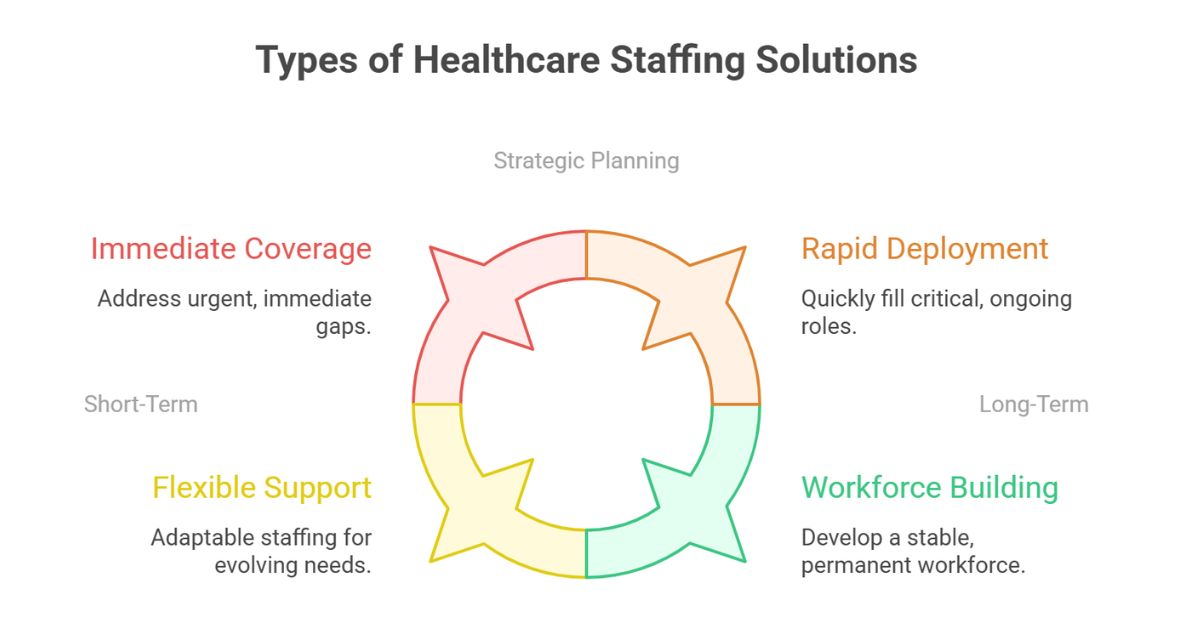
Not every staffing problem needs the same answer. A facility with one urgent weekend gap needs a different model than a hospital building a long-term workforce plan.
Here are the main types of healthcare staffing solutions and when they make the most sense.
Temporary Healthcare Staffing
Temporary staffing helps cover short-term needs. This may include vacations, medical leave, census spikes, flu season, or open shifts while a permanent search continues.
Think of temporary staffing as a bridge. It helps you cross a staffing gap without stopping traffic on the road.
Per Diem Staffing
Per diem staffing is one of the most flexible staffing solutions for healthcare employers. It is useful for last-minute needs, variable schedules, and shift-by-shift coverage. If your challenge is sudden call-outs or unpredictable demand, per diem support can help keep operations stable.
Contract Staffing
Contract staffing is usually set for a specific time period. It is common during transitions, expansions, special projects, or when an employer needs skilled support without making an immediate permanent hire.
Travel Healthcare Staffing
Travel staffing is often used when local talent is limited or a facility needs extended coverage. This model can be especially helpful in rural areas, hard-to-fill specialties, or locations facing repeated shortages.
Locum Tenens Staffing
Locum tenens staffing is widely used for physicians, nurse practitioners, physician assistants, and specialty providers. It helps maintain care access when a provider is on leave, a role is vacant, or patient demand rises.
Direct Hire or Permanent Placement
Direct hire staffing is the right fit when the goal is long-term stability. This model focuses on finding candidates who not only qualify on paper but also fit the team, schedule, workflow, and culture. It is less about “fill the shift” and more about “build the team.”
Allied Health Staffing
Allied health staffing includes therapists, imaging professionals, lab staff, respiratory therapists, sonographers, and similar roles. These positions can be difficult to fill because they require specific credentials and experience. BLS continues to show broad demand across many technical and support healthcare occupations, which is one reason specialized sourcing matters.
Non-Clinical Healthcare Staffing
Healthcare also depends on scheduling staff, medical billers, patient coordinators, front-desk teams, case support, and administrative professionals. When these roles are open, patient flow and staff efficiency can suffer.
The key lesson is simple: staffing is not one-size-fits-all. The best staffing solutions for healthcare industry employers match the hiring model to the real problem.
Roles Commonly Filled Through Healthcare Staffing Solutions
Healthcare staffing support covers a wide range of roles. Most employers first think of nurses, but the need is much broader.
Nursing Roles
Nursing remains the center of many staffing conversations. Common roles include:
- Registered nurses
- Licensed practical nurses
- Nurse practitioners
- Travel nurses
- Per diem nurses
- Nurse managers
- Charge nurses
This demand is backed by Workforce projections data. BLS projects about 189,100 RN openings each year and about 54,400 LPN/LVN openings each year from 2024 to 2034.
Allied Health Roles
Facilities also hire for:
- Physical therapists
- Occupational therapists
- Respiratory therapists
- Radiologic technologists
- Ultrasound technologists
- Lab professionals
- Speech-language pathologists
Support and Caregiving Roles
These roles keep day-to-day care moving:
- CNAs
- Caregivers
- Home health aides
- Medical assistants
- Patient care technicians
Physician and Advanced Provider Roles
These include:
- Physicians
- Physician assistants
- Nurse practitioners
- Specialty providers
Demand is especially notable among advanced practice roles. BLS projects 35% employment growth for nurse anesthetists, nurse midwives, and nurse practitioners from 2024 to 2034, much faster than average.
Administrative and Operational Roles
Hiring support can also cover:
- Medical receptionists
- Care coordinators
- Billing specialists
- Schedulers
- Health information staff
In healthcare, every role touches care in some way. That is why staffing solutions should look at the full care system, not just the most visible vacancies.
Why Healthcare Employers Use Staffing Solutions

Why do healthcare employers turn to staffing partners instead of trying to handle everything in-house?
Because hiring pressure is expensive in more ways than one.
Faster Hiring During Urgent Staffing Gaps
A strong staffing partner shortens the time between when we need help and when someone is in place. That matters because open roles create ripple effects. Schedules get reshuffled. Over time climbs. Team morale drops. Patient flow slows.
Access to Qualified, Pre-Screened Candidates
Good staffing support is not only about volume. It is about a better fit. That means license checks, skill alignment, screening, availability matching, and realistic conversations before the candidate reaches your desk.
Better Staffing Flexibility
Healthcare demand changes fast. Weekends are different from weekdays. Flu season is different from summer. A new contract, a new unit, or staff leave can change hiring needs overnight. Flexible staffing solutions for healthcare give employers room to adjust without rebuilding the whole hiring engine each time.
Lower Recruiting Burden on Internal Teams
Your HR or recruiting team may already be stretched. A staffing partner can handle sourcing, outreach, screening, and coordination, which gives internal teams more space to focus on interviews, onboarding, and retention.
Improved Patient Care Continuity
This is the real heart of the issue. Consistent staffing supports smoother care delivery, less disruption, and less stress on the people already working. When staffing is stable, patients feel it too.
Reduced Burnout for Existing Staff
Burnout and staffing pressure are closely linked. NCSBN’s 2024 nursing workforce findings show that stress and burnout remain major issues, with more than 138,000 nurses leaving the workforce since 2022 and nearly 40% intending to leave by 2029.
That is one reason smart staffing support matters so much. It helps reduce the load on the team you are trying to keep.
Scalable Support
A good staffing partner can help with one urgent role today and a broader workforce plan tomorrow. That scalability matters because healthcare hiring does not stay still.
The American Hospital Association highlighted projections of about 100,000 critical healthcare worker shortages by 2028, with especially severe pressure expected for nurse assistants in many states. That tells employers something important: waiting for the labor market to “settle down” is not a strategy.
How Healthcare Staffing Solutions Work Step by Step
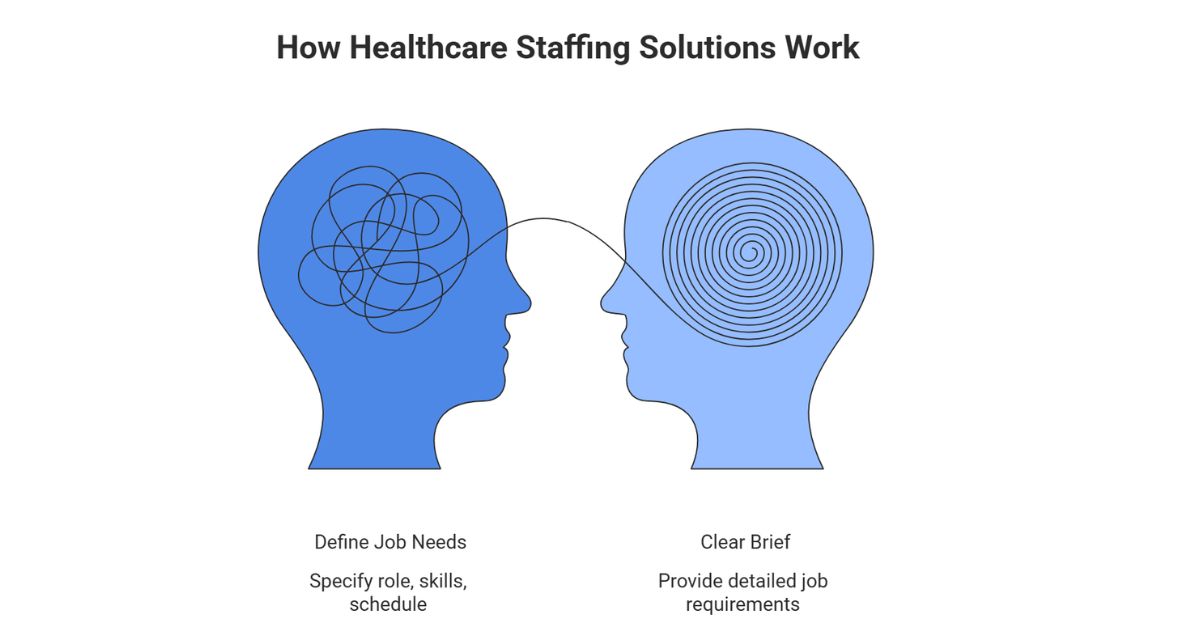
A good staffing process should feel less like guesswork and more like a well-run handoff.
Step 1: Understand the Need Clearly
Everything starts with the job itself. What role do you need? What license or certification is required? What shift, unit, schedule, location, and start date matter most? Is this short-term coverage or a long-term hire?
A vague request creates vague results. A clear brief creates better matches.
Step 2: Source and Screen Candidates
The staffing partner searches its network, databases, referrals, and outreach channels to identify qualified candidates. Screening should go beyond resumes. It should look at experience, work setting fit, schedule alignment, communication style, and readiness to start.
Step 3: Verify Credentials and Compliance
In healthcare, this step is not optional. It includes license checks, education verification, work status, background checks, references, and role-specific health or onboarding documents as required.
If it is weak, everything above it is at risk.
Step 4: Coordinate Interviews and Feedback
A strong staffing partner helps both sides move quickly. That means interview scheduling, candidate prep, employer feedback, and clear updates. Communication matters here more than many agencies realize.
Step 5: Placement and Onboarding
Once the hire is made, onboarding support helps reduce drop-off and start-date delays. Good staffing partners stay involved through this stage.
Step 6: Ongoing Support
The best staffing relationships continue after placement. That may include check-ins, replacement support if needed, and future planning.
This process is one reason many healthcare employers prefer staffing solutions for healthcare industry hiring needs. The goal is not just to send resumes. The goal is to create a smoother hiring workflow from need to start date.
In-House Hiring vs. Healthcare Staffing Solutions
In-house hiring still has an important place. If you have a strong internal recruiting team, predictable hiring needs, and enough time, you may be able to fill many roles without outside support.
But healthcare hiring often does not happen under calm conditions.
When In-House Hiring Works Best
In-house recruiting may be the best fit when:
- The role is not urgent
- The talent pool is accessible locally
- The organization has strong employer branding
- The team has time for sourcing and screening
- The role is part of a steady, long-term workforce plan
When Staffing Solutions Are the Better Option
Staffing support is often better when:
- A vacancy is affecting operations now
- The role is hard to fill
- There are multiple openings at once
- Internal recruiters are overloaded
- The employer needs flexibility
- The location is highly competitive or rural
Cost, Speed, and Quality Trade-Offs
This is where many employers hesitate. They compare agency cost to salary cost and stop there.
But the real math is broader.
The cost of a vacant role may include overtime, manager time, scheduling stress, slower patient throughput, missed revenue opportunities, recruiter overload, and burnout risk. The longer the position stays open, the more the hidden cost grows.
With healthcare demand projected to remain high across the next decade, especially for nursing and advanced practice roles, slow hiring has a real opportunity cost.
The Hybrid Hiring Model
Many employers now use a hybrid model. They keep part of hiring in-house and use staffing partners for urgent openings, niche roles, high-volume needs, or hard-to-reach markets.
That approach often works well because it balances control with speed.
Common Healthcare Hiring Challenges and the Right Staffing Solution for Each
Every staffing problem has a pattern. Once you see the pattern, the right solution becomes clearer.
Last-Minute Call-Outs and Shift Gaps
Best solution: Per diem and on-demand staffing.
These needs require speed and flexibility. Employers should have a ready pool instead of starting from zero each time.
Hard-to-Fill Specialty Roles
Best solution: Specialized recruiters and deeper talent networks.
Specialty roles often need targeted sourcing, not general job postings. This is especially true for advanced practice, imaging, therapy, and provider positions.
High Turnover in Clinical Roles
Best solution: Better screening and a more direct-hire focus.
Turnover is not only a sourcing issue. It is often a fit issue. Better role matching, honest conversations, and retention-minded hiring matter more than quick fill rates alone.
Burnout from Overtime and Understaffing
Best solution: Flexible staffing coverage and proactive planning.
If the same team is repeatedly covering gaps, fatigue builds. NCSBN’s findings on workforce exits and intent to leave show why employers cannot ignore this pattern. Staffing support can act like pressure relief before the system cracks.
Multi-Location Hiring Needs
Best solution: Scalable staffing support.
Health systems and multi-site groups need consistency across locations without reinventing the process every time.
Slow Credentialing and Onboarding
Best solution: Agencies with strong pre-verification processes.
Credentialing delays can turn a “filled role” into an unfilled one very quickly. The right staffing partner should treat compliance speed as part of hiring speed.
These challenges are not isolated. They connect to broader labor market realities. HRSA projects nationwide nursing shortages, and AHA points to serious shortages in several critical healthcare roles and sharp geographic variation.
That means many facilities are competing for the same talent at the same time.
Compliance, Credentialing, and Quality Assurance in Healthcare Staffing
In many industries, a weak hire is a business problem. In healthcare, it can also become a patient-care problem.
That is why compliance, credentialing, and quality assurance sit at the center of good healthcare staffing agency.
Why Compliance Matters
Healthcare employers need confidence that candidates are legally and professionally qualified to work in the role. That includes license validation, certification checks, education review, background screening, work eligibility, and role-specific requirements.
What Should Be Verified Before Placement
At minimum, employers should confirm:
- active licensure where required
- relevant certifications
- education or training history
- work eligibility
- background checks
- references
- immunization or health documentation, when applicable
- unit or specialty readiness
How Strong Staffing Partners Reduce Hiring Risk
A good staffing partner builds these checks into the process, not as an afterthought. They document clearly, communicate quickly, and help employers stay organized.
Quality assurance also means looking beyond documents. It means asking: Can this person work this schedule? In this setting? With this patient population? On this team?
Questions Employers Should Ask
Before choosing a partner, ask:
- How do you verify licenses and certifications?
- How often do you re-check credentials?
- How do you document compliance?
- How do you handle urgent replacements?
- What is your turnaround time for screened candidates?
- How do you support audit readiness?
Trust in healthcare hiring is built one verified detail at a time.
How to Choose the Right Healthcare Staffing Partner
Choosing a healthcare staffing partner is like choosing a co-pilot. You do not need someone who only shows up when the weather is clear. You need someone who can help when conditions are difficult.
Look for Healthcare Specialization
Healthcare hiring is different from general recruiting. The partner should understand clinical roles, workflows, patient-facing expectations, shift realities, and compliance pressure.
Evaluate Speed and Responsiveness
Ask how quickly they present candidates. Ask how often they communicate. Ask what happens when a role is urgent. Fast response is not a bonus in healthcare. It is part of the service.
Review Screening and Credentialing Standards
You should know exactly how candidates are screened and what is verified before presentation. If the answer sounds vague, that is a warning sign.
Ask About Role Coverage and Candidate Depth
Can they support nurses, caregivers, therapists, medical assistants, and specialty roles? Can they help with both urgent and long-term hiring?
Assess Communication and Account Support
Bluebix Health’s audience values easy communication for a reason. Good staffing partnerships reduce admin burden. They do not create more of it.
Check Flexibility and Scalability
Can the partner help with one role this week and ten roles next month? Can they adjust by location, unit, or hiring model?
Review Reputation and Process Clarity
Look for proof of consistency, not just marketing claims. A trustworthy partner explains the process clearly, sets realistic expectations, and follows through.
The best healthcare staffing partner is not simply the one with the biggest database. It is the one that understands your hiring pressure and responds with structure, speed, and credibility.
Where to Find Reliable Healthcare Staffing Solutions

Healthcare employers have several choices when looking for staffing support.
Local Partners
Local agencies may understand community labor markets, regional pay pressure, and local facility expectations very well. They can be a strong fit when you need close market knowledge.
Regional Partners
Regional firms often balance reach and responsiveness. They may be a good option if you operate across several nearby markets and need consistency without losing local understanding.
National Partners
National agencies can help with larger volume, wider reach, travel staffing, and multi-state hiring. They may be especially useful for health systems, provider groups, and organizations with broad geographic needs.
Industry-Specific Healthcare Staffing Agencies
This is often the smartest route for clinical hiring. Specialized healthcare staffing companies understand the difference between a resume that looks good and a candidate who will actually work well in your setting.
What to Look for on a Staffing Agency Website
Look for signs of real capability:
- clear role coverage
- visible screening process
- compliance standards
- fast-response messaging
- simple contact options
- evidence of healthcare specialization
- clear communication promises
Because trust matters so much in staffing solutions for healthcare, the right website should not feel vague or overly polished. It should feel clear, specific, and useful.
What Results Should Employers Expect from the Right Staffing Solution?
The best staffing partnership should create results you can actually feel in daily operations.
Faster Time-to-Fill
You should see less delay between job opening and candidate presentation.
Better Candidate Quality
You should spend less time sorting through mismatched applicants and more time speaking with qualified people.
Fewer Scheduling Disruptions
A strong staffing strategy reduces scramble mode. It does not eliminate every problem, but it lowers the frequency and intensity of staffing shocks.
Lower Overtime Strain
When more roles are filled on time, the pressure on the existing team eases.
A Better Hiring Experience
This matters on both sides. Employers want smoother workflows. Candidates want timely communication and clear expectations. Good staffing support improves both.
The right expectations are realistic, not magical. A staffing partner cannot fix every workforce issue overnight. But they can help you move from reactive hiring to smarter, more stable hiring.
How Bluebix Health Supports Better Healthcare Staffing Outcomes
At its best, Bluebix Health can support healthcare employers in the areas that matter most: speed, trust, candidate quality, and communication.
That means helping employers find qualified nurses, caregivers, medical assistants, therapists, and other clinical professionals without turning the hiring process into another burden for internal teams.
It also means understanding that employers do not only want resumes. They want clarity. They want candidates who are screened, verified, and aligned with the role.
They want updates without chasing. They want a process that feels smooth, not scattered.
For facilities facing urgent openings, ongoing growth, or repeated staffing pressure, the value of a trusted staffing partner is simple: faster hiring, better support, and fewer gaps between need and action.
That is what strong healthcare staffing solutions should deliver.
Conclusion
Healthcare hiring is not getting easier. Demand remains high, workforce shortages are real, and the cost of slow or poor hiring shows up in overtime, burnout, service disruption, and patient experience.
National data from BLS, HRSA, NCSBN, and AHA all point to the same truth: healthcare employers need stronger, more flexible hiring strategies, not just more job posts.
That is why healthcare staffing solutions matter.
The right partner helps you fill roles faster, improve candidate quality, reduce administrative strain, stay compliant, and support your existing team before burnout grows worse.
Whether you need temporary coverage, direct hire support, per diem help, or a hybrid staffing strategy, the goal is the same: build a hiring process that protects both operations and care.
For healthcare employers who need reliable, qualified talent and clear communication, that is not just a staffing advantage. It is a business and patient-care advantage.
FAQs
How are healthcare staffing solutions different from posting jobs on your own?
Job posting helps you attract applicants. Healthcare staffing solutions help you find, screen, verify, and place qualified candidates faster. The difference is support. A staffing partner brings sourcing reach, credential checks, market insight, and hiring coordination, which can save time and reduce the burden on HR and recruiting teams.
Are staffing solutions for healthcare industry employers only useful during emergencies?
No. They are valuable for urgent openings, but also for long-term growth, seasonal demand, role backfills, hard-to-fill specialties, and direct hire needs. Many healthcare employers use staffing support as part of an ongoing workforce strategy, not just when things go wrong or schedules suddenly fall apart.
What types of roles can be filled through healthcare staffing solutions?
Healthcare staffing solutions can cover nurses, licensed practical nurses, nurse practitioners, caregivers, therapists, medical assistants, physicians, advanced providers, imaging professionals, lab staff, schedulers, and administrative roles. The best staffing partners support both clinical and non-clinical hiring needs, depending on the facility type, setting, and urgency.
Why do so many employers ask for flexible staffing solutions for healthcare?
Because healthcare demand changes quickly. Patient volume shifts, staff call out, leaves happen, and expansion plans move fast. Flexible staffing solutions for healthcare help employers respond without overloading internal teams. They allow facilities to adjust coverage by shift, timeframe, location, or role without starting every search from scratch.
How quickly can a healthcare staffing partner fill an urgent role?
The answer depends on the role, location, schedule, and compliance requirements. Some needs move quickly, especially when candidates are already screened and available. More specialized roles may take longer. The most important factor is whether the partner has a strong talent pipeline and a process built for speed.
What should employers look for in a healthcare staffing agency?
Look for healthcare specialization, clear communication, strong screening, credential verification, fast response time, flexible hiring models, and a track record of filling similar roles. A good partner should understand your care setting, explain the process clearly, and reduce administrative pressure rather than adding more complexity.
Can staffing solutions help reduce burnout on existing care teams?
Yes. They cannot solve every workforce challenge alone, but they can ease pressure by filling gaps faster, reducing overtime strain, and helping teams avoid constant schedule disruption. When hiring support is reliable, managers spend less time scrambling and staff spend less time carrying extra workload week after week.
Is direct hire part of healthcare staffing solutions, or is it separate?
Direct hire is absolutely part of healthcare staffing solutions. It is one of the most valuable options for employers focused on long-term retention and team stability. Instead of just covering a shift, direct hire helps employers find candidates who fit the role, culture, schedule, and long-term workforce plan.
Do healthcare staffing partners help with credentialing and compliance?
Strong partners do. They should help verify licenses, certifications, work eligibility, background checks, references, and other required documents before placement. In healthcare, compliance is tied closely to patient safety and operational trust, so this support is not just helpful. It is often essential to smarter, lower-risk hiring.
What results should healthcare employers realistically expect from staffing support?
Employers should expect faster candidate flow, better fit, fewer hiring delays, smoother communication, and less pressure on internal teams. They should not expect miracles overnight. The best staffing partner improves the process, shortens the path to qualified hires, and helps create more stable staffing outcomes over time.