
5 Smart Ways Contract Healthcare Staffing Solves Urgent Hiring
Contract healthcare staffing has become one of the most practical ways for healthcare employers to protect patient care, fill urgent gaps, and keep operations moving without lowering standards.
That matters even more now because healthcare employment is projected to grow faster than average, hospitals continue to report workforce pressure, and federal workforce projections still point to ongoing nursing shortages in many areas.
If you are a medical staffing manager, HR leader, healthcare recruiter, or employer trying to find qualified nurses, caregivers, therapists, medical assistants, or support staff fast, you are not just looking for bodies to fill shifts. You are looking for trust.
This guide walks through what contract healthcare staffing is, how it works, when to use it, how to compare it with other staffing models, and how the right staffing partner can help your organization solve hiring problems before they turn into patient care problems.
What Is Contract Healthcare Staffing?
Contract healthcare staffing is a hiring model in which a healthcare employer brings in qualified professionals for a set period, assignment, or project instead of hiring them directly into permanent full-time roles from day one.
These professionals may work for a hospital, clinic, urgent care center, long-term care facility, home health agency, rehabilitation center, or other care setting for a defined contract term.
In simple terms, it is like borrowing a skilled set of hands when your team needs support now, not months from now.
This model is different from direct hire, where a facility hires a candidate as its own permanent employee. It is also different from casual per diem coverage in some cases because contract placements are often designed around defined terms, clear schedules, and ongoing support from a staffing partner.
Some employers use contract staffing for 13-week assignments, some for several months, and some for shorter urgent coverage.
Healthcare employers use contract staffing for many reasons. They may need fast help after a sudden resignation. They may need coverage during leave.
They may be opening a new unit, managing seasonal patient volume, or struggling to fill a specialized role through normal recruiting channels.
What most decision-makers really want to know is not the textbook definition. They want to know whether this model will help them fill roles faster, reduce stress on their internal team, protect patient experience, and avoid the long drag of open positions.
In that sense, contract healthcare staffing is less about a staffing label and more about a practical operating solution.
It is also closely tied to broader healthcare staffing solutions, temporary healthcare staffing, contract medical staffing, and clinical staffing support.
In the real world, these terms often overlap, but the core goal stays the same: place the right clinician or support professional in the right role at the right time.
How Contract Healthcare Staffing Works
The contract healthcare staffing process usually starts with a need that cannot wait. A nurse resigns. A therapist goes on leave. A clinic adds more appointments. A facility’s internal hiring team is buried under open requisitions. At that moment, the employer reaches out to a staffing partner and defines the role.
The Request Stage
The first step is clarity. A healthcare employer shares the job title, shift pattern, facility type, patient population, certifications required, experience level, start date, contract length, and any “must-have” details. This part matters more than many teams realize. A vague request creates vague results.
For example, saying “we need an RN fast” is not enough. Saying “we need an experienced med-surg RN for night shifts, three 12s, EMR experience preferred, start next Monday” gives the staffing partner a real target.
Screening and Matching
Once the request is clear, the staffing partner begins sourcing and screening. That usually includes reviewing work history, validating licensure, checking certifications, assessing skill fit, and confirming availability. The goal is not just speed. It is fit.
A strong staffing process works like a bridge, not a funnel. It should connect the needs of the facility with the experience of the candidate in a way that makes daily operations easier, not harder.
Credentialing and Onboarding
Credentialing is one of the most important parts of the process. It may include license checks, certifications, background screening, health documentation, healthcare immunization records, drug testing, and facility-specific compliance steps. In healthcare, speed matters, but trust matters more. That is why credentialing cannot be rushed carelessly.
Placement and Ongoing Support
After a candidate is approved, the placement starts. But that should not be the end of the relationship. A strong staffing partner continues to support the employer and the worker after the first shift. That means checking attendance, handling questions, replacing poor-fit placements if needed, and keeping communication open.
For healthcare employers, this ongoing support is often the hidden value in contract staffing. It is not just about finding a person. It is about reducing friction after the placement begins.
Who Uses Contract Healthcare Staffing?
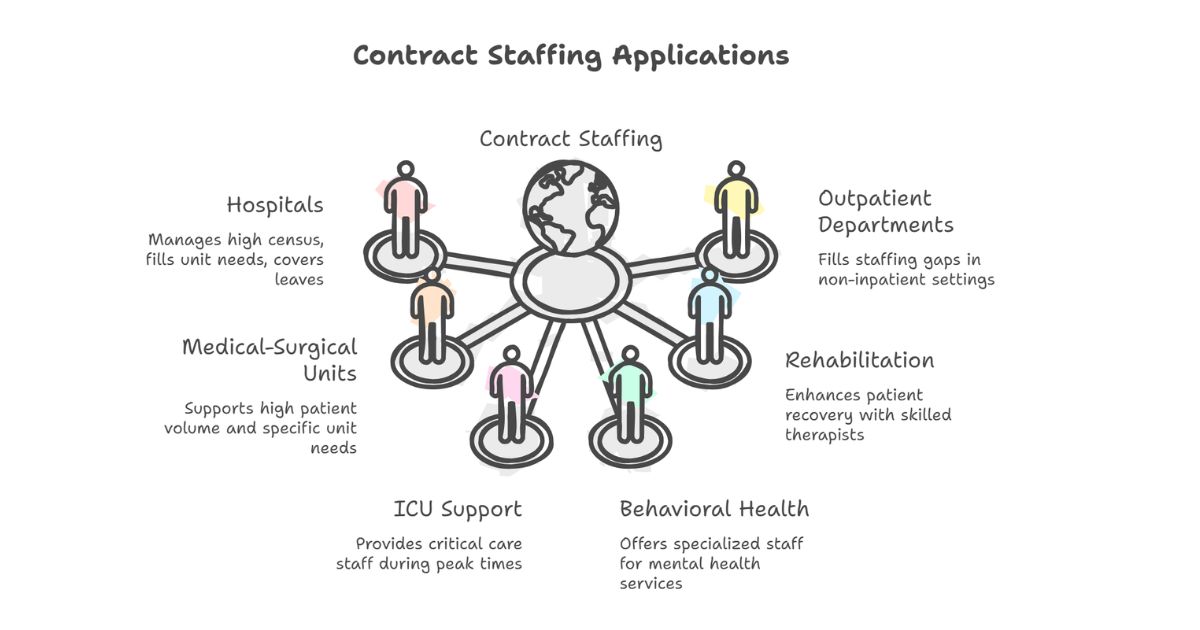
Contract healthcare staffing serves a wide range of employers, not just large hospitals. Any healthcare organization that needs flexible, reliable talent can benefit from it.
Hospitals and Health Systems
Hospitals often use contract healthcare staffing to manage high census periods, fill unit-specific needs, cover leaves, and support departments that are under staffing pressure. Medical-surgical units, ICU support, behavioral health, rehabilitation, and outpatient departments may all use contract talent depending on the need.
Clinics and Physician Practices
Clinics often face a different kind of staffing pressure. They may not need a large number of people at once, but even one missing medical assistant, nurse, or front-desk coordinator can disrupt the flow of the entire day. In smaller settings, one vacancy can feel like removing a wheel from a moving cart.
Long-Term Care and Skilled Nursing Facilities
Long-term care organizations often need dependable support for nurses, caregivers, CNAs, and medication-related roles. These settings depend heavily on consistency, compassion, and shift reliability. Contract staffing can help maintain care continuity when full-time recruiting moves slowly.
Home Health and Hospice
Home health and hospice require workers who can operate with both skill and independence. These teams often need nurses, aides, therapists, and care coordinators who are comfortable outside the walls of a facility. Contract staffing can help these organizations respond faster when caseloads rise or travel coverage becomes harder.
Ambulatory Surgery Centers and Urgent Care
Urgent care and surgery centers need efficiency. Patient throughput, clinical quality, and scheduling precision all matter. Contract staffing supports these environments by helping fill openings that would otherwise slow care delivery.
Behavioral Health, Rehab, and Specialty Care
Behavioral health providers, rehabilitation centers, imaging centers, dialysis settings, and specialty practices also use contract staffing. These roles can be harder to fill because they often require more specific experience and stronger fit.
Digital Health and Emerging Care Models
Some employers now also need support in newer care environments, including telehealth coordination, care navigation, and health-tech-enabled patient support. This is where contract healthcare technology staffing can start to matter.
As healthcare organizations use more digital systems, remote workflows, and platform-based care, they may need contract professionals who understand both patient care and healthcare technology operations.
A staffing model that can support clinical and operational technology roles gives employers more flexibility as care delivery evolves. AHA’s 2026 workforce scan also highlights redesign, technology governance, and evolving staffing models as major workforce themes.
Types of Roles Commonly Filled Through Contract Healthcare Staffing
One of the strengths of contract healthcare staffing is the range. Employers can use it for front-line clinical roles, allied health roles, support roles, and specialized short-term needs.
Registered Nurses and Licensed Practical Nurses
RNs are one of the most common contract roles. They may be needed in med-surg, rehab, telemetry, behavioral health, outpatient clinics, long-term care, home health, or procedural settings. LPNs and LVNs are also frequently placed in long-term care, post-acute settings, clinics, and assisted living.
CNAs, Caregivers, and Direct Care Support
Certified nursing assistants and caregivers help facilities maintain basic patient support, mobility assistance, hygiene care, and daily monitoring. These workers are often the hands and heart of everyday care delivery. When these roles stay open too long, the burden quickly shifts to the rest of the team.
Medical Assistants and Patient Care Technicians
Medical assistants are essential in outpatient settings. They keep visits flowing, handle rooming, collect vital signs, support charting, and help clinicians stay on schedule. Patient care technicians add hands-on support in facility settings where workflow speed matters.
Therapists and Allied Health Professionals
Allied health staffing remains one of the most valuable uses of contract hiring because many of these roles are essential but harder to recruit.
Physical Therapists
Physical therapists support recovery, mobility, and functional progress in hospitals, rehab centers, outpatient clinics, and home health.
Occupational Therapists
Occupational therapists help patients regain everyday skills and independence. Their work is deeply practical and highly specialized.
Speech-Language Pathologists
Speech-language pathologists support communication, swallowing, and recovery after illness or injury.
Respiratory Therapists
Respiratory therapists are especially important in acute care, critical care, pulmonary support, and post-acute settings.
Imaging, Lab, and Diagnostic Roles
Healthcare organizations may also use contract staffing for radiology technologists, sonographers, laboratory professionals, and other diagnostic staff. These roles can become urgent quickly because care delays often start when testing capacity falls behind.
Administrative and Operational Support
Not all staffing pressure is strictly bedside pressure. Employers may also need contract schedulers, medical coders, front-desk staff, patient access workers, care coordinators, and administrative support roles that keep the business side of care moving.
The lesson here is simple: contract healthcare staffing is not only for nurses. It is a flexible model that supports a broad healthcare workforce.
Why Contract Healthcare Staffing Matters in Today’s Healthcare Market
Healthcare staffing pressure is not just a feeling. It is backed by labor market trends. The Bureau of Labor Statistics projects healthcare occupations to grow much faster than average and estimates about 1.9 million openings a year on average due to growth and replacement needs.
HRSA also projects continued nursing shortages, including larger shortages in nonmetropolitan areas.
That matters because understaffing does not stay neatly inside an HR dashboard. It reaches patient access, staff morale, overtime costs, retention, scheduling, and care continuity.
AHA’s workforce materials also describe broad health system pressure and the need for redesigned staffing models and stronger workforce strategies.
This is why contract healthcare staffing matters. It gives employers a way to stay flexible when the labor market is tight. It helps them move faster without pretending the market is easy. It creates breathing room.
Think of it like an overflow valve in a high-pressure system. Without it, the pressure builds until something cracks. With it, the organization gains room to respond before the strain spreads.
For HR teams and recruiters, the value is speed and support. For clinical leaders, it is coverage and continuity. For operations leaders, it is stability. For patients, the benefit is indirect but important: more reliable staffing makes it easier for care teams to function well.
Benefits of Contract Healthcare Staffing for Employers
The benefits of contract healthcare staffing go beyond quick placement. When used well, it improves how a healthcare organization operates day to day.
Faster Access to Qualified Talent
The first clear benefit is speed. Contract staffing can help employers move faster than traditional recruiting when the need is urgent. This matters when every open shift creates stress for managers and fatigue for the staff already on the floor.
Better Flexibility
Healthcare demand moves. Census changes. Leave happens. Service lines grow. A flexible staffing model allows employers to adjust without rebuilding the whole workforce each time.
Reduced Overtime and Burnout
When open roles stay open, the same reliable people usually absorb the extra work. That may keep the schedule standing for a while, but it often increases burnout and morale problems.
Research reviews have consistently found that lower nurse staffing levels and heavier staffing pressure are associated with poorer outcomes and greater nurse burnout.
Contract staffing can help reduce that pressure by spreading the workload more realistically.
Less Hiring Pressure on Internal Teams
HR teams in healthcare often balance urgent hiring, credentialing, scheduling pressure, and leadership expectations at the same time. Contract staffing lightens that load. It does not replace internal recruiting strategy, but it can support it when time is tight.
Better Continuity of Care
Stable staffing supports smoother care delivery. No staffing model can solve every operational issue, but a well-matched contract clinician or support professional can help a unit function with less disruption than an ongoing vacancy would.
Easier Hiring for Hard-to-Fill Roles
Specialty positions, off-shift roles, rural coverage, and short-notice needs are often hard to fill through normal recruiting alone. Contract staffing gives employers another path.
Stronger Operational Stability
For medical staffing managers and operations leaders, this is often the biggest win. A good staffing model makes the day feel more manageable. The schedule holds. Communication improves. Managers spend less time scrambling.
This is where a healthcare staffing agency contract can become valuable. Instead of making a fresh emergency call every time a role opens, an employer can build a working relationship with a staffing partner that already understands the facility, the hiring standards, and the pace of need.
Bluebixhealth can support that kind of relationship by helping organizations explore staffing solutions.
For employers, the advantage is not just access to talent. Having a staffing partner that can reduce delays, support fast communication, and help create a smoother hiring experience when pressure is high.
When Should a Healthcare Facility Use Contract Staffing?
Not every hiring need requires contract staffing, but many do. The right time to use it is usually when the cost of waiting becomes higher than the cost of acting.
During Seasonal or Census Spikes
Patient demand is not flat. Flu season, respiratory surges, local population swings, and service-line growth can all increase staffing needs quickly. Contract staffing helps facilities add support without immediately changing the long-term structure of the workforce.
For Last-Minute Callouts or Urgent Vacancies
Sometimes the need is immediate. A team member resigns. Another goes on leave. A shift pattern suddenly becomes hard to cover. In those cases, contract staffing is often the fastest practical option.
During Planned Leave
Maternity leave, medical leave, family leave, and extended time away are common reasons employers use contract staffing. These are predictable but still disruptive if not planned well.
When Opening or Expanding Services
A new program, clinic location, patient population, or unit may need coverage before permanent recruiting catches up. Contract staffing can buy time and protect patient access during the transition.
For Specialized Skill Gaps
Some needs are narrow but essential. A therapist with a certain background. A respiratory professional for a specific environment. A nurse comfortable in a specialty workflow. Contract staffing helps employers reach talent pools that general hiring may miss.
When Recruiting Has Slowed Down
Sometimes the role has been open too long. Interviews are dragging. Candidate flow is thin. Leadership is frustrated. In those moments, contract staffing is not a backup plan. It is a practical strategy.
A good rule is simple: use contract healthcare staffing when the organization needs speed, flexibility, or coverage without lowering its standards.
Contract Healthcare Staffing vs. Other Staffing Models
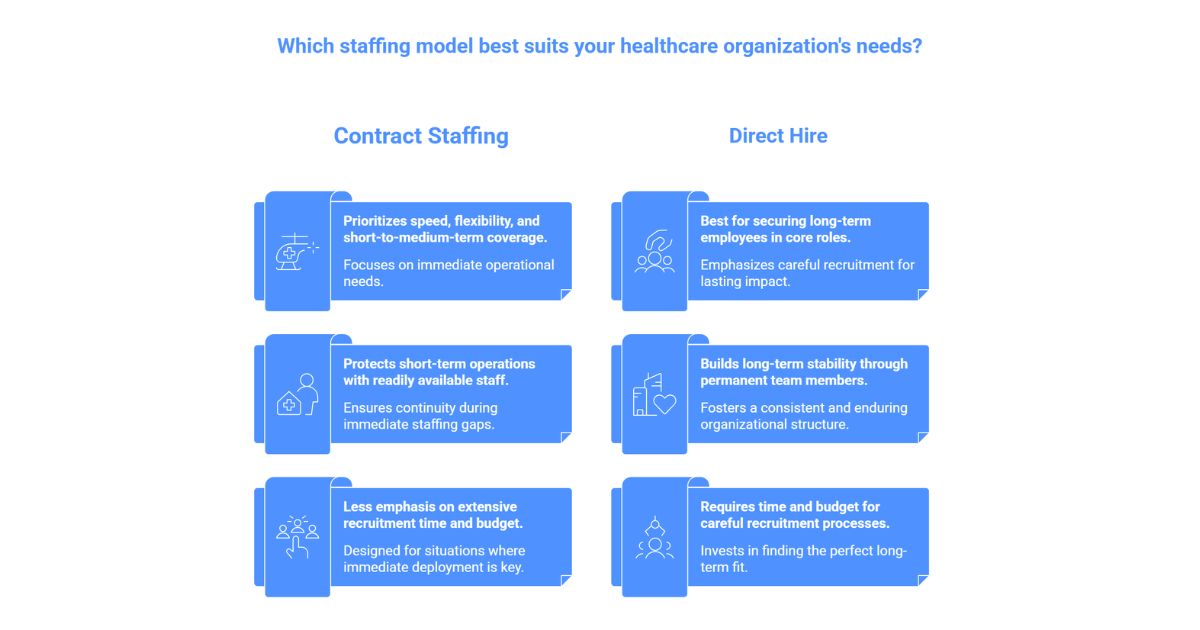
Healthcare employers often ask which model is best. The answer depends on the goal.
Contract Staffing vs. Direct Hire
Direct hire is best when the organization wants a long-term employee in a core role and has the time and budget to recruit carefully. Contract staffing is best when speed, flexibility, or short-to-medium-term coverage matters more right now.
Direct hire builds long-term stability. Contract staffing protects short-term operations.
Contract Staffing vs. Per Diem Staffing
Per diem staffing usually focuses on short, often shift-based coverage. Contract staffing typically offers more structure around assignment length and continuity.
If you need scattered extra help, per diem may work. If you need predictable coverage for several weeks or months, contract staffing may be stronger.
Contract Staffing vs. Travel Nursing
Travel staffing often involves clinicians who work temporary assignments away from home, sometimes with housing-related arrangements and broader geographic mobility.
Contract staffing may overlap with this, but many contract placements are more localized or structured differently around employer need.
Contract Staffing vs. Locum Tenens
Locum tenens usually refers to temporary physician or advanced practice provider coverage. Contract healthcare staffing often covers a broader range of roles, including nurses, allied health, caregivers, support staff, and operational healthcare roles.
Contract Staffing vs. Temp-to-Hire
Temp-to-hire is useful when the employer wants to evaluate a worker before making a direct offer. Contract staffing may or may not include that goal. Sometimes the aim is simply to fill a defined-term need well.
Which Model Fits Which Goal?
If your main goal is speed, contract staffing often performs well.
If your goal is long-term retention, direct hire may be stronger, though temp-to-hire can bridge the gap.
If you need specialty coverage fast, contract staffing or locum-style support may be the best path.
If you need flexible support across a changing schedule, per diem or contract staffing may help, depending on continuity needs.
The smartest employers do not pick one model forever. They build a mix. They use direct hire for core stability, contract staffing for flexibility, and targeted specialty coverage where needed.
This blended approach is often more realistic because healthcare demand does not behave like a straight line. It moves in waves. A flexible workforce strategy helps employers move with those waves instead of getting knocked over by them.
Common Challenges in Contract Healthcare Staffing and How to Solve Them
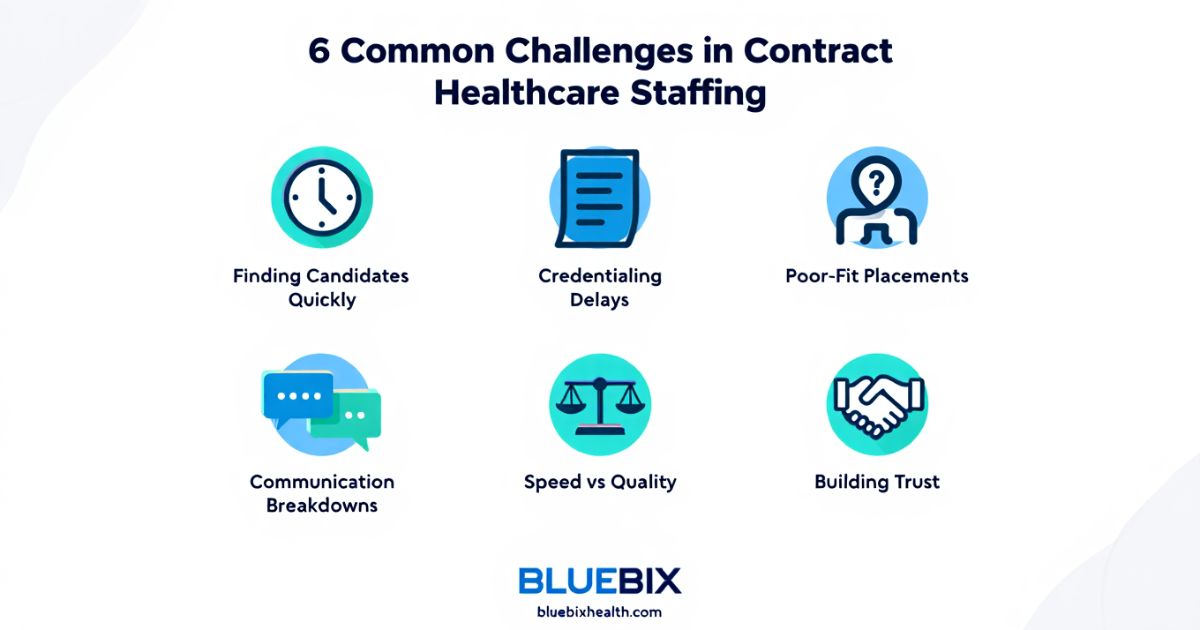
Contract staffing can solve major hiring problems, but it also comes with real challenges if the process is weak.
Challenge 1: Finding Reliable Candidates Quickly
Speed can tempt organizations to accept a poor fit. The fix is clear role definition, stronger screening, and working with a partner that understands healthcare staffing deeply.
Challenge 2: Credentialing Delays
A candidate may be willing and qualified, but missing documentation or slow internal approvals can delay placement. The fix is a tighter credentialing workflow, clear checklists, and fewer handoff gaps between teams.
Challenge 3: Poor-Fit Placements
A worker can look good on paper but struggle in the environment. That usually happens when culture fit, workflow expectations, or patient population details were not shared clearly. Better intake leads to better matching.
Challenge 4: Communication Breakdowns
Managers, staffing coordinators, HR teams, and agency contacts all need a shared line of communication. If updates are slow or unclear, frustration grows on all sides.
Challenge 5: Balancing Speed With Quality
This is one of the biggest challenges in healthcare staffing. Employers want fast coverage, but they also need verified talent. The answer is not choosing one over the other. It is building a process that protects both.
Challenge 6: Trust
A staffing partner is only as useful as the trust behind the relationship. Employers need honest updates, realistic timelines, and candidates who actually match the request. Agencies need clear feedback and prompt decisions.
The solution to most of these problems is not complexity. It is clarity. Clear roles. Clear screening. Clear expectations. Clear communication.
Credentialing, Compliance, and Quality Standards in Contract Healthcare Staffing
If speed is the engine of contract staffing, credentialing is the steering wheel. Without it, the process can move fast in the wrong direction.
Credentialing is non-negotiable because healthcare staffing is tied directly to patient safety, regulatory expectations, and facility reputation. A strong staffing process should verify licensure, certifications, required experience, background information, and role-specific readiness before a candidate ever starts.
This is more than paperwork. It is risk control.
Licensure and Certification Checks
Employers should know that every clinician entering the facility meets the legal and professional requirements of the role. That includes verifying active licensure, compact status when relevant, specialty certifications, and role-specific qualifications.
Experience and Skills Validation
Not all RNs are interchangeable. Not all therapists fit every setting. Not all medical assistants move smoothly across every workflow. Skills validation helps protect against costly mismatches.
Health Requirements and Facility Policies
Vaccination requirements, health clearances, drug screens, TB documentation, training modules, and site-specific onboarding rules all affect readiness. A staffing partner that handles these well reduces headaches for the employer.
Ongoing Monitoring
Credentialing should not stop the day the worker starts. Expirations, renewals, and compliance changes all need monitoring over time.
This matters because healthcare employers are judged not only by who they hire directly, but also by who they allow through the door. Research reviews have repeatedly linked better nurse staffing and richer skill mix with stronger patient outcomes, which is one more reason quality standards in staffing deserve serious attention.
For employers, the message is simple: never treat credentialing like a side step. It is one of the main reasons contract healthcare staffing works safely when it works well.
How to Choose the Right Contract Healthcare Staffing Partner

Choosing a staffing partner is like choosing a relief pitcher in a tight game. The stakes rise quickly, and the wrong choice shows up fast.
Look for Real Healthcare Understanding
A strong partner should understand the roles you hire, the facility environments you manage, and the daily pressure your team faces. You want a partner that knows the difference between filling a role and solving a staffing problem.
Check Their Screening Process
Ask how candidates are sourced, screened, credentialed, and matched. A vague answer usually signals a vague process.
Ask About Response Time
When you need help, how fast do they respond? How quickly do they send candidates? How do they handle urgent requests? The speed of communication often tells you more than the sales pitch.
Ask About Replacement Policies
What happens if the placement is not a fit? How quickly can they pivot? Good staffing partners prepare for that question instead of dodging it.
Ask About Communication Structure
Who do you call? Who follows up? How are updates handled? A staffing relationship should feel organized, not scattered.
Look for Transparency
Trust grows when timelines are honest, candidate details are clear, and problems are acknowledged early. No staffing agency can promise magic. But a reliable one can promise honesty and consistent effort.
Consider Partner Fit, Not Just Candidate Fit
Some agencies work well for hospitals. Some are stronger for post-acute care. Some move fast but do not communicate well. Some communicate well but struggle to deliver at speed. The right partner fits your operating style as much as your open roles.
The benefit of Bluebixhealth is not just access to candidates. It is the ability to help companies move from staffing stress to staffing control with clearer support and more practical hiring help.
How to Improve Results With Contract Healthcare Staffing
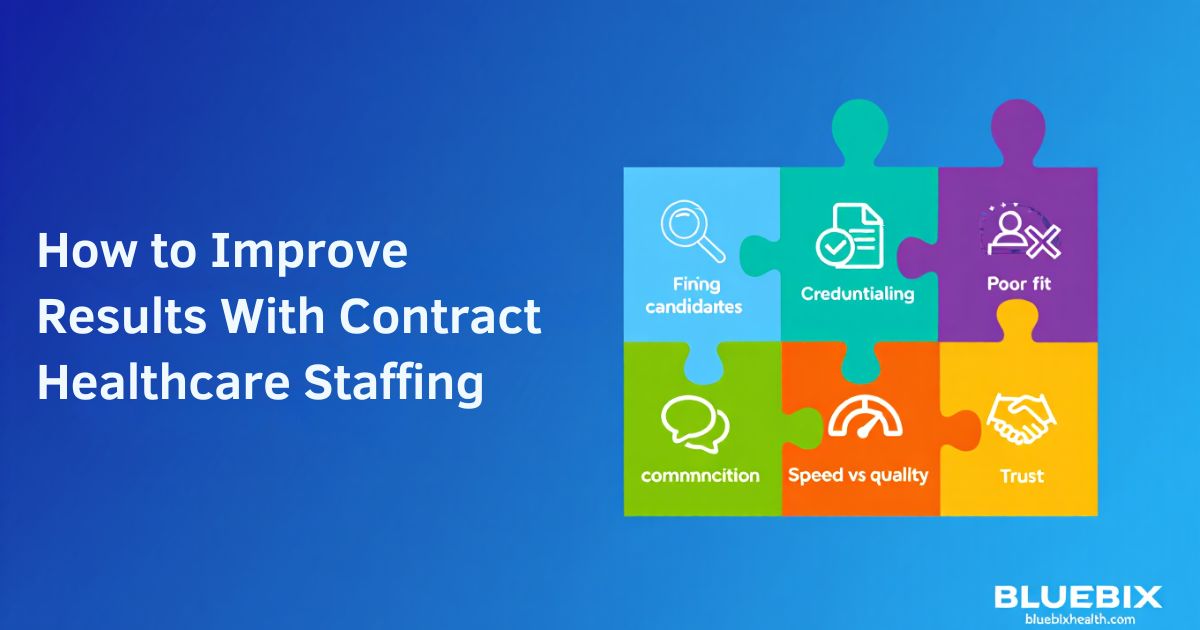
The quality of your staffing results depends not only on the agency but also on how your organization manages the process.
Write Better Job Requests
A sharper job request creates a sharper match. Include patient population, shift hours, required certifications, EMR exposure, department pace, expected start date, and any experience that truly matters.
Share Culture and Workflow Expectations
If your team is fast-paced, highly collaborative, and detail-heavy, say so. If the environment requires independence and calm under pressure, say that too. Technical fit alone does not guarantee placement success.
Speed Up Internal Decisions
Many good candidates are lost not because the agency was slow, but because the employer took too long to review, interview, or approve. Internal delay quietly kills hiring momentum.
Improve Communication Between Teams
HR, medical staffing managers, department leaders, and staffing partners should be aligned. Misalignment creates duplicate work and slower outcomes.
Measure What Matters
Do not evaluate contract healthcare staffing only by hourly rates. Track fill speed, shift reliability, credentialing turnaround, worker quality, replacement frequency, and manager satisfaction.
The better your process, the better the staffing outcome. Even a strong staffing partner performs better when the employer side is organized, decisive, and clear.
Cost of Contract Healthcare Staffing: What Employers Should Expect
Cost is one of the first questions employers ask, and rightly so. But it is also one of the easiest places to look too narrowly.
The cost of contract healthcare staffing depends on role type, market demand, urgency, location, shift difficulty, specialty level, compliance requirements, and assignment duration. A hard-to-fill night shift in a specialty setting will not be priced like a standard day-shift support role.
That is the visible cost.
The hidden cost is what happens when the role stays open. Overtime rises. Managers stretch. Quality slips. Full-time staff get tired. Retention pressure grows. Scheduling becomes a daily emergency.
This is why the cheapest staffing option can cost more later. A low rate with poor reliability can create larger operational damage than a better-priced placement with a stronger fit and follow-through.
Think of staffing cost the way you think of hospital throughput. A slow process seems cheap until it starts backing up everything behind it.
The smartest way to evaluate cost is through value. Ask:
Is this model helping us fill faster?
Is it reducing overtime?
Is it protecting patient care?
Is it easing stress on managers?
Is it helping us avoid long vacancy periods?
AHA has also emphasized financial pressure, labor strain, and the importance of redesigned workforce strategies, which reinforces why healthcare employers should evaluate staffing as an operating decision, not just a purchase line.
Onboarding and Retaining Contract Healthcare Staff for Better Performance
A contract placement does not succeed because the person arrives. It succeeds because the person is set up to work well.
Why the First Shift Matters
The first shift is like the opening scene of a movie. It sets the tone for everything that follows. If the onboarding is rushed, confusing, or disorganized, confidence drops immediately.
Facility Orientation
Even skilled clinicians need local orientation. They need to know workflows, charting expectations, escalation paths, safety procedures, and unit norms. A worker who is clinically strong can still stumble if the first day feels like being dropped into a maze without a map.
Clear Expectations
Managers should explain what success looks like. What matters most? Speed? Communication? Documentation accuracy? Teamwork? Clear expectations reduce missteps.
Respect Drives Retention
Contract workers notice how they are treated. If they feel ignored, unsupported, or treated like outsiders, performance often suffers. If they feel welcomed and respected, the opposite is more likely.
Turn Strong Contractors Into Long-Term Assets
Some contract staff become excellent long-term fits. Employers who build positive experiences can create a future talent pipeline instead of repeating the same search every few months.
Retention is not only a full-time employee issue. It is also a contract workforce issue. The better the experience, the stronger the continuity.
The Future of Contract Healthcare Staffing
Contract healthcare staffing will likely become even more important as healthcare workforce demand keeps rising, clinical roles stay difficult to fill in some markets, and employers seek more flexible workforce models.
BLS employment projections, HRSA workforce forecasts, and AHA workforce strategy materials all point to an environment where demand, workforce redesign, and staffing flexibility will continue to matter.
Technology will shape this future too. Faster sourcing, better credential tracking, stronger communication tools, and more digital workflows will improve how staffing happens. This is also where contract healthcare technology staffing may grow.
As healthcare organizations rely more on digital systems, telehealth support, data coordination, platform-based care delivery, and operational tools, some employers will need contract talent that sits at the intersection of healthcare and technology.
At the same time, the human part of staffing will remain central. No software can replace trust, fit, and real communication.
The future probably belongs to healthcare organizations that use a mixed strategy: strong permanent hiring where stability matters most, contract staffing where flexibility is essential, and better workforce planning across both. The employers that do this well will not only fill roles faster. They will operate with more resilience.
Conclusion: Why Contract Healthcare Staffing Is a Practical Solution for Modern Healthcare Hiring
Contract healthcare staffing is not a shortcut. It is a smart response to a hard labor market and a fast-moving care environment.
For healthcare employers, medical staffing managers, HR teams, and recruiters, the value is clear: faster hiring support, better flexibility, reduced pressure on internal teams, and stronger coverage when patient care cannot wait.
The real goal is not just filling shifts. It is protecting operations, supporting care quality, and creating a workforce strategy that can bend without breaking.
When the right people are in the right roles at the right time, healthcare teams can do what they do best: care for people well.
FAQ
How is contract healthcare staffing different from simply using extra shifts for current employees?
Extra shifts may solve one problem today, but create two more next week through fatigue, burnout, and overtime pressure. Contract healthcare staffing adds outside support instead of squeezing more from the same team. It protects coverage while helping employers avoid overloading reliable employees who are already carrying a heavy workload.
Can contract healthcare staffing work for small healthcare employers, not just big hospitals?
Yes. Small clinics, home health agencies, urgent care centers, and specialty practices often benefit greatly because one vacancy can disrupt the entire operation. Contract staffing gives smaller employers access to talent and flexibility they may not be able to generate quickly through internal recruiting alone, especially during urgent coverage gaps.
What makes a healthcare staffing agency contract worth having in place ahead of time?
A prebuilt healthcare staffing agency contract shortens response time when a need arises. Instead of scrambling through paperwork during a staffing emergency, the employer already has terms, communication channels, and expectations in place. That turns staffing from a reactive fire drill into a faster, more controlled process when pressure rises.
Does contract staffing lower hiring quality compared with direct hire?
Not if the process is strong. The quality depends on screening, credentialing, communication, and role clarity. A well-run contract staffing process can deliver excellent candidates quickly. A poor direct-hire process can still produce weak results. The model matters less than the discipline, fit, and follow-through behind it.
Can contract healthcare staffing support both clinical and non-clinical roles?
Yes. Many employers use it for nurses, therapists, medical assistants, and caregivers, but it can also support schedulers, care coordinators, coders, patient access staff, and selected operational roles. The best staffing strategy looks at the whole care delivery system, not only the bedside positions everyone sees first.
When does contract healthcare technology staffing become relevant in healthcare?
It becomes relevant when healthcare organizations need support for tech-enabled care delivery, digital workflows, platform operations, telehealth coordination, data support, or hybrid clinical-operational roles. As healthcare becomes more digital, some staffing needs sit between care and technology, and employers may need flexible talent who can work comfortably in both spaces.
What is the biggest mistake employers make when using contract healthcare staffing?
The biggest mistake is being unclear. Vague job details, slow feedback, and weak internal coordination usually create poor matches and slow placements. Employers get better results when they define the role clearly, move decisions faster, and treat the staffing partner like part of the hiring process instead of a last-minute vendor.
How can employers tell if a contract placement is truly successful?
A successful placement shows up in daily operations. Shifts are covered, managers feel less pressure, staff morale stabilizes, and patient flow improves. Beyond attendance, employers should look at fit, communication, reliability, onboarding ease, and whether the placement reduced overtime or prevented service disruption in a meaningful way.
Can contract healthcare staffing help improve retention of full-time staff?
Yes, indirectly and sometimes strongly. When contract staff reduce overtime, plug urgent gaps, and ease daily pressure, full-time employees are less likely to burn out. Contract staffing is not a full retention strategy by itself, but it can create the breathing room that helps a tired team stay intact longer.