
How Do Recruitment Agencies Work to Help Companies Hire Faster
If healthcare hiring feels slow, you’re not imagining it. The best recruitment agencies don’t just send resumes; they run a repeatable system that finds, verifies, schedules, and secures people fast. This guide breaks down what happens behind the scenes and how you can speed it up. How Do Recruitment Agencies Work to Help Companies Hire Faster? It’s a question on many leaders’ minds.
2. Why Healthcare Hiring Feels Slow (And What Faster Really Means)
When we discuss How Do Recruitment Agencies Work to Help Companies Hire Faster, we must consider the competitive landscape that healthcare recruiters face today.
Healthcare is different from most industries. You’re not hiring someone to start next month. You’re hiring someone to safely care for patients, often on a specific unit, on a specific shift, under strict compliance rules, with a start date that can’t slip.
So when leaders ask, How Do Recruitment Agencies Work to Help Companies Hire Faster?, what they really mean is:
Understanding How Do Recruitment Agencies Work to Help Companies Hire Faster can dramatically impact your hiring process. Every second counts when filling critical healthcare roles. How Do Recruitment Agencies Work to Help Companies Hire Faster? This is essential for employers seeking immediate solutions.
- How do we stop losing good candidates to faster competitors?
- How do we fill shifts without cutting corners on compliance?
- How do we reduce no-shows, drop-offs, and last-minute surprises?
Faster hiring isn’t just about posting earlier. It’s reducing the time between four moments:
- Role opened → 2) Qualified candidate identified → 3) Interview completed → 4) Candidate started
In healthcare, speed must stay tied to safety and readiness. A fast hire that fails onboarding, misses credentials, or quits after week one isn’t fast; it’s expensive.
That’s why the best agencies focus on a simple goal:
Qualified + compliant + ready now.
Grasping How Do Recruitment Agencies Work to Help Companies Hire Faster leads to better strategies for managing your hiring pipeline.
2.1 The real bottlenecks: credential checks, scheduling, no-shows, competition
Here’s what usually slows things down:
- Credential verification takes time (licenses, BLS/ACLS, state registry checks).
- Scheduling gets messy, especially across nights, weekends, and managers with limited interview windows.
- No-shows and ghosting happen when candidates don’t feel guided or when offers take too long.
- Competition is real. Finding good nurses, caregivers, and allied health talent often have multiple options.
- Internal delays stack up: unclear must-haves, slow feedback, shifting requirements, and one more interview.
In other words, time-to-fill isn’t one big problem; it’s 10 small delays adding up.
2.2 What speed-focused employers actually want: qualified + compliant + ready now
Speed-focused healthcare employers don’t want 50 applicants. They want 5 strong options who are:
- Licensed (or credentialed) and verifiable
- Available for the actual shift pattern
- Comfortable with the unit setting (ICU, Med-Surg, LTC, Home Health, etc.)
- Clear on pay, start date, and expectations
- Prepared to interview quickly and accept an offer confidently
That’s what an agency is built to deliver.
3. What Is a Recruitment Agency, Exactly? (And How It Differs From Job Boards)

A recruitment agency is a hiring partner that finds and qualifies candidates for you, not just for your job post.
A job board is like putting a sign outside your building: Help Wanted. Sometimes it works. But in healthcare, the people you want may not be actively applying. Many are already employed, selectively looking, or only open to the right shift, location, or team.
A recruitment agency does three things job boards don’t:
- Actively searches (sourcing) instead of waiting
- Qualifies and verifies before you spend time interviewing
- Owns outcomes like speed, compliance readiness, and continuity
3.1 Recruitment agency vs job board vs internal recruiter vs RPO
Let’s simplify the options:
- Job board: You post; applicants come (or don’t). You screen, schedule, and verify. Volume can be high, quality uneven.
- Internal recruiter: Great for culture alignment and long-term hiring—but often stretched thin, especially during surges and turnover waves.
- Recruitment agency (staffing/placement): Brings pre-qualified candidates, speeds up sourcing, screening, scheduling, and (often) compliance collection.
- RPO (Recruitment Process Outsourcing): A larger-scale outsourcing model where an external team runs much of your recruiting function. Helpful for high-volume or multi-site systems, but setup can take longer.
Healthcare employers who need speed often use a mix: internal recruiting for steady roles, and agencies for urgent, specialized, or high-churn needs.
3.2 The agency promise: pre-qualified talent + process + accountability
A strong agency doesn’t just deliver candidates. It delivers a system:
- A ready pipeline (not built from scratch every time)
- A screening process aligned to your unit/shift needs
- A compliance path that reduces risk
- Scheduling coordination that keeps momentum
- Accountability through expectations (like time-to-submit targets)
That’s how hiring speeds up without quality dropping.
4. How Recruitment Agencies Work Step by Step to Help Companies Hire Faster (Core Workflow)
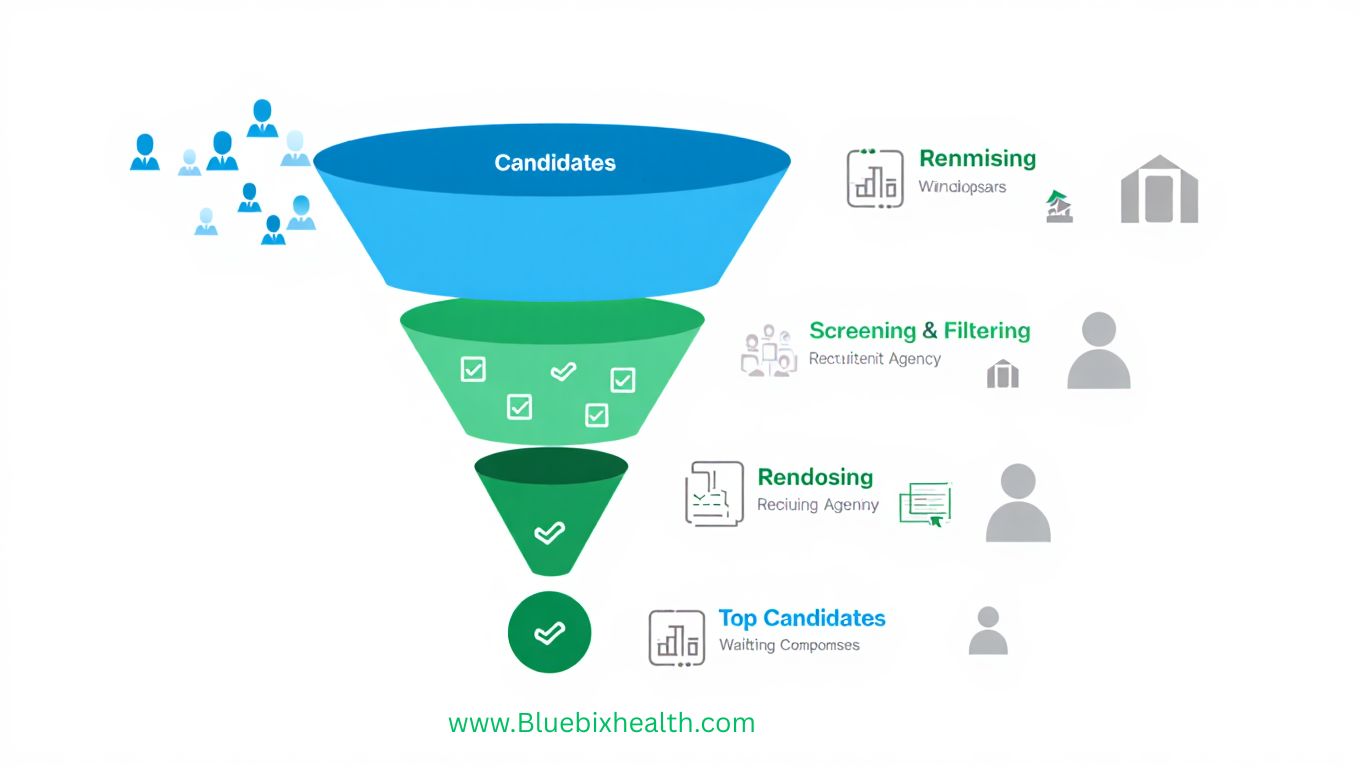
Focusing on How Do Recruitment Agencies Work to Help Companies Hire Faster will streamline your hiring process, ensuring compliance, quality, and speed.
4.1 Intake & role scoping: defining must-haves, shift needs, start date, pay range
Everything starts with intake. A good agency will push for clarity on:
- Role title and scope: CNA vs caregiver vs MA vs RN, don’t assume titles mean the same thing everywhere.
- Unit and patient population: ICU/ER needs differ from LTC or Home Health.
- Shift pattern: days/nights, weekends, 12s vs 8s, rotating, call requirements.
- Start date urgency: ASAP must become a real date and an onboarding timeline.
- Must-haves vs nice-to-haves: required certs, years of experience, EMR familiarity.
- Pay range and differentials: candidates move faster when compensation is clear.
Think of intake like writing a GPS destination. If you’re vague, you’ll still drive, but you’ll take longer and make wrong turns.
4.2 Building the candidate pipeline: active sourcing + database + referrals
This is where agencies create speed you usually can’t replicate in-house—because they’re not starting from zero.
Agencies source candidates through:
- Existing databases (talent pools): past applicants, silver-medalist candidates, previous placements.
- Active outreach: direct messages, calls, email outreach, social recruiting, local networks.
- Referrals: clinicians refer clinicians, especially when the agency has built trust.
- Community pipelines: partnerships with training programs or local groups (when relevant).
- Reactivation: reaching out to previously credentialed candidates who are now available.
The key difference: job boards are passive. Agencies are proactive.
In healthcare, proactive sourcing matters because many great candidates don’t apply to every job. They respond to a clear message like:
We have a night shift Med-Surg role, $X/hr, start date next Monday, and you’ll interview within 48 hours.
When outreach is specific, response rates rise—and hiring speeds up.
4.3 Screening & qualification: skills, behavior, availability, shift-fit
Screening is not just Are you qualified? It’s Are you qualified for this exact role and ready to move?
A strong agency screens for:
- Clinical basics: scope of practice, core skills, unit exposure
- Shift-fit: can they truly do nights, weekends, doubles, or live-in (if caregiver)?
- Reliability signals: attendance history, reasons for leaving, schedule stability
- Communication: responsiveness, clarity, professionalism
- Motivation: why they want this role and what would make them decline later
This step removes the biggest time-waster in hiring: interviewing people who were never going to accept your offer.
A helpful analogy: screening is like checking if a key fits the lock before you walk to the door in the rain.
4.4 Healthcare compliance checks: licenses, certifications, background, immunizations
Healthcare hiring has a second gate: compliance.
Agencies that truly speed up hiring either handle these checks directly or run a tight coordination process so documentation is collected early.
Typical checks include:
- License verification: state board checks (RN/LPN), registry verification (CNA), or other credential validation
- Certifications: BLS, ACLS, PALS, CPR, specialty certs
- Background screening: criminal checks, OIG/GSA exclusions (where applicable), employment verification
- Immunization and health records: TB, Hep B, MMR, varicella, flu (varies by facility policy)
- References: focused, fast reference checks tied to job requirements
Speed comes from timing: the fastest agencies start document collection during sourcing and screening, not after the offer.
That prevents the painful scenario where you finally pick someone, and then spend 10 more days chasing paperwork.
4.5 Shortlisting & submission: presenting only ready-to-interview candidates
Once candidates are screened and compliance-ready enough, the agency submits a shortlist.
A quality submission should include:
- A short profile summary (unit, shift, strengths)
- Availability and start date
- Pay expectations
- Compliance status (what’s verified, what’s pending)
- Any risk flags (commute, schedule limitations)
This is where speed becomes visible to you: instead of sorting resumes, you get interview-ready options.
4.6 Interview coordination & scheduling speed: interview slots, reminders, back-ups
Agencies speed up scheduling by acting like an air-traffic controller:
- confirming interview windows
- sending reminders
- prepping candidates on format and expectations
- keeping backup candidates warm in case someone drops
Small actions here prevent big delays. One missed interview can cost you the candidate entirely.
4.7 Offer management: negotiation, acceptance, start-date lock
Agencies often manage the offer loop:
- Align on pay and start date
- Handle questions quickly
- Reduce back-and-forth
- Lock acceptance in writing
- Keep the candidate engaged through onboarding
This is where many hires are lost if momentum slows.
5. The Speed Levers Agencies Use That Most Employers Don’t Have In-House
5.1 Always-on sourcing: recruiters working multiple channels daily
Most HR teams are juggling onboarding, employee relations, scheduling coordination, and multiple open reqs. Agencies are different: sourcing is the job.
They work multiple channels every day, databases, referrals, outreach, and reactivation—so when you open a role, they’re not starting. They’re continuing.
That’s why a good agency can often submit candidates in 24–72 hours, especially for common roles like caregivers, CNAs, MAs, and many nurse positions. Market conditions vary.
5.2 Talent pools built over time: warm candidates + past placements
Speed is often a relationship advantage.
Agencies build talent pools like a well-stocked pantry. When you need dinner fast, you don’t go shopping from scratch, you use what’s already there.
Warm pools include:
- previously interviewed candidates
- past placements ready for a new assignment
- candidates who were not now but open later
- referrals from trusted clinicians
This is one of the biggest reasons agencies outpace job boards.
5.3 Fast credentialing playbooks: checklists, document collection, verification flow
Agencies that move fast treat credentialing like a checklist, not a mystery.
They typically use a primary source verification:
- standard document request lists (role-specific)
- a clear order of operations (license → certs → background → health records)
- reminders and follow-ups
- pre-filled forms where possible
- early detection of issues (expired BLS, missing TB, incomplete references)
Even without fancy tech, a disciplined workflow speeds up compliance because candidates know exactly what to provide and when.
5.4 Rapid matching: skill + unit + shift + location + urgency scoring
The fastest match isn’t the best resume. It’s the best fit.
Agencies often match using a few core filters:
- clinical skill alignment
- unit setting experience
- shift availability
- commute/location practicality
- urgency (who can start fastest)
- reliability signals (responsiveness, attendance pattern)
Think of it like triage: you prioritize the candidates most likely to succeed quickly, not just those who look good on paper.
5.5 Contingency planning: backups for no-shows and sudden call-outs
Healthcare staffing lives in the real world, where call-outs happen.
Agencies plan for:
- backup candidates for the same shift
- alternates who can start within a few days
- quick replacements when a candidate declines late
This reduces your operational risk. Hiring faster isn’t only about filling roles, it’s about keeping coverage stable.
6. Types of Recruitment Agencies (And Which One Helps You Hire Fastest)
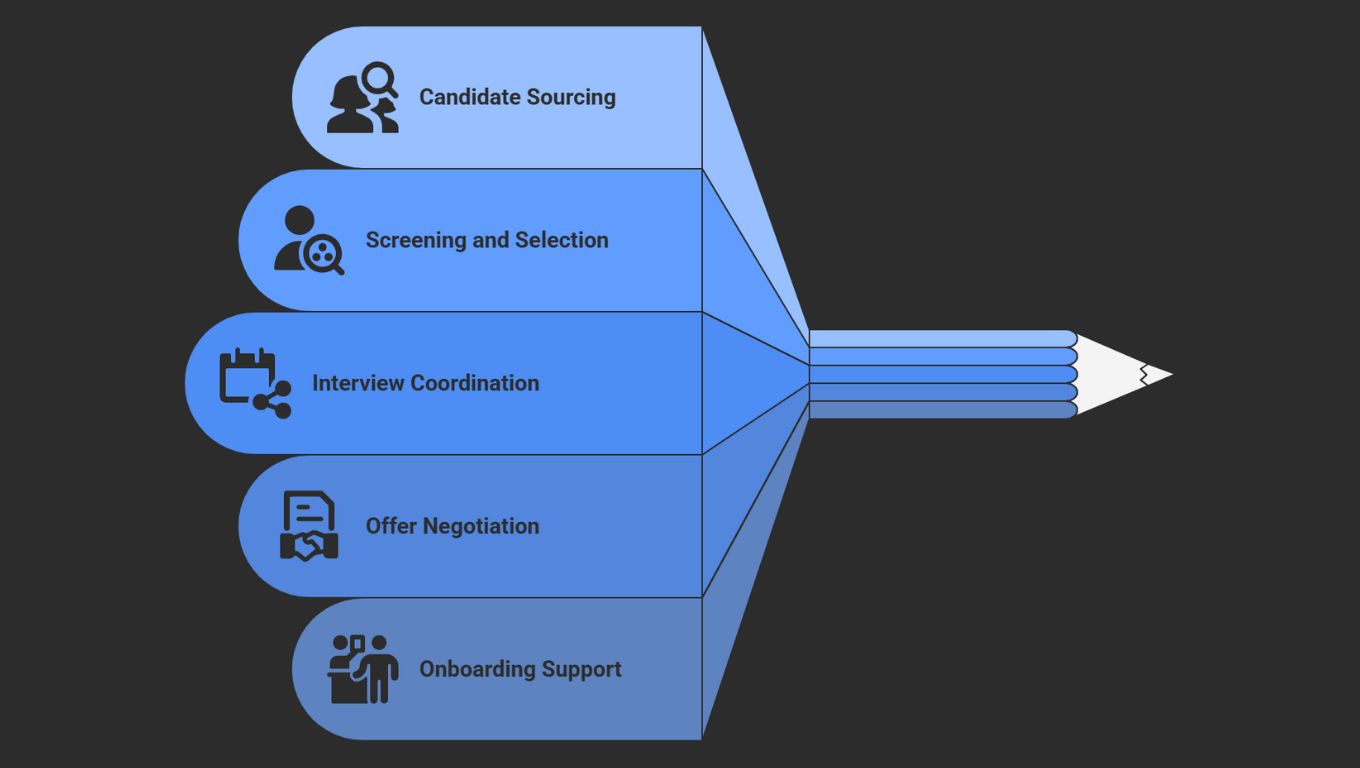
6.1 Contingency recruiting (pay on hire): best for urgent roles with clear requirements
Contingency recruiting usually means you pay when a hire is made. This can move quickly when:
- Requirements are clear
- decision-making is fast
- Pay is competitive
It’s common for direct hire placement and can be effective for urgent but straightforward roles, especially when your team can interview quickly.
6.2 Retained search: best for leadership/specialized hard-to-fill roles
Retained search is often used for leadership or niche clinical positions. It’s more research-heavy and can take longer upfront, but it can be the right tool when the role is critical and the talent pool is limited.
Speed here comes from precision, not volume.
6.3 Temporary staffing (short-term coverage): fastest for shift gaps
If your problem is We need coverage now, temporary staffing is often the fastest option.
Temp staffing can be ideal for:
- seasonal surges
- unexpected turnover
- leave coverage
- immediate shift gaps
A strong healthcare staffing agency can sometimes fill urgent needs faster because credentialed candidates are already active in their pool.
6.4 Temp-to-perm: reduce risk while hiring quickly
Temp-to-perm lets you move quickly while reducing long-term risk. You bring someone in to cover a need now, evaluate fit, and convert to permanent if it works.
For healthcare employers burned by early turnover, this model can be both fast and safer.
6.5 Direct hire/permanent placement: speed + quality for stable teams
Direct hire focuses on long-term stability. It can still be fast if the agency has a strong pipeline and your team gives fast feedback.
For core staff roles, this model balances speed and quality.
7. Benefits for Healthcare Employers: Beyond Faster Hiring
7.1 Better quality applicants: fewer unqualified resumes, more interview-ready candidates
Job boards often create resume noise. Agencies reduce that noise.
Instead of reading 80 applications to find 4 viable people, you may get 4–6 candidates who already match:
- credentials
- shift pattern
- unit exposure
- pay expectations
- start-date reality
That’s a direct productivity gain for hiring managers and HR teams.
7.2 Reduced compliance risk: verification, documentation, and audit readiness
Compliance isn’t optional in healthcare, and missing documentation can create real risk.
Agencies help reduce that risk by:
- verifying licenses and certifications early
- collecting required documents in a structured way
- tracking what’s completed vs pending
- supporting audit readiness (especially in systems with strict requirements)
Even when your organization must do final verification, agencies can speed up the process by delivering candidates who are already organized and document-ready.
7.3 Lower time-to-fill and recruiter workload: fewer steps for your HR team
When agencies run sourcing, screening, and scheduling, your internal team gets time back.
That time is often better spent on:
- improving onboarding
- reducing turnover
- strengthening internal referrals
- candidate experience improvements
- workforce planning
Speed isn’t only about filling roles; it’s also about reducing burnout on the teams trying to fill them.
7.4 Improved candidate experience: clear updates, smooth scheduling, trust
Candidates drop out when they feel ignored or confused.
Agencies improve experience by:
- giving clear timelines
- prepping candidates for interviews
- keeping communication active
- resolving questions quickly
A better experience often means fewer late-stage surprises and higher acceptance rates.
7.5 Flexibility at scale: ramp up for seasonal surges or expansion
Need 3 CNAs today and 10 next month? Many internal teams can’t flex that quickly.
Agencies can scale recruiting capacity up or down, which is helpful for:
- new facility openings
- census changes
- seasonal demand spikes
- expansion into new service lines
8. What Data Should I Track to Prove Faster Hiring (And Hold Everyone Accountable)
If you don’t measure speed, you can’t improve it. Here’s a simple hiring speed dashboard many healthcare teams use.
8.1 Time-to-submit, time-to-interview, time-to-offer, time-to-start
Track four timestamps for every role and interview tips:
- Time-to-submit: role intake → first qualified candidate submitted
- Time-to-interview: submission → interview completed
- Time-to-offer: interview → offer sent
- Time-to-start: offer accepted → first day worked
Even basic tracking reveals the truth: many delays happen after candidates are found, during scheduling, and decision-making.
8.2 Quality metrics: retention, performance, attendance, compliance, completeness
Speed without quality is a trap. Track:
- 30/60/90-day retention
- Manager satisfaction (simple 1–5 rating works)
- attendance and punctuality
- compliance completeness on day 1
- early turnover reasons (shift mismatch, pay, commute, workload)
A practical benchmark as an internal guideline: if a role is filled fast but retention drops, your screening or role clarity needs tightening.
8.3 Pipeline health: source performance, response rates, drop-off reasons
Ask your agency (and your team) to track:
- response rate to outreach
- source performance (referrals vs job boards vs database)
- interview show rate
- offer acceptance rate
- top drop-off reasons
When you know why candidates drop, you can fix the real problem, not guess.
9. What the Agency Needs From You to Move Fast (Employer Readiness Checklist)

9.1 A must-have vs nice-to-have list (skills/certs)
Speed dies when requirements change midstream.
Decide upfront:
- Required licenses/certs (RN, CNA, BLS, etc.)
- Required unit exposure (ICU vs Med-Surg)
- Non-negotiables (weekends, nights, patient ratios)
- What you can train on vs what you can’t
Clear must-haves create faster matching and fewer wasted interviews.
9.2 Fast feedback rules: 24-hour review + fixed interview windows
If you want faster hiring, set two rules:
- 24-hour resume review (yes/no/maybe)
- Fixed interview blocks (example: Tue/Thu 2–5 pm)
When feedback slips to 3–5 days, candidates accept other offers. In healthcare, availability is a moving target.
9.3 Competitive pay & shift clarity: avoid late-stage drop-offs
Many declines happen because of late surprises:
- The pay range wasn’t clear
- differentials weren’t explained
- shift expectations changed
- Weekends were added late
Be direct early. Clarity feels strict, but it prevents wasted time for everyone.
9.4 A single point of contact + decision timeline
Agencies move faster when they don’t have to chase five people for answers.
Choose:
- one primary contact
- one backup decision-maker
- a clear decision timeline (example: We decide within 48 hours after interviews.)
9.5 A compliant onboarding path: badges, EMR access, orientation plan
Even the best hire can be delayed by onboarding.
Have a ready path for:
- badge/ID
- EMR access timing
- orientation schedule
- unit onboarding plan
When onboarding is smooth, your time-to-start improves dramatically.
10. What are the Common Myths That Slow Hiring (And What to Do Instead)

10.1 More resumes = better: why volume can delay decisions
More resumes often mean more confusion.
Hiring teams waste time debating weak options, re-screening, and re-interviewing. Ask for fewer, stronger candidates with clear submission notes.
Quality shortlists beat large piles every time.
10.2 We’ll decide later: how delayed feedback kills availability
In healthcare staffing, candidates don’t stay available for long, especially strong ones.
A delay of even 48–72 hours can mean:
- schedule changes
- competing offers
- loss of interest
Decide faster with a checklist: must-haves met? Shift confirmed? pay accepted? start date feasible?
10.3 Experience matters more than fit: unit/shift mismatch drives turnover
A highly experienced clinician can still fail if:
- The unit is unfamiliar
- The shift is unrealistic
- The commute is too long
- expectations don’t match reality
Fit is not soft. It’s a retention strategy.
10.4 Agencies are only for emergencies: when proactive partnerships win
The fastest hiring happens when the agency already knows you.
If you only call when you’re desperate, the agency must learn your needs under pressure.
Proactive partnerships build pipelines before you’re short-staffed, so speed becomes normal, not miraculous.
11. How to Choose a Recruitment Agency for Fast, Reliable Healthcare Hiring
11.1 Specialization: Do they truly recruit nurses/caregivers/clinical roles?
Start here: do they specialize in top healthcare staffing, or are they generalists?
Healthcare is compliance-heavy and role-specific. You want partners who understand:
- nursing roles and units
- caregiver/LTC realities
- allied health specialties
- credentialing and verification workflows
- urgency and shift coverage constraints
Ask for examples of recent placements similar to your needs.
11.2 Verification standards: licensing checks, reference process, compliance proof
Speed is only helpful if it’s safe.
Ask:
- How do you verify licenses and certifications?
- What do you collect before submission vs after offer?
- How do you document compliance readiness?
- Do you have checklists by role?
- What happens if something doesn’t verify?
A good agency can explain its verification process clearly, without being vague or defensive.
11.3 Speed SLAs: time-to-submit expectations and escalation process
You don’t need complicated contracts to set expectations.
Ask for practical targets like:
- First shortlist within 48–72 hours for common roles
- Daily updates until interviews are scheduled
- Escalation plan if no candidates by day 3
Also, ask how they prioritize urgent roles and what they need from you to hit those targets.
11.4 Candidate communication: transparency, updates, interview prep
A fast agency communicates like a partner.
Ask:
- How often do candidates get updates?
- Do you prep them for interviews?
- How do you prevent ghosting?
- How do you confirm availability before submissions?
Strong communication reduces no-shows and late declines, two of the biggest hiring speed killers.
11.5 Replacement/guarantee terms: reduce risk and maintain momentum
For permanent placement, ask about replacement guarantees.
For temp staffing, ask about:
- replacement speed for call-outs
- backup coverage approach
- reliability tracking
Guarantees don’t replace good screening, but they reduce risk and keep hiring moving.
11.6 Coverage & scale: regional availability, multi-shift coverage strength
If you’re multi-site or operate 24/7, your agency should be able to support:
- your location footprint
- hard-to-cover shifts (nights/weekends)
- Surge in hiring during seasonal demand
Ask for an honest answer: What do you cover best, and where do you struggle?
11.7 Technology & workflow: scheduling, document collection, fast turnaround
Tech isn’t everything, but workflow is.
Ask what tools they use for:
- scheduling coordination
- document collection and reminders
- compliance tracking
- candidate status updates
Even a simple system can work if it’s disciplined. The goal is fewer handoffs, fewer delays, and fewer missing documents.
12. A Simple Hire Faster Playbook You Can Use With Any Agency (Action Framework)
12.1 The 3-day hiring sprint: intake day → shortlist day → interview/offer day
Here’s a practical sprint model many fast-moving healthcare teams use:
Day 1: Intake (30–45 minutes)
- Confirm must-haves, shift pattern, pay range, start date
- Agree on interview blocks for Day 3
- Set submission target: 3–5 interview-ready candidates”
Day 2: Shortlist
- The agency submits candidates with a compliance status
- Employer reviews within 24 hours
- Agency confirms interview availability and prepares candidates
Day 3: Interview + offer
- Run interviews in a tight block
- Choose the top candidate the same day
- Send offer within hours (not days)
- Lock start date and onboarding steps
This sprint works because it compresses decision-making. Momentum stays high.
12.2 The 2 candidates per slot rule to avoid delays
No-shows happen. Scheduling conflicts happen. Don’t let one missed interview derail your week.
Use this rule:
- For every interview time slot, have two candidates confirmed:
- one primary
- one backup
If the primary cancels, you still use the slot. That’s how you protect speed.
12.3 Pre-set interview blocks each week
Speed improves when interviews are routine, not reactive.
Pick two recurring blocks (example: Tue 2–5 pm and Thu 2–5 pm). Agencies can then recruit according to your schedule, which increases show rates and reduces delays.
12.4 Offer template + decision checklist to reduce back-and-forth
Most delays come from small questions:
- differential details
- weekend expectations
- orientation schedule
- documentation requirements
- start date confirmation
Fix this with two tools:
- Offer template (consistent pay language and requirements)
- Decision checklist (must-haves met, shift confirmed, start date feasible, compliance path clear)
When your team can say yes confidently, offers go out faster, and acceptance rates rise.
13. Conclusion: What to Expect When You Partner With the Right Agency

13.1 Key takeaways: speed comes from process + pipeline + compliance readiness
Recruitment agencies help companies hire faster by doing the work that slows most healthcare teams down: sourcing, screening, scheduling, and organizing compliance, at speed.
When you understand How Do Recruitment Agencies Work to Help Companies Hire Faster, you gain a competitive edge in the healthcare hiring market.
The best results come when three things line up:
- Process: clear intake, fast feedback, tight scheduling
- Pipeline: always-on sourcing and warm talent pools
- Compliance readiness: documents collected early, verification tracked clearly
If any one of those is weak, hiring slows. When all three are strong, you don’t just fill roles, you fill them with confidence.
13.2 Clear next step: request verified candidates / talk through roles
If you’re hiring nurses, caregivers, medical assistants, or allied health professionals and you need speed without compliance risk, the next step is simple: share your role details and shift needs, and request a shortlist of verified, interview-ready candidates. BlueBix Health can walk through your requirements and build a faster hiring path for your team.
To summarize, knowing How Do Recruitment Agencies Work to Help Companies Hire Faster is key to maximizing your recruitment success.
FAQ
- How can I tell if an agency is actually verifying licenses and certifications, without waiting for a problem?
Ask for their verification workflow in writing: what databases they use, what documents they collect, who signs off, and how they handle expirations. A strong agency shares sample checklists, anonymized compliance packets, and clear timelines before you submit roles. - What should my team do if we keep losing candidates after interviews?
Treat drop-off as a speed and clarity issue. Tighten your interview window, give same-day feedback, and pre-align pay, start date, and shift expectations before scheduling. Ask the agency to pre-close candidates and present backup options for every interview slot. - Do recruitment agencies help with onboarding, or do they stop after an offer is accepted?
Good agencies stay engaged through the start date. They coordinate document collection, reminders, and compliance completion, and they troubleshoot last-minute issues (transportation, schedule changes, missing paperwork). Ask whether they have a “start-date lock” process and who owns follow-ups. - How fast is fast for healthcare hiring, realistically?It depends on role urgency, location, and compliance requirements. Many agencies can submit qualified profiles within 24–72 hours for common roles if your requirements are clear and you respond quickly. The best measure is time-to-submit and time-to-interview, not just time-to-fill.
- What’s the difference between temp staffing and direct hire if my goal is speed?
Temp staffing is often faster because agencies can deploy pre-cleared professionals for immediate coverage. Direct hire can still be quick, but you’ll typically add steps like longer interviews and permanent compensation alignment. Choose based on urgency, budget, and whether the role is coverage or core team. - How do I prevent resume flooding while still getting options fast?
Set quality filters: must-have credentials, unit experience, shift availability, and start date. Then request a small batch (3–5) of interview-ready candidates with short summaries, not dozens of resumes. Also, define a submission SLA and ask for only candidates who have confirmed interest. - If my hospital has strict compliance rules, will an agency slow us down?
The right agency speeds you up by running compliance in parallel with sourcing and scheduling. They should know your requirements upfront and deliver candidates with complete documentation packets. If they repeatedly submit incomplete profiles, your process will slow set standards, and reject incomplete submissions early. - How do agencies source candidates so quickly when job boards are slow?
They use multiple channels at once: existing databases, past placements, referrals, targeted outreach, and local networks. Most importantly, they maintain warm talent pools by staying in touch with clinicians regularly. Ask what percentage of hires come from their own pipeline vs public postings. - What should I include in a job request to get better candidates faster?
Provide the decision-critical details: exact role, unit, shift pattern, pay range, required certifications, start date, interview availability, and any non-negotiables (weekends, floating, patient ratios if relevant). Ambiguity causes mismatches and delays—clarity is a hiring accelerator. - How do I structure a partnership so the agency prioritizes my openings? Agree on expectations: response time, submission SLA, interview scheduling windows, weekly check-ins, and a single point of contact. Share upcoming demand forecasts and hard-to-fill roles early. Agencies prioritize clients who give fast feedback, clear requirements, and predictable hiring processes.