How to Make the Perfect Resume for Healthcare
If you’re wondering how to make the perfect resume for healthcare, you’re really asking one thing: How do I show I’m safe, reliable, and ready for patient care fast?
For candidates, a strong healthcare resume opens doors to better jobs, better pay, and better shifts. For healthcare employers, HR teams, and recruiters, it’s the quickest way to spot who is truly ready for the floor. In this guide, we’ll walk through practical, real-world strategies to build healthcare resumes for nurses, caregivers, medical assistants, therapists, and more that are easy to screen, easy to trust, and easy to hire from.
2. Why the Perfect Healthcare Resume Matters to Employers & Recruiters
2.1 What healthcare employers really look for in a resume
When a hiring manager or recruiter opens a healthcare resume, they scan for three things within seconds:
- Can this person do the job safely? (skills, experience, clinical setting)
- Are they reliable? (work history, length of stay, references)
- Will onboarding be smooth? (licenses, credentials, eligibility to work, schedule fit)
They’re not only reading a document, but they’re trying to protect patients, staff, and the organization. A clear, focused resume helps them quickly answer yes or no with confidence.
2.2 How a strong resume speeds up hiring, reduces risk, and protects patient care
In busy hospitals, clinics, and home care agencies, time is the enemy. A sharp healthcare CV speeds up:
- Shortlisting
- Compliance checks
- Interview decisions
When resumes clearly show relevant experience, valid licenses, and up-to-date skills, employers make faster, safer hiring decisions. Good resumes reduce back-and-forth questions, prevent wrong hires, and support better patient care by getting the right people into the right roles sooner.
3. Healthcare Resume Basics: Formats, Length & Core Structure
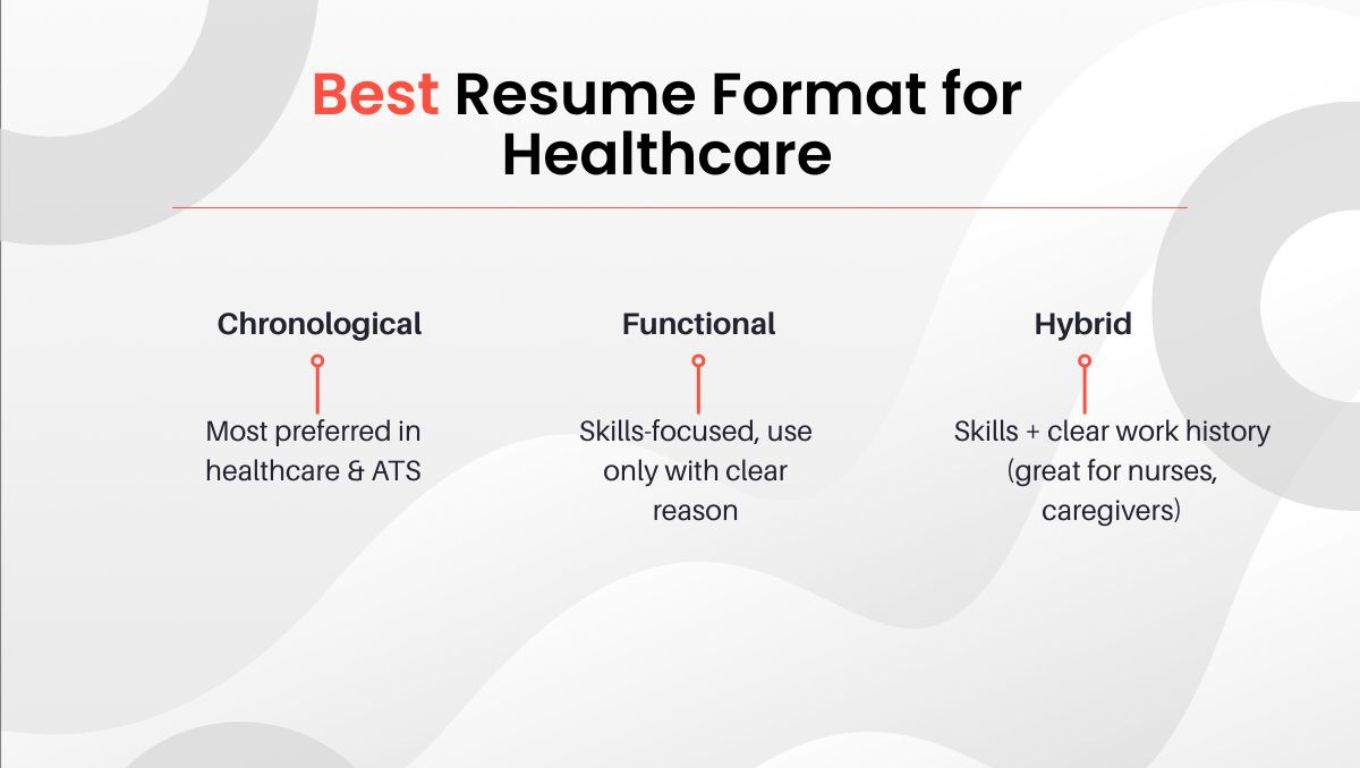
3.1 Chronological vs functional vs hybrid: which format works best in healthcare?
Most healthcare employers’ roles and ATS systems prefer a reverse-chronological resume. It lists your most recent role first and clearly shows your progression: staff nurse → charge nurse → nurse supervisor, for example.
A functional resume (focusing mostly on skills) can look suspicious in healthcare unless there’s a very clear reason (career change, long break). A hybrid resume—skills plus clear work history often works best for nurses, caregivers, and medical assistants who want to highlight both skills and steady employment.
3.2 Recommended resume length and section structure for nurses, caregivers, and allied health professionals.
For most clinical roles:
- 1 page is ideal for new grads or early-career professionals
- 2 pages work well for experienced nurses, therapists, and multi-facility professionals
A simple, high-performing order:
- Name, contact info, professional title
- Summary profile
- Licenses & certifications
- Work experience
- Education
- Skills
- Optional: volunteer work, temp shifts, projects, languages
Think of it like a patient chart: the most critical information should always be at the top and easy to find.
4. How to customize my healthcare resume for the specific position, unit, and facility.
4.1 Reading job descriptions like a recruiter: what to copy, what to adapt
Job descriptions are your blueprint. Recruiters use them to screen candidates; ATS systems use them to match keywords. When you read one:
- Highlight required skills & certifications (e.g., BLS, ACLS, CNA, LVN, RN)
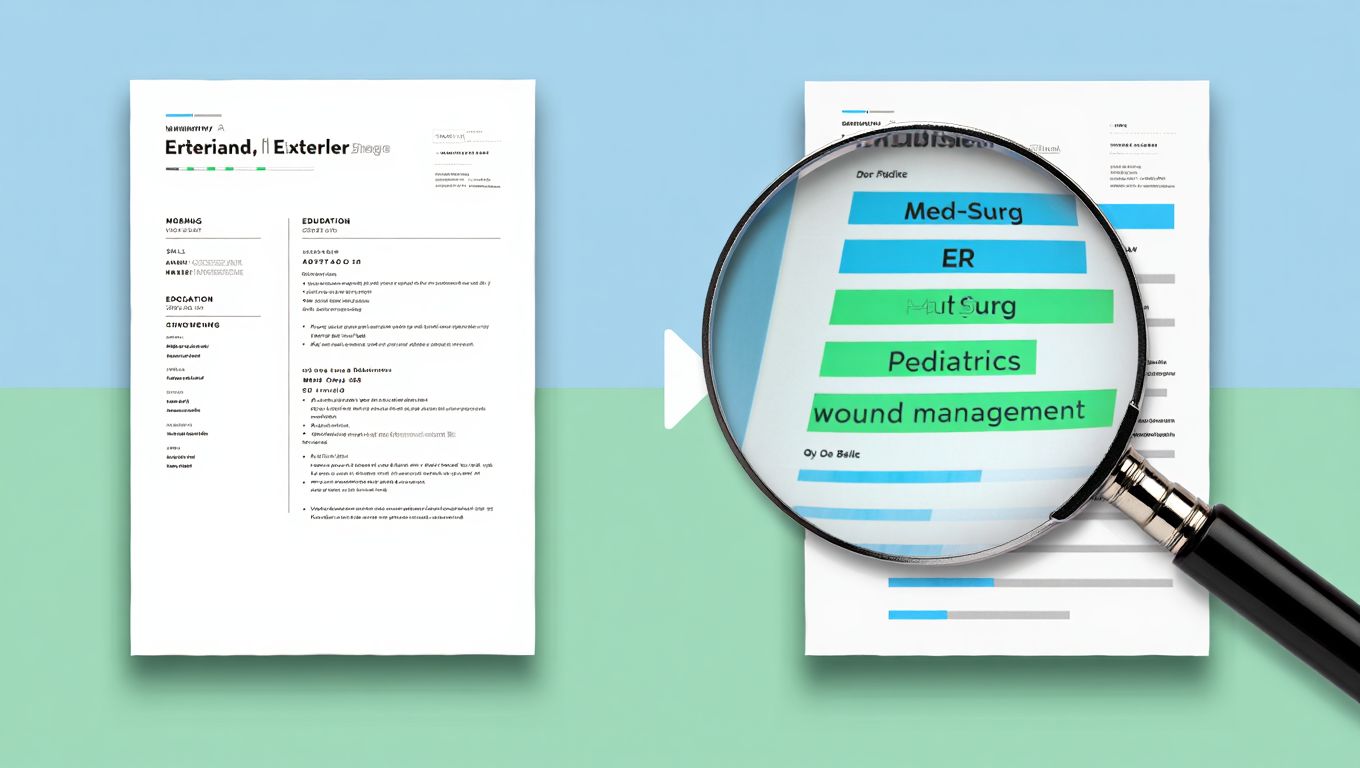
- Include the specific unit you served, such as ICU, Med-Surg, ER, Pediatrics, Behavioral Health, or Home Health.
- Look for must-have experience (ventilator care, wound management, dementia care)
Don’t copy sentences word for word. Instead, mirror the language in your bullets and skills. If the role asks for medication administration and documentation, use that phrase naturally where it fits your actual experience.
4.2 Aligning skills, shifts & settings with employer expectations
A great healthcare resume doesn’t just say “nurse” or “caregiver.” It shows:
- Settings: hospital, long-term care, assisted living, home health, rehab
- Shifts: day, night, rotating, weekends, 12-hour, live-in
- Patient types: geriatric, pediatric, post-op, chronic, psychiatric
Employers want to know: Can this person handle our environment? If a unit runs 12-hour nights with high-acuity patients, highlight your comfort with similar shifts and caseloads.
4.3 Using keywords for ATS while keeping the resume human-friendly
Applicant Tracking Systems (ATS) scan for job-specific keywords: patient assessment, care planning, vital signs, electronic medical records, wound care,” ADLs, telemetry, etc.
Use keywords:
- In your summary
- In work experience bullets
- In a skills section
But always keep sentences natural. Write for humans first, then make sure key terms from the job posting are present and accurate.
5. Step-by-Step: Building Each Section of the Perfect Healthcare Resume
5.1 Contact information & professional title that builds instant trust
Your contact section should be clean and simple:
- Full name
- Professional title (e.g., Registered Nurse (RN), Certified Nursing Assistant (CNA), Caregiver, Medical Assistant)
- Phone
- Professional email
- City/State (and Open to relocation if relevant)
- Optional: LinkedIn profile
Avoid unprofessional emails (no cutebaby121@…). Your title should match the role you’re applying for—this helps both ATS and recruiters see alignment at a glance.
5.2 Writing a high-impact summary for nurses, caregivers & allied staff
Your summary is like a quick handover report about you. In 3–4 lines, show:
- Your role and years of experience
- Settings you’ve worked in
- Key strengths and patient outcomes
- Any standout certifications
Example (Nurse):
Registered Nurse with 5+ years’ experience in high-acuity Med-Surg and Step-Down units. Skilled in patient assessment, IV therapy, care planning, and EMR documentation. Known for calm, clear communication with families and strong collaboration with multidisciplinary teams to improve patient outcomes and reduce readmissions.
Example (Caregiver):
Compassionate Caregiver with 4+ years supporting seniors in home care and assisted living. Proficient in dementia care, mobility support, medication cueing, meal preparation, and delivering meaningful companionship.Trusted by families for reliability, patience, and respectful, dignified care.
5.3 Work experience: turning daily tasks into measurable outcomes employers care about
Many healthcare resumes are written as simple task lists, for example:
- Assisted patients with activities of daily living (ADLs)
- Documented care and observations in patient charts
Instead, show impact and context:
- Managed daily care for 10–12 post-op patients, including assessments, wound care, and discharge teaching, contributing to low readmission rates.
- Supported 8–10 residents with bathing, dressing, transfers, and toileting while maintaining safety, privacy, and dignity.
- Collaborated with RNs and therapists to update care plans and communicate changes promptly to families and providers.
Use the simple formula: Action + How + Result
For example:
Assisted with feeding and hydration for 15+ residents per shift, closely monitoring intake/output and reporting changes to nursing staff, helping reduce dehydration-related incidents.
This helps employers see how you think and how you work on a team, not just what you did.
5.4 Education, licenses & certifications: what recruiters verify first
In healthcare, credentials are gatekeepers. Place them where they’re easy to see:
- Degree (e.g., BSN, ADN, Diploma in Nursing, nursing licenses, Medical Assistant Program)
- School & graduation year (if recent)
- Active licenses (RN, LPN/LVN, CNA, RRT, PT, OT, etc.)
- License numbers and states, if appropriate for the job
- Certifications: BLS, ACLS, PALS, NRP, CPI, IV Therapy, Infection Control, etc.
If you’re still waiting on an exam result or are newly licensed, make that clear:
- RN License – Pending, Expected May 2026
- NCLEX passed; licensure processing.
Recruiters will always double-check this section, especially for hospital roles and travel assignments.
5.5 Crafting a skills section that integrates clinical, interpersonal, and technical strengths to meet real-world hiring expectations.
Think of your skills section as a quick snapshot of your toolbox. Include:
Clinical skills:
- Vital signs, wound care, catheter care, injections
- Medication administration, IV therapy, oxygen therapy
- ADLs, mobility assistance, transfers, fall prevention
Soft skills:
- Empathy, patience, and active listening
- Teamwork, conflict resolution, and time management
- Family communication, cultural sensitivity
Technical skills:
- EMR/EHR systems (Epic, Cerner, Meditech, etc.)
- Telehealth platforms
- Documentation standards, care planning software
Don’t list skills you’ve never used. In healthcare, honesty is non-negotiable. Align your skills list to the job you’re applying for, but keep it truthful and backed by your experience bullets.
5.6 Optional sections: volunteer work, temp shifts, career breaks & relocations
Healthcare careers are not always linear. You may have:
- Temp or agency assignments
- Volunteer work in clinics or community health
- Gaps for caregiving, illness, or relocation
- Cross-country or international moves
Use optional sections to turn potential questions into strengths:
- Volunteer Nurse – Free Community Clinic, 2023–Present
- Travel CNA – Multiple Skilled Nursing Facilities, 2021–2023
- Career Break – Family Caregiver, 2020–2021 (Completed online CEUs and maintained active RN license)
This tells employers: I was still learning, caring, and serious about my profession—even during changes. If you want to learn more interview tips
6. Show, Don’t Tell: Practical Healthcare Resume Examples & Mini Layouts
6.1 Example layout: staff nurse resume optimized for hospital hiring
Top of page:
- Name + Registered Nurse (RN)
- City/State | Phone | Email | LinkedIn
Next sections:
- Professional Summary – 3–4 lines tailored to hospital unit
- Licenses & Certifications – provide your RN license details (state and license number) and any current BLS or ACLS certifications.
- Professional Experience – 3–4 roles, each with 4–6 impact-focused bullets
- Education – Degree, school, year
- Skills – Clinical, soft, tech (EMR systems, telemetry, etc.)
The layout is clean, with clear headings, enough white space, and no distracting graphics.
6.2 Example layout: caregiver/home health aide resume for home care agencies
Header:
- Name + Caregiver / Home Health Aide
Sections:
- Summary – Focus on compassion, reliability, and experience with seniors/clients
- Work Experience – List agencies, private clients (respecting privacy), and key duties
- Skills – ADLs, mobility assistance, dementia care, companionship, light housekeeping
- Certifications – CPR, First Aid, CNA (if applicable), local caregiver trainings
- Additional – Languages, driving license, availability (days/nights/live-in)
For caregiver roles, reliability and personality shine through examples and references more than fancy wording.
6.3 Example layout: medical assistant / allied health support resume
Header:
- Name + Medical Assistant or Allied Health Support Professional.
Core sections:
- Summary – Clinic or hospital experience, patient flow, front/back office
- Skills – Vital signs, rooming patients, EKGs, injections, scheduling, EMR
- Experience – Clinics, urgent care, specialty practices
- Education & Certifications – highlight your medical assistant education, national certifications (CMA/RMA), phlebotomy skills, and other related training.
Highlight both clinical tasks and administrative duties, healthcare careers, as many employers need medical assistants who can flex between the front and back office.
7. Optimizing Healthcare Resumes for ATS & High-Volume Recruiting Pipelines
7.1 What is an ATS, and how do healthcare employers use it?
An Applicant Tracking System (ATS) is like a digital triage system for resumes. Hospitals, health systems, and agencies use it to:
- Store applications
- Filter candidates by keywords and requirements
- Track where each person is in the hiring process
When hundreds of people apply for a nurse or caregiver job, ATS rules decide who gets seen first. If your resume doesn’t match the keywords and criteria, it might never reach human eyes—even if you’re qualified.
7.2 Formatting, file types & keyword strategies that pass screening
To keep both ATS and humans happy:
- Use simple formatting: standard fonts, no tables, no images
- Save as .docx or PDF, depending on the employer’s instructions
- Use clear headings: “Professional Experience, Skills, Education.
- Match keywords from the job posting (skills, certifications, unit types)
- Avoid uncommon abbreviations and slang
For example, instead of “Handled meds,” write “Medication administration and documentation in EMR.”
Think of ATS like a search engine. If a recruiter searches “ICU RN ACLS,” your resume should clearly show those words if they truly apply to you.
8. Red Flags & Deal-Breakers: How Employers Read Healthcare Resumes in 15 Seconds
8.1 Gaps, job-hopping & agency-hopping: when it’s a risk vs. a non-issue
Healthcare recruiters are used to seeing:
- Travel roles
- Agency contracts
- Seasonal or PRN work
These are not automatic red flags. Problems appear when:
- Roles are very short with no explanation
- Job titles or employers are vague
- Employment dates seem edited to hide gaps
Instead of hiding gaps or rapid changes, explain them briefly:
- PRN/On-call role; shifts varied by census
- Short-term contract; facility closed
- Relocated due to family needs
Clarity reduces suspicion. In many cases, honesty about job changes actually builds trust.
8.2 Errors that delay compliance, onboarding & credentialing
In healthcare, small resume mistakes can cause big delays:
- Wrong or missing license numbers
- Expired certifications are listed as active
- Inconsistent dates between the resume and forms
- Typos in employer names or titles
- Missing contact info for references (when requested)
Recruiters and credentialing teams need accurate information to verify your background. Double-check everything. Think of it like medication administration: the wrong dose on paper can cause real-world problems.
9. How Employers & Recruiters Can Use This Guide in Real Hiring Workflows
9.1 Turning this article into a checklist to pre-screen applicants faster
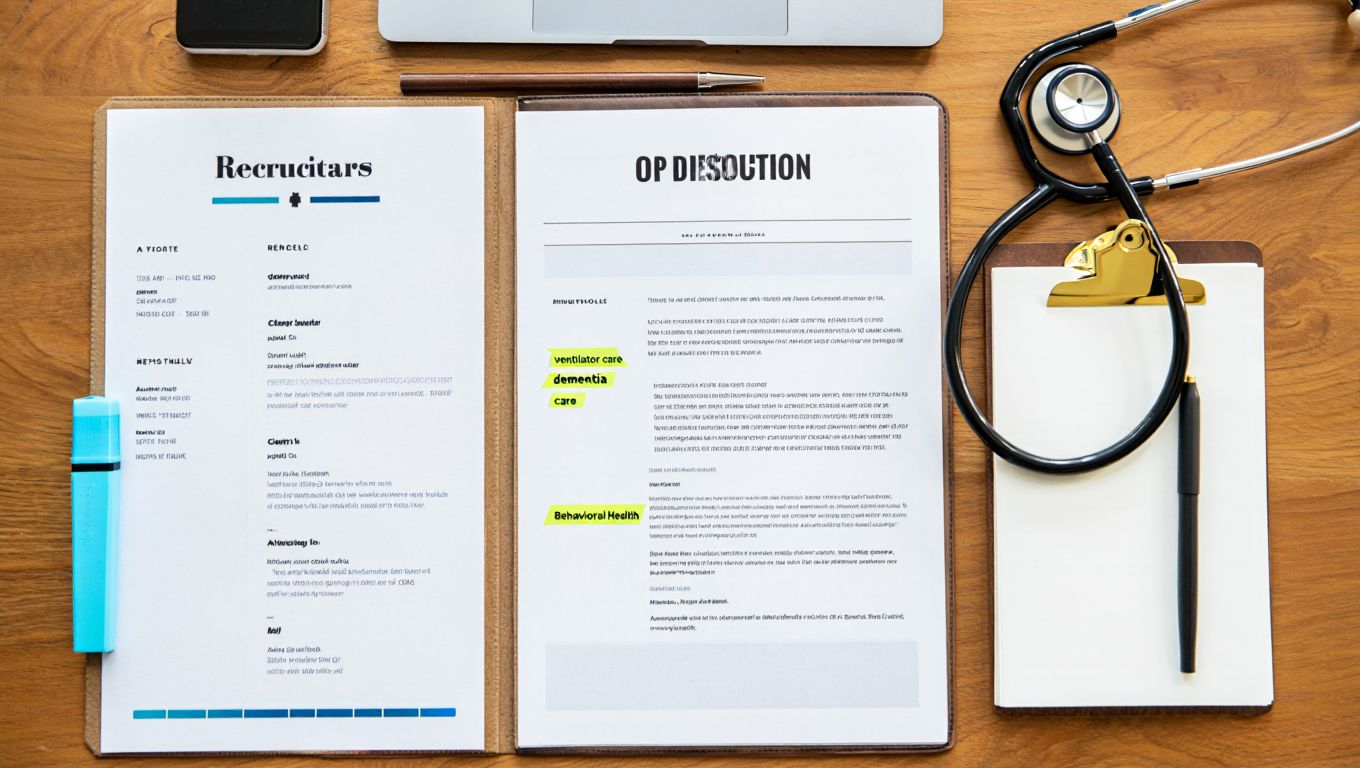
If you’re a healthcare employer, staffing company, or recruiter, you can use this guide as a practical checklist:
- Does the resume show the right unit/setting experience?
- Are licenses and certifications clear and current?
- Are skills and keywords aligned to the role?
- Is the work history stable or clearly explained?
You can create a simple scorecard (e.g., 1–5 for each area) to standardize screening across your team. This speeds up hiring and keeps decisions consistent and fair.
9.2 Sharing clear resume guidelines with candidates to improve application quality and boost response rates.
Many good candidates lose out simply because their resume doesn’t show their value clearly. To fix that, you can:
- Share a short resume guide or template based on this article
- Include Resume Tips in your job posts or email campaigns
- Offer brief feedback to promising candidates on what to improve
When candidates send better resumes, you:
- Reduce back-and-forth questions
- Move them faster to interview and compliance
- Improve fill rates and client satisfaction
Platforms like Bluebixhealth can also help by attracting candidates and guiding them to submit employer-ready resumes from day one.
10. When a Great Resume Isn’t Enough: References, Portfolios & Soft Signals
10.1 How employers validate what’s written on the resume
A resume is a promise. Employers then verify that promise by:
- Calling references (supervisors, charge nurses, DONs)
- Checking licenses and certifications with official boards
- Confirming employment dates and roles
- Reviewing disciplinary records, where applicable, and medical standards
Encourage candidates to:
- Keep a list of updated references
- Notify references that calls may come
- Be consistent in all documents (resume, application, forms)
This helps speed up credentialing and reduces surprises late in the process.
10.2 Communication style, responsiveness, and cultural fit that go beyond what’s written on the resume.
Even the perfect resume can’t show everything. Employers also watch:
- How quickly candidates respond to calls, emails, or messages
- Whether they show up on time to interviews and orientation
- How they speak about past employers, patients, and colleagues
- Their body language and attitude in interviews and video calls
These soft signals tell you whether someone will work well with your teams, respect your workflows, and treat patients and families with kindness. The resume gets them into the room; their behavior keeps them there.
11. Conclusion: Work with Bluebixhealth to elevate resume quality and achieve stronger hiring outcomes.
A perfect healthcare resume isn’t about fancy design or big words. It’s about clarity, honesty, and alignment with the role. When a resume shows the right clinical experience, up-to-date credentials, and real impact on patient care, employers can make confident decisions faster. That means fewer empty shifts, less burnout on existing staff, and better outcomes for patients.
For healthcare employers, HR teams, and recruiters, this guide can become your shared language with candidates. Use it to coach them, standardize your screening, and lift the overall quality of applications coming into your pipeline.
If you want more than just better resumes and you want more qualified applicants, pre-screened and ready to hire, partner with Bluebixhealth. We connect you with verified nurses, caregivers, medical assistants, and allied health professionals who come to you with employer-ready resumes, clear credentials, and a smoother path to onboarding.
Ready to fill roles faster with better-quality talent?
Reach out to Bluebixhealth today and turn strong resumes into stronger teams and safer patient care.
FAQs
- Can I keep one resume version for every healthcare role I apply to?
You can use one core resume, but create tailored versions for each type of role or facility. Keep a master document with all details, then duplicate and adjust the summary, skills, and top three experiences to mirror the job description and care setting. Save each with clear, descriptive filenames. - Should I highlight specific achievements, or will recruiters just skim my job titles?
Yes—if they show patterns employers care about, like longevity, complex cases, or rapid promotions. A short, focused achievements section or mini portfolio link can help a lot. Keep it concise, quantify results, and prioritize outcomes that relate directly to patient safety, satisfaction, efficiency, or team collaboration. - How honest do I need to be about gaps in my healthcare career?
For clinical roles, gaps matter less when they’re explained clearly and honestly. Add a one-line explanation under the timeline, such as family leave, relocation, study, or health recovery. Balance the gap by highlighting courses, volunteering, or upskilling that kept your clinical knowledge, communication, or documentation skills active. - Will a visually designed resume help me stand out to hospital HR teams?
Subtle design helps; heavy design hurts. Use clean headings, spacing, and bullet points, and maybe one accent color. Avoid text boxes, graphics, photos, and complex columns that confuse ATS. A simple, professional layout that prints well in black and white usually performs best in hospital or agency workflows. - Can I mention my preferred shifts or scheduling limits on my resume?
Yes, especially for home care, travel, and facility-based roles with strict availability needs. You can briefly mention shift preferences or scheduling flexibility in your summary and in a short bullet under recent roles. Make sure whatever you write matches what you’ll actually accept during scheduling, interviews, and onboarding. - Should I still use an “objective” if I’m an experienced nurse or caregiver?
A short, relevant objective can work for students, career changers, or international candidates. For experienced nurses, caregivers, and allied staff, a summary that highlights years of practice, key settings, signature strengths, and measurable results usually performs better and helps busy recruiters understand your level in seconds. - How should international healthcare candidates adapt their resumes for U.S. employers?
International candidates should emphasize license status, exam completion plans, visa situation, and English proficiency alongside clinical experience. Clarify equivalent role titles, explain major relocations, and avoid local jargon and acronyms. Recruiters need to see that compliance will be manageable and that your skills match local standards and patient expectations. - If I work through an agency, do I list the staffing firm or the hospital as my employer?
If you’ve done both, list the legal employer in your main line and indicate the assignment site in parentheses or in the bullet text. For example, show the staffing agency as the employer and note multiple facilities served, or highlight long-term contracts to prove stability, reliability, and adaptability. - Can I mention my own or my family’s health journey on a healthcare resume?
You can mention it briefly in your summary or a short bullet, especially if the experience strengthens empathy, patience, or resilience with patients and families. However, keep the focus on what you can do for patients and teams now. Employers mainly need to see professionalism, boundaries, and readiness. - Is a two-page resume too much for healthcare recruiters who are very busy?
A one-page resume works for new or early-career professionals. Once you have multiple roles, units, or specialties, two pages are acceptable if every line earns its place. Prioritize your last 10 years, remove outdated or generic items, and make sure the first page alone tells a complete, compelling story.